
The leader of the Chinese Communist Party (CCP) made a sudden appearance in Xiong’an New Area, Hebei, accompanied by three members of the CCP’s Political Bureau on March 23 after being absent from Beijing for over four months. He claimed that “the central decision on the construction of Xiong’an New Area is completely correct.” Analysts believe that Xi’s defense confirms that he is being questioned due to the unfinished construction in Xiong’an New Area. Despite the high-profile promotion by state media, the current situation in Xiong’an New Area is desolate, with mainland bloggers confirming significant skepticism among the public towards the area.
According to CCP state media reports, Xi visited China Huaneng Group and Beijing Fourth Xiong’an School with Chinese Premier Li Keqiang, Director of the Central Office Cai Qi, and Vice Premier Ding Xueyang on the 23rd of March. During the meeting in the afternoon, Xi stated that Xiong’an New Area, designated as the “central bearing area for the relocation of non-capital functions in Beijing,” has “completely correct decisions by the CCP Central Committee, and all aspects of work are solid and effective.”
Current affairs commentator Tang Jingyuan told Dajiyuan that projects like the Xiong’an New Area are typical CCP political achievements deeply tied to Xi Jinping’s power consolidation. Hence, any doubts about Xiong’an New Area are considered attacks on Xi himself, prompting him to strongly defend the project. This also indicates that he is facing various doubts and attacks from within the party.
Xi Jinping visited Xiong’an for the first time with Li Keqiang, Cai Qi, and Ding Xueyang on May 10, 2023, marking the first appearance of the State Council Premier in Xiong’an. Xi has visited Xiong’an multiple times in the past ten years, while former Premier Li Keqiang has never accompanied him or expressed his stance on the construction of Xiong’an.
Tang Jingyuan pointed out that after the CCP’s 20th National Congress in 2023, Xi Jinping, with three Politburo Standing Committee members, visited Xiong’an to demonstrate his power. In recent years, the CCP has experienced internal turmoil, with Xi’s supporters facing large-scale purges. In January of this year, a fierce power struggle broke out between Xi and Zhang Yuxia, resulting in Zhang Yuxia’s arrest and internal dissatisfaction within the party. Against this backdrop, Xi urgently needs to replicate the scenario from three years ago by visiting Xiong’an with three trusted allies to maintain the illusion of being firmly in power.
Commentator Cai Shenkun stated online that the Xiong’an New Area was personally pushed by Xi Jinping, making it the project he cares about the most and one that must not have any unfinished aspects during his tenure, as it is considered a millennium plan that cannot fail, requiring the central party’s support.
Netizens mockingly commented, “All he needs to do is move from the small garden in Zhongnanhai to his grand Xiong’an garden. Is he willing?” “The 4 projects resisted within the system are Xiong’an, digital yuan, unified large market, and property tax. As long as there is resistance within the system, not even the central government can do anything.”
Established on April 1, 2017, Xiong’an New Area has been in existence for nearly nine years. Its official positioning is as a “concentrated area for the relocation of non-capital functions in Beijing,” requiring the relocation of organs, state-owned enterprises, and related populations from Beijing on a large scale.
Xi’s visit to China Huaneng Group on March 23, one of the first central enterprises to relocate to Xiong’an New Area, has officially relocated its headquarters to the area. Meanwhile, Beijing Fourth Xiong’an School is a key project supported by Beijing as part of the “turnkey” assistance to construct Xiong’an New Area, located in the starting area of Xiong’an New Area, with the school only starting classes in September 2023.
Despite CCP state media reports last year that the construction progress of the headquarters of the first four central enterprises relocated to Xiong’an was smooth and the second batch of four central enterprise headquarters relocating to Xiong’an had all commenced construction, the overall progress of the relocation of Beijing institutions and project construction has been sluggish.
Tang Jingyuan mentioned that the current situation in Xiong’an is significantly different from Xi Jinping’s initial expectations. Only eight large central enterprises have relocated thus far, far below the planned scale. Additionally, official data shows a current permanent population of only approximately 1.4 million, while the initial vision planned a permanent population of around 5 million. Therefore, there is a substantial gap between the actual situation and the original plan.
During the inspection in May 2023, Xi warned that relocation should not be based on personal preferences; if relocation is necessary, it must be done. He emphasized that relocation should not be a mere formality or result in a return to the original place. He also stressed that decisions regarding Xiong’an New Area were “completely correct.”
Some details of Xi’s previous statements were seen as indicating resistance to relocation efforts.
Xiong’an New Area, lauded by the CCP as a “millennium plan,” still lacks signs of vibrant life to this day, with even the relaxation of property purchase restrictions failing to boost its popularity.
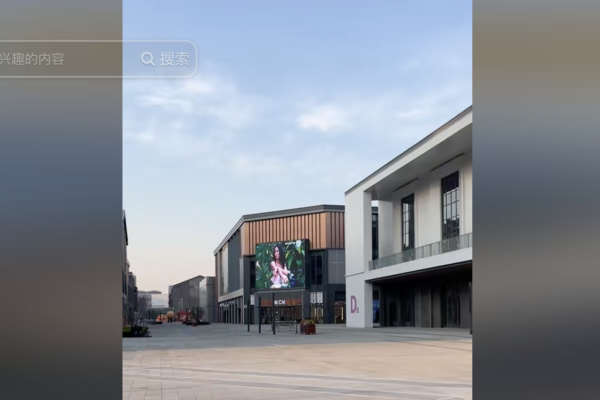
Due to the CCP’s emphasis on promoting the “theory of economic prosperity,” searches related to Xiong’an on mainland Chinese social media platforms mostly reflect official viewpoints praising the area. However, various online videos show that despite the massive investment of 800 billion RMB in Xiong’an New Area, the area remains quiet. The streets are sparsely populated, and the neatly arranged residential buildings resemble model blocks with no signs of liveliness.
Bloggers indirectly confirmed that there is a significant amount of skepticism circulating online about Xiong’an New Area.
Beijing Jiaotong University, Beijing University of Science and Technology, Beijing Forestry University, and China University of Geosciences were the first four Beijing universities to relocate to Xiong’an New Area. According to the “China Xiong’an Official Website” in January this year, the building area of the first four relocated university branches in Xiong’an has reached a cumulative total of 2.56 million square meters, with only six completed buildings. The total planned building area for the four schools is approximately 6.2 to 6.5 million square meters.
There have been longstanding claims that teachers from Beijing universities designated for relocation are reluctant to move to Xiong’an and prefer to stay in Beijing for stability.
Dajiyuan conducted interviews on the mainland at the end of last year. Zhang, an administrative staff member at a Beijing university, visits Xiong’an to “experience life” every year because his school has a branch there. He told reporters, “Xiong’an City is quite beautiful, with convenient transportation, supermarkets, and convenience stores, but it lacks vitality. It’s inconvenient! It’s a two-mile walk to the supermarket, and for significant healthcare needs, one has to return to Beijing. What will I do with my home in Beijing?”
Zhang mentioned, “The school requires us to work at the Xiong’an branch, but many people are unwilling. Recently, the school stated that those who refuse might have their labor contracts terminated, reassuring them by suggesting they can take turns working there for two or three years. If it’s truly a good place, why force people to go?”