
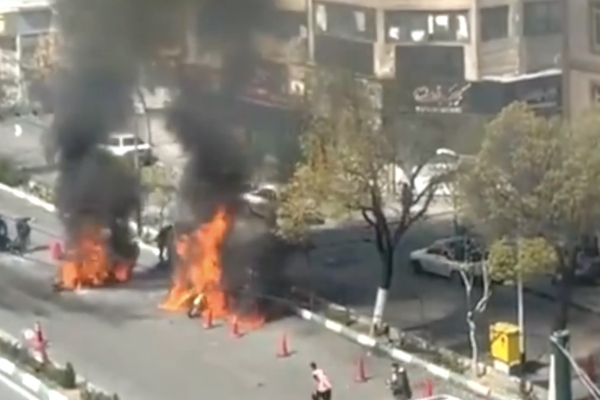
For decades, one of the most direct manifestations of state power in Iran has not been in government buildings or military bases, but on the streets throughout the country.
Checkpoints established by Basij militia, Islamic Revolutionary Guard Corps (IRGC), and police have long been integrated into the daily lives of Iranians. These checkpoints are scattered across major intersections, highways, and community centers, serving as a constant reminder of the extent to which the state intervenes in citizens’ private lives.
Now, this checkpoint system is becoming a direct target of attack. In recent days, Israel has significantly expanded its military operations inside Iran, focusing on strategic targets including the internal law enforcement network of the Islamic Republic of Iran. Israeli airstrikes are increasingly targeting major cities, especially the various Basij militia checkpoints, police stations, and mobile security units scattered throughout the capital city of Tehran.
According to reports, on March 17, Israeli forces killed Basij militia commander Gholamreza Soleimani. Based on a statement released by the Israeli military on March 17 and videos obtained from inside Iran, several Basij militia outposts in Tehran were attacked within a short period of time.
One of the attacked locations was set up inside a former football club, highlighting the extent of infiltration of Iran’s security forces in civilian settings.
Israeli Prime Minister Benjamin Netanyahu suggested that the purpose of these strikes is to create conditions that compel action from the Iranian side. Some analysts believe that Israel’s actions are aimed at weakening the Iranian regime’s power while maintaining aerial dominance, especially through drone operations.
“This is to eliminate the regime’s repression tools on the streets,” Middle Eastern historian Shahram Kholdi said in an interview with The Epoch Times’ Persian edition. “At the same time, maintaining aerial presence, especially through drone operations, can create a protective space for protests to return to the streets.”
Kholdi pointed out that the Basij militia has signaled that if the pressure eases, they may retaliate against civilians. “They threatened that if the airstrikes stop, they will retaliate against the people,” he said. “In this case, the continued aerial surveillance by Israel and possibly the United States may help limit violent acts and provide some level of protection for civilians.”
National security analyst Bijan Kian stated that Israel’s recent actions are helping to limit the Islamic regime’s ground capabilities. “The Iranian regime is under pressure,” he said. “At the same time, Israel’s actions also help curb the regime’s capabilities at the street level.”
However, “the situation is still subject to change, and if necessary, the Iranian government may seek assistance from allied groups in Iraq, Lebanon, and Afghanistan.”
Kian also emphasized that “despite the changing situation, the broader power structure still exists.”
Meanwhile, senior Israeli security officials interviewed by Epoch Magazine indicated that the United States and Israel may be waiting for a strategic moment to provide basic protection to Iranian protesters – including using Israeli military drones to provide aerial cover for Iranian demonstrators and to strike Basij personnel who attempt to attack protesters.
According to their assessment, the longer the Basij militia and the IRGC are weakened militarily, the more likely protesters will take to the streets and revive anti-regime demonstrations.
To understand the broader impacts of these developments, it is necessary to understand what these checkpoints in Iran have meant for years. Checkpoints are not just security facilities; they are tools that are integrated into people’s daily lives, reflecting government authority.
At these checkpoint locations, young couples may be stopped and questioned. Women may be questioned due to dress codes. Vehicles may be searched without clear reasons. In some cases, minor issues can lead to detention or punishment. The reasons for interrogation at checkpoints are unpredictable, causing a constant psychological pressure on the people that extends far beyond the checkpoints themselves.
For many Iranians, especially in the two decades following the 1979 Islamic Revolution, being interrogated at checkpoints was not an isolated incident but a common occurrence.
A couple now living in Canada recalled, “When we were in our early twenties and just got married, our car was often stopped at checkpoints. If we didn’t have our marriage certificate, it would be a serious problem.”
Amir Rezaei Nevis, a 48-year-old industrial automation expert now residing in Canada, recounted a memorable experience from his youth in Tehran. “At that time, we were at a small celebration at a friend’s house,” he said. “We were dancing, waiting for dinner. Suddenly, a group of Basij members rushed in. The girls quickly covered their hair and put on appropriate headscarves.”
“Everyone at the scene was taken to the local police station. The next day, young men and women were whipped, and adults were fined. At that moment, I felt a deep disgust for the Islamic Republic.”
There is a widely circulated case. In November 2022, during protests in the western town of Izeh, a 9-year-old Kian Pirfalak was shot dead in a checkpoint incident. At that time, Pirfalak and his family’s vehicle was shot at a checkpoint. His mother later said in a video that their car was shot by plainclothes police, not by the alleged “terrorists” claimed by the authorities.
Belgian parliamentarian Darya Safai stated on March 11 that checkpoints like the one where Pirfalak was killed have long been symbols of fear and oppression. However, she pointed out that since the Israeli airstrikes began, these checkpoints have increasingly become a source of fear even for the Israeli regime’s own forces.
Videos filmed inside Iran show a decrease in Basij militia activities on open streets, as they move checkpoints to tunnel or enclosed facilities with lower exposure.
These videos depict scenes that were previously unimaginable: security personnel of the Iranian regime becoming cautious and even retreating due to the perceived threat of drones.
One scene in a video shows an Iranian civilian playing drone flight sounds from a balcony on the second floor, which prompts security personnel to look up and observe before quickly retreating. Another scene shows an Iranian civilian playing drone sounds from his car stereo near a checkpoint, causing the personnel to panic and flee.
Despite warnings from the Iranian government to stay indoors, many Iranians took to the streets on March 17 to celebrate Chaharshanbe Suri. This traditional festival, which dates back several hundred years, involves jumping over bonfires, singing, and dancing in the streets on the night before the last Wednesday before Nowruz, the Persian New Year.
Nowruz, celebrated on March 20 or 21 every year, marks the arrival of spring and renewal of nature. This year, videos filmed inside Iran show many people gathering together and singing the patriotic song “Ey Iran,” which is closely tied to Iran’s national identity.
Israeli Prime Minister Netanyahu stated in a video on March 17 that hitting the checkpoints and Basij militia posts inside Iran would help create a safer ground environment. Some observers believe this will give Iranians the confidence to gather in public spaces.
For decades, the checkpoints have been a visible and unavoidable authority in the daily lives of Iranians. Now, this authority is being challenged. However, whether this change will bring about deeper political reforms remains unclear.
As the Iranian New Year approaches, a transformation is becoming increasingly clear: the power dynamics on the streets are beginning to shift, and the fear imposed on ordinary Iranians by the regime for many years is now increasingly backfiring on the regime’s own forces.