
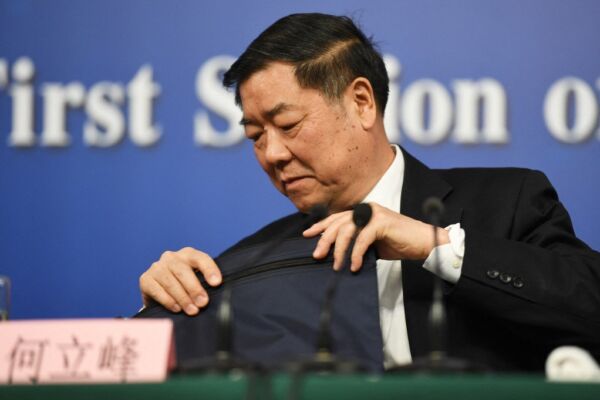
Recently, Jin Lei, former member of the Standing Committee of the Sichuan Provincial Committee and Minister of Organization, was unexpectedly appointed as a member of the Guangdong Provincial Committee and Secretary of the Shenzhen Municipal Committee. The appointment of Jin Lei, who is not even a member of the Central Committee of the Communist Party of China, has sparked various speculations about the backing behind him. Some theories suggest that Jin Lei belongs to the Xia Da Gang led by He Lifeng, indicating a rise in He Lifeng’s influence.
On March 22, it was officially announced that Jin Lei, former member of the Standing Committee of the Sichuan Provincial Committee and Minister of Organization, would assume the positions of member of the Guangdong Provincial Committee and Secretary of the Shenzhen Municipal Committee.
Born in February 1970 in Jiyuan, Henan Province, Jin Lei has held various positions in Henan Province, including Deputy Secretary of the Zhengzhou City Committee of Henan, Director of the Party School of the City Committee, Deputy Secretary of the Anyang City Committee, and Mayor. Since December 2019, he moved to Sichuan, where he served as Secretary of the Deyang City Committee, member of the Standing Committee of the Sichuan Provincial Committee, Secretary of the Deyang City Committee, Secretary of the Politics and Law Commission of the Sichuan Provincial Committee, Minister of Organization Department of the Sichuan Provincial Committee, Minister of Social Affairs Department, and President of the Provincial Party School (Sichuan Administrative College). He himself is not a member or alternate member of the Central Committee of the Communist Party of China.
Shenzhen possesses significant economic and political resources, making it a highly contested area for various factions within the Communist Party. Jin Lei lacks experience governing major cities or in coastal and developed regions, leading to multiple analyses about who might be supporting him.
Public records show that Jin Lei graduated from the Department of Political Science and Administration at Wuhan University and holds a master’s degree in economics from Xiamen University.
When Jin Lei was in charge of Shenzhen, reports highlighted his master’s degree in economics from Xiamen University. He studied finance at the School of Finance and Economics at Xiamen University and obtained his master’s degree in economics in 2002.
According to a report by Caixin, alumni from the School of Economics and Finance at Xiamen University have been gaining influence in the political scene. Vice Premier of the Communist Party of China, He Lifeng, graduated from the Economics Department of Xiamen University, obtaining his master’s and doctoral degrees from there. Other alumni include Liu Kun, Director of the National Social Security Fund and former Minister of Finance, who studied with He Lifeng at the university. The list also includes Shanghai Mayor Gong Zheng, Wang Jiang, Executive Vice Director of the Central Financial Office, Pei Jinjia, Minister of Veterans Affairs, Shen Danyang, Director of the State Council Research Office, and Pan Xianzhang, Deputy Director of the Taiwan Affairs Office.
After the 20th National Congress of the Communist Party of China, changes in the power structure in Zhongnanhai revealed evident power consolidation efforts by He Lifeng, who oversees economic and financial matters.
The National Development and Reform Commission (NDRC) has been He Lifeng’s stronghold. After He Lifeng stepped down from his position as director, current NDRC director Zheng Shajie was once his ally when he was in Fujian. Liu Kun, He Lifeng’s old classmate, returned to the Ministry of Finance over a year after leaving the position of Minister and assumed the rare dual roles of Secretary of the Party Committee and Chairman of the National Social Security Fund of the Communist Party. Lao Fu’an, who succeeded Liu Kun as Minister of Finance, was also his deputy when Liu Kun was Director of the Finance Department of Guangdong Province.
The Xia Da “financial and economic gang,” also known as the “Xia Da Gang,” led by He Lifeng, has long been under scrutiny, with relevant reports emerging in the past two years.
Economic scholar Li Hengqing, who now resides in the United States, told Epoch Times that He Lifeng’s expanding power could lead to conflicts with other factions aligned with Xi Jinping.
Li Hengqing cited that currently, He Lifeng holds more power compared to his predecessor, Liu He. This is attributed to his closer relationship with Xi Jinping, who strategically positioned him from Tianjin to the NDRC and eventually to become the Vice Chairman of the National Committee of the Chinese People’s Political Consultative Conference. However, in terms of economic governance, He Lifeng has not achieved significant results. He initiated the Binhai New Area as Deputy Mayor of Tianjin, which resulted in deserted developments and huge debts.
Various speculations have emerged about the influential figures behind Jin Lei.
Commentator Cai Shenkun mentioned in a recent video that Jin Lei is a very mediocre individual. Previously, Shenzhen’s secretaries were mostly “political stars” (such as Ma Xingrui), but the criteria for appointments has fundamentally changed. The current trend leans towards appointing “mediocre individuals” – those with limited influence and less obvious factional ties. The more mediocre one is, the more reassured Xi Jinping may be, as long as loyalty to the political ideology is unwavering. This has become a key standard in the current administration’s personnel decisions, placing less emphasis on capability.
Cai Shenkun pointed out that Xi Jinping’s family roots can be traced back to Dengzhou in Nanyang, Henan Province. He suggested that certain officials from Henan may have built a special political trust through long-term interactions. Local officials in Nanyang have established a unique political trust through renovations of ancestral halls and care for family members involved in Xi’s affairs, such as Xi Yuanping and Qi Qiaoqiao. Jin Lei’s smooth promotion from Henan to Sichuan is seen as a result of this “Xi’s hometown line.”
Cai Shenkun also mentioned that in Jin Lei’s career path, Peng Qinghua, the current Vice Chairman of the National People’s Congress and former Secretary of the Sichuan Provincial Committee, likely played a role. While Peng Qinghua did not directly intervene, he is considered a high-ranking official with influence. Peng Qinghua has long worked in the Organization Department and served as Secretary to the former head of the Organization Department, Song Ping. In 2019, Peng Qinghua transferred a group of officials from department-level positions to frontline positions in municipal bureaus in Sichuan, including Jin Lei.
Although there is much speculation about the appointment of the new Secretary in Shenzhen, commentator Li Linyi believes that these officials may not necessarily have a smooth tenure in the future.
In the last 30 years, among the nine Secretaries of Shenzhen, Zhang Gaoli was involved in a scandal of sexual abuse with tennis star Peng Shuai; Huang Liman was rumored to be a mistress of former party leader Jiang Zemin; Li Hongzhong has always been a controversial figure. Wang Rong, one of several high-ranking officials dismissed from their positions last November, was implicated in the authorities’ investigation into “naked officials” (direct family members who settled abroad). In addition, Ma Xingrui, currently a member of the Political Bureau, reportedly fell from grace after stepping down as Secretary of Xinjiang in July last year.