
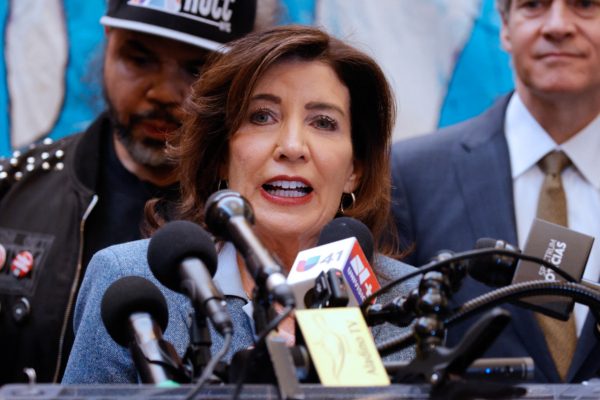
New York Governor Ho Chu recently proposed amendments to the “Climate Leadership and Community Protection Act” (CLCPA) passed in 2019, aiming to delay certain greenhouse gas emission reduction requirements and adjust the rules, sparking intense backlash from the state’s political arena and environmental groups. She stated that this move is intended to prevent further increases in energy prices and life costs. However, critics argue that this action may undermine New York’s position as a leading state in American climate policy.
According to multiple media reports, Ho Chu hopes to postpone the climate implementation rules originally set to be enacted by 2024 to 2030, and consider adjusting the implementation of the 2030 emission reduction target, and even establish new targets for 2040 to make the policy more “feasible” and affordable for the people.
The climate law requires New York State to reduce greenhouse gas emissions by 40% from 1990 levels by 2030 and 85% by 2050, making it one of the most ambitious carbon reduction legislations in the United States.
The Ho Chu administration pointed out that without adjusting the policy, residents and businesses may face significant increases in energy and fuel costs. Some estimates suggest that household energy and transportation expenses could significantly rise in the future, severely affecting people’s livelihoods.
Multiple media outlets have noted that Ho Chu has been continuously advocating for a reevaluation of the climate law’s implementation pace based on “affordability.” She believes that overly aggressive carbon reduction policies in the current situation of inflationary pressures and economic uncertainties may harm residents’ lives and business competitiveness.
The business community and some unions support the proposed amendments, arguing that the original policy’s set emission reduction pace is “impractical” and could lead to soaring electricity and heating costs, potentially affecting investment and employment. Critics of the law have long argued that Ho Chu’s adjustments are still insufficient. They point out that forcibly pushing for rapid carbon reduction could result in energy shortages, increased pressure on the power grid, and even hinder the state’s economic development.
However, environmental groups and some Democratic lawmakers strongly oppose any measures that weaken the climate law, believing that this will delay energy transition and increase long-term climate risks. They accuse the governor of attempting to “hastily amend significant climate legislation” in budget negotiations, lacking transparency.
Some lawmakers believe that the climate law itself is not the primary cause of rising energy prices and should be addressed by increasing investments in clean energy and subsidies to reduce the burden on residents.
As the April 1 deadline for state budget negotiations approaches, the debate over the climate law has become one of the most politically tense policy issues in New York State, reflecting the real contradiction between climate goals and living costs.
For many residents of New York, climate policy is no longer just an environmental issue but directly related to electricity bills, oil prices, rent, and employment opportunities. If the carbon reduction transition lacks technological and infrastructure support, overly aggressive regulations could ultimately impose a heavy cost on ordinary households.