
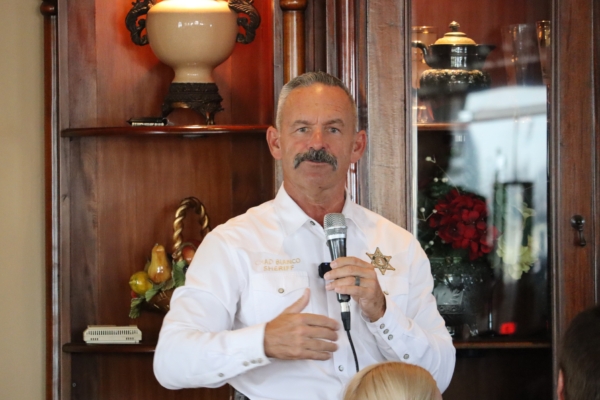
Riverside County Sheriff Chad Bianco held a press conference on March 20th to announce the reopening of the investigation into the November 2025 special election district redraw and criticized California Attorney General Rob Bonta for allegedly interfering with the investigation. This decision came after a Riverside County Superior Court judge issued an order on March 19th and appointed an investigator.
Bianco explained the three purposes of the press conference: 1) to inform the public about the investigation into last year’s special election based on concerns raised by a citizen volunteer group auditing public records from the Registrar of Voters (ROV); 2) regarding the alleged interference in the election investigation by the California Attorney General; 3) to assure Riverside County residents of their commitment to ensuring election security, reliability, and accuracy.
The investigation is ongoing, and the Riverside County Sheriff’s Department has served the Registrar of Voters with a judge-approved search warrant. Bianco briefly outlined the investigation status: the handwritten registration ballots stored by the Registrar of Voters totaled 611,426, while the number reported and certified to the Secretary of State was 657,322, a difference of 45,896 votes.
So how did this discrepancy occur? “The Registrar of Voters’ response is that they did not rely on handwritten records but used more accurate machine counting,” Bianco said. “I want people to understand that any margin of error in elections, no matter how small, is unacceptable, let alone a difference of 45,896 votes.” He stated that the new investigation aims to confirm the authenticity of this difference, and “if true, we will determine the cause.” A recent survey by UC San Diego showed that 40% of Californians do not trust the election process and counting mechanisms.
According to California election law, the special election ballots will be destroyed in May of this year, hence the reopening of the investigation cannot be delayed. From February 26th to March 6th, Bianco received three letters from the Attorney General requesting the suspension of the investigation and submission of relevant materials. Bianco stated, “According to the principle of separation of powers, the Attorney General has no authority to intervene in court decisions or evidence.” He believes his personnel know how to count votes. He noted that Bonta and the Secretary of State never expressed concerns over the 45,896 vote difference but instead questioned the compliance of the investigation; however, now, the Riverside County Sheriff’s Department, the District Attorney, and four out of five elected board members urged for a “thorough, fair, and ethical investigation.”
In a letter dated February 26th, Bonta expressed his legal duty to ensure the enforcement of state election law, giving him the oversight of all county sheriffs in criminal investigations and related actions. He stated, “Across the country, there is no indication of widespread voter fraud, whether it’s ballot counting, recounting, manual counting, audits, or court litigations.”
Upon learning that Bianco had seized about 1,000 boxes of special election ballots and related materials in February, Bonta remarked that although he had received copies of the requested affidavits, they failed to indicate reasonable belief in criminal conduct and did not mention the county Registrar of Voters’ defense at the February 10th county board meeting.
“Not only was the search not delayed until March 6th, but it was carried out immediately.” The Attorney General criticized the Riverside Sheriff’s Office and ordered through a letter: 1) to properly preserve all seized ballots, documents, and related materials; 2) to halt further actions.
In a letter dated March 4th, Bonta wrote, “I have learned of your plans to start counting ballots tomorrow and intend to use law enforcement officers; however, these individuals have not undergone professional training and lack any experience in ballot counting, which is absolutely unacceptable… Not only does this set a dangerous precedent but also increases public distrust in the electoral system; furthermore, you have openly defied my orders.”
On March 6th, Bonta, through a letter, requested the Riverside Sheriff’s Office to provide copies of all materials related to the investigation by March 11th, including five items. The third item was to trace materials: provide the search warrants signed by Judge Shouka on January 29, 2023, and by Judge Diaz on March 6, 2024, and the related materials; the fourth item was to provide contact information for the whistleblowers “Riverside Election Integrity Team” (REIT) and the investigators and the Riverside Sheriff’s Office in the form of voicemails, emails, and text messages; the fifth item was to provide any correspondence between the Sheriff’s Office and the county Registrar of Voters.
The REIT, composed of local residents, stated that a total of 627,802 ballots were delivered to the Registrar of Voters’ office, with 16,376 invalidated for various reasons, making the actual count of 611,426 ballots.
During the county board meeting on February 10th, Riverside County Registrar of Voters Art Tinoco presented three factors contributing to the error: REIT omitted certain ballot categories in tallying votes; REIT used “raw data” unprocessed by election workers; additionally, “REIT used handwritten paper documents based on manual counting, prone to human errors.”
Tinoco stated that the Registrar of Voters office utilized two machine systems, namely the Election Information Management System (EIMS), responsible for tracking ballots at polling centers, ballot drop-off points, and those sent by mail, and the Live Votes System (LVS), tasked with scanning ballots and conducting official counting on election day. “The EIMS system recorded 103 fewer ballots than the actual count,” he noted.
As reported by the Riverside County Record, Tinoco’s office revealed that a 2% difference between the two systems could be considered normal; however, the Secretary of State’s office, in an email to the newspaper, stated that no threshold had been set.
Several REIT members contested Tinoco’s statements. Shari Franklin said, “Hundreds of Registrar of Voters office staff signed forms, solemnly declaring that the recorded data is accurate… But once this data is entered into the computer system, the values undergo a ‘magical’ change.”
REIT stated that they had engaged in repeated communication and verification with the Registrar of Voters’ office to ensure they obtained all paper forms, as well as data on rejected ballots, provisional ballots, confidential ballots, and temporary ballots. ◇