
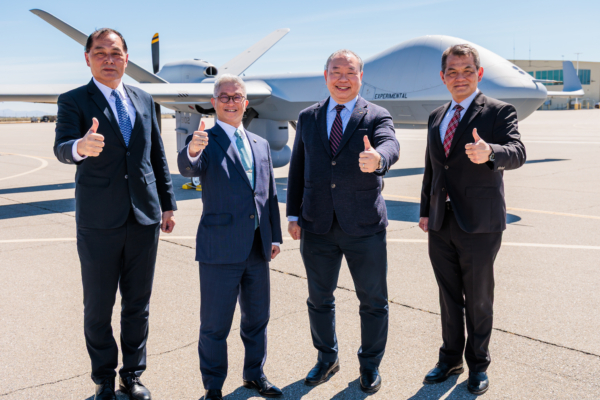
Taiwan’s Ministry of National Defense released an update on the procurement of the “MQ-9B High-Altitude Long-Endurance Unmanned Aircraft” on March 22. Deputy Minister of Defense Xu Sijian attended the delivery ceremony of the first two drones on March 17 (US West Coast Time).
On March 22, the Political Warfare Bureau of Taiwan’s Ministry of National Defense issued a press release regarding the “MQ-9B High-Altitude Long-Endurance Unmanned Aircraft.” On March 17, Deputy Minister of Defense Xu Sijian, accompanied by Ambassador Yu Da-yuan of the Taipei Economic and Cultural Representative Office in the US, attended the delivery ceremony of the first batch of 2 MQ-9B drones for the Republic of China Air Force.
Taiwan has faced frequent provocations and military threats from the Chinese Communist Party in recent years. To strengthen its military capabilities, the Ministry of National Defense of Taiwan has procured 4 new drones from the United States. The US plans to deliver 2 drones each in 2026 and 2027.
Deputy Minister Xu Sijian and Ambassador Yu Da-yuan personally experienced the powerful surveillance capabilities of the drones from the control room.
The Ministry of National Defense expressed gratitude to the US government, as well as entities like General Atomics Aeronautical Systems, for their strong support. They also mentioned continued collaboration with the US to ensure smooth production progress through the Taiwan-US security cooperation mechanism and enhance Taiwan’s defense capabilities.
In addition to attending the drone delivery ceremony, Deputy Minister Xu Sijian visited the F-16 BLK70 fighter jet production line in South Carolina on March 16. He witnessed the completion of the acceptance check flight by Lockheed Martin Corporation.
The Taiwan-specific F-16 BLK70 fighter jets require continuous test flights to fine-tune various systems, circuits, and software to ensure quality and flight safety. Lockheed Martin has deployed hundreds of employees working round the clock to produce these jets.
After the “acceptance check flight” by Lockheed Martin, the jets will undergo final acceptance tests by the US government before delivery to Taiwan. The Ministry of National Defense stated that they will continue coordinating with the US through the Taiwan-US security cooperation mechanism to expedite the delivery process of the fighter jets.
Last October, the Taiwan People’s Party accused the US of not delivering military equipment worth up to NT$659 billion (approximately $204 billion) according to the Ministry of National Defense’s “US Arms Sales to Taiwan Implementation Report.” The delivery of the planned 66 F16V fighter jets in 2026 has not occurred.
Director of the Office of War Planning Huang Wenqi clarified the situation during an interview on the media program “Chatting with You after Work” on March 18. He refuted the claim that payment had been made to the US without receiving equipment as “completely erroneous,” explaining that the US arms sales require phased payments for procurement.
Huang Wenqi elaborated on the payment process for the F-16V procurement. The US provides a billing based on future payment needs, Taiwan then transfers the expected quarterly funds to its office in the US, which is further wired to the Federal Reserve Bank of the US government. The funds remain Taiwan’s until allocated for production needs by the manufacturer.
Huang Wenqi stressed that Taiwan is purchasing completely new weapon systems, necessitating payment schedules. The F-16V fighter jet procurement costs around NT$240 billion (approximately $74 billion), of which Taiwan has already paid about NT$140 billion (approximately $43 billion). Approximately 60 jets have been manufactured on the assembly line, with several already assembled.