
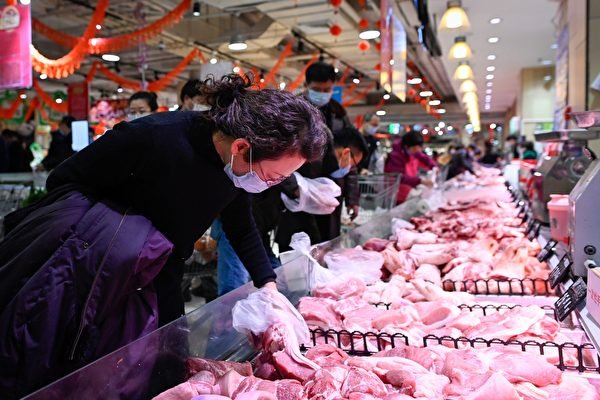
【Epoch Times News March 22, 2026】China’s lean pork pig trading average price was reported at 9.89 yuan per kilogram on March 20th, setting a new low price in nearly 15 years. On the same day, the main contract 2605 of lean pork pigs hit the lowest price since the contract was listed. Officials acknowledged that the price of live pigs has entered the warning zone of excessive decline.
According to a report from the Economic Observer on March 21st, the average trading price of lean pork pigs at 9.89 yuan per kilogram set a near 15-year low, compared to 9.92 yuan per kilogram on May 2018, with only about 0.3 yuan per kilogram difference from the low point in 2010.
Meanwhile, this week the lean pork futures market has seen a continuous decline for five consecutive trading days. On March 20th, the closing price of the main contract 2605 of lean pork pigs was reported at 10,220 yuan per ton, a decrease of over 8% from the closing price last week, reaching as low as 10,215 yuan per ton during trading, refreshing the lowest price since the contract was listed.
According to monitoring data from the Ministry of Agriculture and Rural Affairs, on March 20th (Friday of this week), the average wholesale price of pork in Chinese agricultural markets was 15.98 yuan per kilogram, a 1.2% decrease compared to 16.17 yuan per kilogram on the previous Friday (March 13th). The average price for this week was 16.13 yuan per kilogram, a 3.4% decrease from the average price of 16.7 yuan per kilogram last week.
This week, the average price of live pigs has dropped compared to the previous week. According to data from China Swine Network, on March 20th, the price of live pigs (outer three yuan) compared to the previous Friday (March 13th) decreased by 0.5%; the weekly average price decreased by 0.4% compared to the previous weekly average price.
Currently, the breeding cost for pig enterprises is mostly around 12 yuan per kilogram, indicating that the current pig prices have fallen below the breeding cost line completely, resulting in a severe situation where spot prices are significantly lower than the cost line. According to data from Yongyi Consulting, from March 6th to March 12th, the average loss per pig in the industry was between 250 yuan to 300 yuan. Pig farming has been in continuous losses for nearly six months.
In addition, Zhuochuang Information monitors the average trading weight of live pigs in China at 125.55 kilograms, a decrease of 0.04% compared to the previous period. The Paper believes that the decrease in the average weight of pig trading indicates that some regional breeding ends lack confidence in the future market outlook, opting to reduce weight at selling to minimize losses.
The Paper cited relevant bureaus of China’s National Development and Reform Commission and the Ministry of Agriculture and Rural Affairs at a symposium with pig breeding enterprises, analyzing that the decline in pig prices has entered the zone of excessive decline warning.
Regarding the continued decline in pig prices in 2026, Zhu Zengyong, a researcher at the Beijing Institute of Animal Husbandry and Veterinary Science of the Chinese Academy of Agricultural Sciences, analyzed to the Economic Observer that the core factor leading to the decline in pig prices is strong supply and weak demand. On the demand side, pork consumption rapidly enters the off-season after the Chinese New Year, showing a significant weakening trend in seasonal demand; On the supply side, since the first half of 2025, the inventory of breeding sows has been consistently high.
Looking forward, the agricultural team at CITIC Futures believes that in the second quarter, with ample outflow of live pigs and high live pig inventory, coupled with the off-season consumption, as inventory releases in the future process, prices still face downwards pressure. Pig farming is expected to continue to incur losses. In the long run, the market concentration has been continuously increasing in recent years, and the resilience of capacity reduction, therefore, may prolong the bottom of the pig cycle.
DDF Futures told The Paper that the slow digestion of production capacity may lengthen the bottoming out period of prices, and it does not rule out periodic rebounds in pig prices during this time. However, a cyclical reversal still requires patience and waiting.
Since July 2025, the spot price of Chinese commodity pigs has entered a downward channel. Last October, the average price fell below 11 yuan per kilogram. In the fourth quarter, the peak season of demand during the New Year briefly boosted prices, but they plummeted again after the holiday.
In 2026, the situation of losses in the breeding end continues to worsen. Statistics from Zijin Tianfeng Futures Research Institute show that as of March 13, 2026, a self-bred and self-raised pig incurred a loss of 283 yuan, while commercially purchased pig farming incurred a loss of 118 yuan per pig. Since February, with the continued decline in pig prices, the extent of losses under these two modes has been expanding.
The losses of pig enterprises are consistently widening, as seen in the financial reports of listed pig enterprises. The sales situations of China’s three major listed pig companies, New Hope Liuhe Co., Ltd., Muyuan Foods Co., Ltd., and Wens Foodstuffs Group Co., Ltd., all show declining sales prices and revenue.
For example, in the “February 2026 Sales Briefing” of New Hope on March 7, it was stated: “The sales revenue of commercial pigs was 1.327 billion yuan, a decrease of 18.49% compared to the previous month and a decrease of 7.42% year-on-year. The average sales price of commercial pigs was 11.45 yuan per kilogram, a decrease of 8.25% compared to the previous month and a decrease of 21.79% year-on-year.”
Muyuan Foods had a sales average price of 11.59 yuan per kilogram for commercial pigs in February, a year-on-year decrease of 18.72%; the sales revenue of commercial pigs was 6.405 billion yuan, a year-on-year decrease of 23.98%. Wens Foodstuffs sold 2.697 million head of pigs in February, an increase of 3.80% year-on-year, but the revenue decreased by 15.58% year-on-year.