
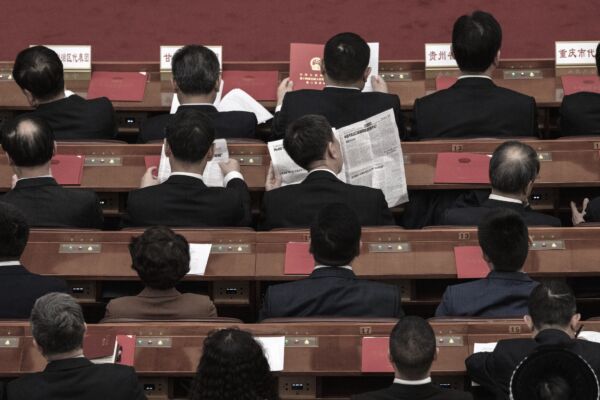
China’s economy has stagnated, with the decades-long model of economic growth facing setbacks. The Chinese Communist Party (CCP) has recently launched a movement in response to party leader Xi Jinping’s so-called “correct performance view,” aiming to redefine how officials’ performances are evaluated. Analysts believe Xi is trying to correct the excessive emphasis on GDP worship, but the result has left officials in a dilemma being pulled in three different directions.
The CCP Central Committee issued a notice on February 23 regarding the “establishing and practicing of the correct performance view.” This campaign is designed to redefine how performance evaluations are conducted for leadership teams at county level and above, focusing on preventing deviations in performance evaluation methods, with a completion goal by the end of July.
According to reports from official CCP media Xinhua News Agency on February 24, a party leadership group meeting was held in Beijing to address the rectification of performance views.
An informant, Mr. Chen, interviewed by Epoch Times earlier, mentioned that under Xi’s highly centralized system, there have been frequent purges of cadres through party channels, reflecting not stability but anxiety. Such political corrections often occur when power dynamics are loosening rather than being in a phase of strong consolidation.
An article by Liz C. Lee and Wang Shengyu from the Asia Society Policy Institute’s China Analysis Center, published by Foreign Policy, indicates that Xi struggles to align China’s massive administrative machinery in the direction he desires.
The article points out that the CCP’s governance is facing a typical principal-agent dilemma. Xi has identified priorities, yet the incentives given to local officials for implementation are not always consistent.
For most of the reform era, the CCP has relied on a brutally simple principle: GDP growth. Local officials have understood the rule: as long as the growth machine keeps running, accumulating debt, environmental degradation, speculative construction, and even outbreaks of social unrest have been tolerable.
Many years later, this model has led to significant distortions. While China appears to be advancing economically and has transformed into a global industrial power, this model has reached its limits, with high-speed growth becoming increasingly hard to sustain. During the National People’s Congress in March 2026, Premier Li Keqiang acknowledged the serious challenges facing China’s economy and revised down the economic growth target.
At the end-of-year Central Economic Work Conference, Xi Jinping emphasized the pursuit of genuine growth without padding, promoting high-quality and sustainable development.
Lee and Wang’s article suggests that Xi is struggling to establish a new evaluation system as he moves away from the long-standing GDP worship. He faces difficulties in creating a new evaluation system, with local officials needing to meet three conflicting demands simultaneously.
The first demand is strict political obedience. During the reform era, local officials had space to tailor central directives to local realities. This space has significantly shrunk. Xi insists that the CCP’s strategic decisions must be implemented without deviation or modification. Inadequate implementation or excessive enthusiasm can both be seen as political mistakes.
The second expectation involves technological upgrades. Beijing still desires economic vitality, hence the introduction of the concept of “new quality productivity” to reconstruct the growth framework. Officials are encouraged to promote advanced manufacturing, artificial intelligence, green technology, and other frontier industries.
The third expectation focuses on systemic security. Beijing increasingly views financial risks and local government debt as long-term threats to stability. Industrial parks, infrastructure, and vast real estate development projects, despite boosting GDP, have left behind heavy debts and idle assets.
Lee and Wang’s article argues that each of these priorities is meaningful in itself. However, they collectively create a bureaucratic trilemma where officials can only satisfy two out of the three. Innovations require risk-taking, and if local officials prioritize risk control and strict compliance with central directives, innovation will be affected. Pursuing innovation burdens local government balance sheets, increases fiscal pressure, and disrupts financial stability.
The article suggests that Xi is unable to shake the CCP’s worship of GDP. Faced with conflicting demands, officials have resorted to “lying flat,” and Xi’s anti-corruption campaign has heightened this phenomenon. The CCP is undergoing a massive internal cleansing, with 181 mid-level cadres under investigation, nearly twice the number from the previous year.
According to Foreign Policy, officials’ caution does not always imply inactivity, but out of fear of making too many mistakes, they rush into politically favored sectors to demonstrate compliance with the core. As a result, various provinces and municipal authorities have flooded into the same high-tech industries, leading to waves of repeated construction projects and wasted capital.
At the Central Economic Work Conference on December 10, 2025, Xi reiterated the need to focus on domestic demand and encourage innovation at the local level. However, recent years have seen continuous economic downturn in China, with local finances reaching a critical point of constraint and officials and civil servants within the system facing reduced privileges.
Beijing seems to be aware of the tense situation. Xi’s article published in the Party’s magazine, Qiushi, on March 1, calls on officials to “shoulder heavy burdens, tackle tough challenges, and handle hot potatoes fearlessly.” Xi clarifies that “strict Party governance” does not mean over-control, leading to passivity, but rather to push officials to be proactive. However, few officials are willing to risk their careers on vague promises of leniency.
Xi’s emphasis on political loyalty does not tolerate a more confident bureaucratic institution, always rewarding theatrical loyalty, which breeds silent resentment among officials. The authorities often publicly demand loyalty while privately labeling dissatisfied officials as double-players. Xi desires a bureaucratic institution that can do everything at once, which is impossible, leaving officials unable to escape the trilemma.