
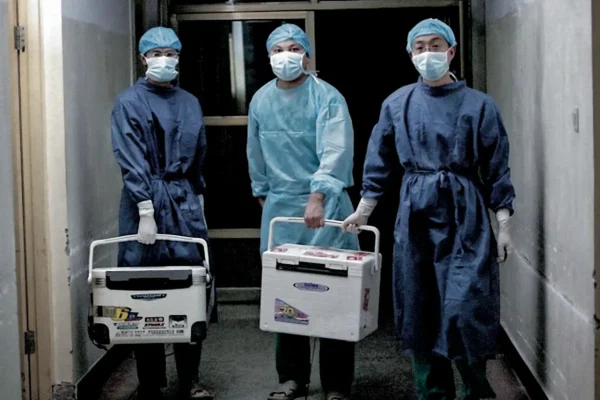
Guangzhou resident Gaofei recently sent an open letter to five ministries of the Chinese Communist Party, urging the immediate comprehensive suspension of human organ transplant operations and initiating a citizen petition. By last Thursday (19th), nearly 450 people had signed the petition, drawing widespread attention. In the letter, Gaofei stated, “Every life is sacred and unique, not bio-parts that can be dismantled and circulated by the state machinery or interest groups.”
Gaofei, the initiator of the appeal, revealed in an interview that his WeChat account was banned, forcing him to move out of his residence, leaving him in a precarious situation with nowhere to stay, and worrying about potentially being “disappeared.” He emphasized that the issue of life is non-negotiable, saying, “This is not a plea to the authorities, but a long-term game against the evil forces that ignore or even devour life.”
On March 8, 2026, Gaofei sent an “Urgent Appeal” to the offices of the National People’s Congress Standing Committee, the State Council, the Ministry of Public Security, the National supervisory Commission, and the National Health Commission. The related mail was acknowledged between March 11 and 12.
The appeal titled “Defending the Bottom Line of Life: An Urgent Appeal for Comprehensive Review and Suspension of Human Organ Transplant Operations” initiated an online petition, with the joint signatures reaching 440 people by March 19.
The appeal pointed out that since the enforced legalization of organ transplants by the Chinese Communist Party, societal anxiety has been constantly rising. Numerous cases related to “brain death” are precisely concentrated in the younger population, the allocation process is opaque, and terms like “secret crimes” and “organ black market” continue to emerge, severely impacting social trust and security. The appeal urged for a comprehensive review and suspension of human organ transplant operations.
On March 19, Gaofei received a written notification from the Baiyun District Public Security Sub-bureau in Guangzhou, stating that the matter of reviewing and suspending organ transplant operations is “not within the jurisdiction of this agency and lower-level public security agencies,” and advised him to forward it to the health department based on the guidelines of the “Regulations on Letters and Visits.”
Meanwhile, Gaofei’s WeChat Moments content was completely blocked, the link to the citizen petition webpage was disabled, and his WeChat public account was permanently banned after a few days of use.
Throughout the process of initiating the appeal, Gaofei faced ongoing pressure: receiving late-night calls from the police, being asked to “understand the situation at the police station,” and being forced to move out of his residence due to the landlord’s “renovation,” leaving him with nowhere to stay.
Despite these challenges, he continues to release all communication content with the authorities publicly, stating, “If the government can’t handle transparency, there is no need for us to live.”
In an interview with a reporter, Gaofei emphasized, “I am not requesting a problem of a single case, but an institutional policy issue. The threat and fear that this issue poses to the whole society are real and tangible. The government’s disregard for the anxieties and fears of civil society is a failure of the government itself.”
He pointed out that the Chinese authorities had previously disclosed that the number of missing persons per year from 2016 to 2020 was not less than one million each year, reaching 3.26 million in 2016, and relevant data disappeared entirely after 2021, while organ transplant data also fell into an “information black hole.”
Overseas human rights lawyer Wu Shaoping told the media that the regulations on organ transplantation in China currently exist only in the form of State Council regulations, with a lower legislative level and significant conflicts with upper-level laws.
“In legal terms, ‘brain death’ does not stand, but the vast majority of organ transplants in China require the organs to be taken while the heart is still beating – this means that legally, the act of harvesting organs is actually killing,” he said.
Wu Shaoping further indicated that although the current regulations have a “Transplant Ethics Committee,” it essentially operates as “internal review,” and the long-standing corruption issues in the Red Cross Society of China make it challenging to ensure fairness.
In an interview, overseas human rights lawyer Xu Silong commended Gaofei’s actions while maintaining a cautious attitude towards the actual effectiveness. He stated that Gaofei’s initiative has at least threefold significance: to continue fermenting discussion about organ transplants and missing persons, to prompt more people to acknowledge the connection between the two issues, and to convey civil opposition voices to the Chinese Communist Party leadership.
He noted that organ transplants per se do not necessarily violate humanitarian principles, but the fundamental difference lies in the design and implementation of the system: “Organ donations in democratic countries are altruistic and the priority is fair scheduling. However, the Chinese Communist Party has turned organ transplants into an industry, which violates the most basic ethical principles.”
Xu Silong also pointed out that under a lack of transparency mechanism, the significant market demand and profit margin provide continuous impetus for illegal organ harvesting.
As societal worries and anxieties spread online, some voices from within the Chinese system offer a more direct observation angle to the outside world.
Mainland human rights lawyer Shen Guoliang categorically described organ harvesting as “has already become an industry,” and warned, “live organ harvesting is quite common, and no one is safe.”
He urged governments and people worldwide not to view this issue as an internal matter of China, stating that “it is spreading continuously” and believed it to be “the bloodiest anti-human crime on this planet,” calling for immediate action to expose and stop it.
A mainland police officer claiming to have been personally involved in executing death sentences, Jiang Chengping, shared a shocking firsthand testimony. Approximately fifteen to sixteen years ago, he executed a firing squad, where the condemned kept twitching after being shot, then swiftly taken to an adjacent autopsy van to harvest the organs on-site, and the body was immediately sent to the crematorium.
“When I fired the first shot, he was still twitching. I was about to turn him over and shoot again, but they said no, we had to harvest immediately,” Jiang said. He mentioned that at that time, he knew that “over 90% of organ providers were death row inmates” and that they were generally chosen from those who had cut ties with their families, with no one to claim the body. He candidly admitted, “Is it illegal? It’s up to them to decide.”
The sentiments of ordinary citizens are equally heart-wrenching.
Zhao Zirui from the mainland stated, “The ‘live organ harvesting’ has sparked widespread anger, and people are in fear, not daring to go out at night.”
A resident of Shandong Province, Chen Yahui, described the increasingly tense social atmosphere in their locality, saying, “There are many missing people, and fewer people are on the streets. Parents are reluctant to let children go out, not even confident in sending them to school.” She expressed that this fear has spread from southern regions to northern provinces.
Gaofei informed the media that his wait for a positive response from the five ministries is not indefinite. He revealed that if no affirmative reply is received within the stipulated period, he would use the citizen petition list as evidence of public opinion to submit to the relevant departments and initiate the second-phase action, including preparing for a protest march application.
He emphasized, “This is not a plea to the authorities, but a long-term game against the evil forces that ignore or even devour life.”
Wu Shaoping believes that fundamentally, the scope for reform within the current system framework is extremely limited because the profit chain formed by organ transplants is deeply embedded in the power structure. He stated, “It is better to have a name in the law than to have none — they will not proactively close this convenient door.”
He also pointed out that the Chinese Communist Party is using its vast organ resources as a bargaining chip to entice and influence dignitaries in other countries, elevating this issue beyond mere medical ethics into deeper geopolitical meanings.
Xu Silong grounded the significance of the appeal in the realm of civic responsibility, stating, “Before doing anything, don’t consider whether it will be useful; you must voice opposition and find ways to do it.”
He urged the international community and governments to conduct independent investigations into China’s organ transplant issue, gather evidence suitable for legal analysis, and hold those accountable through international legal mechanisms.
In his appeal letter, Gaofei wrote, “Every life is sacred and unique, not bio-parts that can be dismantled and circulated by the state machinery or interest groups.”
(For safety reasons, the interviewees Shen Guoliang, Jiang Chengping, Zhao Zirui, and Chen Yahui are all pseudonyms.)