
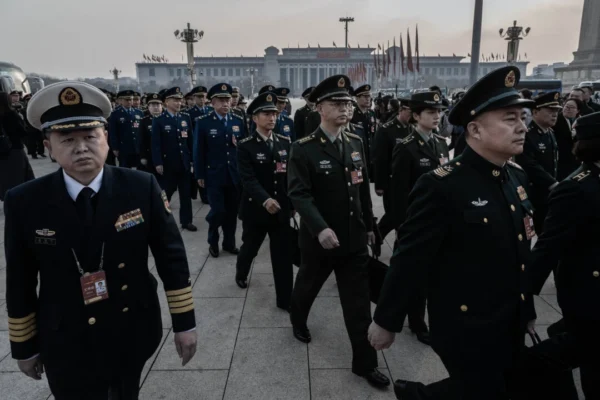
The leader of the Chinese Communist Party, Xi Jinping, has purged a significant number of senior military officials. It is currently known that nearly 70 senior generals have been purged. Among the 81 senior generals who have been personally promoted by Xi Jinping since he came to power, almost 60 have been purged, a historically unprecedented proportion of removals. Experts believe that Xi will pay a heavy price for his actions.
Since the resumption of military ranks in the Chinese Communist Party in 1988, Deng Xiaoping awarded military ranks to 17 senior generals (Hong Xuezhi was the only one who received the rank of senior general twice in 1955 and 1988). During the 15 years when Jiang Zemin held military power, a total of 79 senior generals were selected in 11 batches. Under Hu Jintao’s leadership, 45 senior generals were promoted in a steady manner. In comparison, since coming to power, Xi Jinping has promoted 81 senior generals, leading to a complete turnover in the military leadership.
However, behind this large-scale promotion, an unprecedented wave of purges has followed. Apart from the earlier removal of former Vice Chairmen of the Central Military Commission, Guo Boxiong and Xu Caihou, as well as Joint Chiefs of Staff Fang Fenghui and Political Work Department Director Zhang Yang, the scale of purges has only increased in Xi Jinping’s third term following the 20th National Congress of the Communist Party of China.
A list of current and retired senior generals who have encountered issues (67 individuals) is as follows:
Not promoted by Xi Jinping – 9 individuals: Guo Boxiong, Xu Caihou, Wang Xibin, Tian Xiusi, Wang Jianping, Fang Fenghui, Zhang Yang, Zhang Youxia, Liu Yazhou.
Personally promoted by Xi Jinping – 58 individuals: Wei Fenghe, Xu Fenlin, Wei Liang, Miao Hua, Zhao Zongqi, Zheng Weiping, Zhu Fuxi, Wang Ning, Yi Xiaoguang, Han Weiguo, Liu Lei, Yu Zhongfu, Gao Jin, Li Shangfu, Yuan Yubai, Wu Shezhou, Zhu Shengling, Shen Jinlong, Qin Shengxiang, Ding Lihang, Zheng He, An Zhaoqing, He Weidong, He Ping, Wang Jianwu, Li Qiaoming, Zhou Yaning, Li Fengbiao, Yang Xuejun, Xu Zhongbo, Guo Pujiao, Li Wei, Wang Chunning, Wang Xiubin, Liu Zhenli, Jugansheng, Wang Haijiang, Lin Xiangyang, Chang Dingqiu, Xu Xueqiang, Liu Qingsong, Wu Yanan, Xu Deqing, Qin Shutong, Yuan Huazhi, Li Yuchao, Zhang Hongbing, Wang Qiang, Huang Ming, Zheng Xuan, Ling Huanxin, Wang Houbin, Wang Wenquan, Hu Zhongming, Wang Renhua, Xiao Tianliang, He Hongjun, Chen Hui.
In addition, Deputy Chief of the General Staff of the Central Military Commission, Xu Qiling, has also encountered issues. Based on recent events, safe current senior generals include Zhang Shenmin, Dong Jun, and newly promoted Yang Zhibin and Han Shengyan.
Independent commentator Cai Shenkun commented that such a massive purge has no precedence in the history of the Chinese Communist military. This method of simultaneous promotion and removal essentially dismantles the existing power structure within the military. Senior generals become high-risk positions, and the professional dignity and trust in the system among military leaders suffer a devastating blow, the consequences of which could be immeasurable in future potential conflicts.
Researcher Shen Mingshi from the Taiwan Institute for National Defense and Security Studies told Epoch Times that Xi Jinping’s relentless purge of senior generals, including He Weidong, Miao Hua, and Zhang Youxia, aims to ensure complete obedience from the military to him. Continuous purges lead to a vacuum of power, a dearth of high-ranking officers, and numerous issues arising in various military training scenarios, creating a dilemma for Xi. Furthermore, retired senior generals also find no peace due to the expanding purges, leading to a sense of resignation within the military.
Shen Mingshi noted that according to the Chinese Communist culture, in the past, military leaders could engage in corruption through the development of armaments, and the advancement of armaments could occur due to corrupt practices, such as acquiring advancements in stealth fighters or aircraft carriers. Now, with Xi’s anti-corruption efforts, it seems like the bathwater is being poured out along with the child inside, making potential researchers hesitant to engage in armament development due to the high risks of corruption. Without the driving force of money, coupled with a sense of constant unease, the development of the Chinese Communist military will slow down.
Yuan Hongbing, a scholar based in Australia, previously revealed that within the Chinese Communist official circles, Xi is now known as the “Senior General Slayer,” indicating his role as a destructor of senior generals.
Yuan Hongbing informed Epoch Times on March 20 that one of the important objectives behind Xi Jinping’s military reforms is to satisfy his personal ambitions for power. He seeks to establish a system where he has the final say as the Chairman of the Central Military Commission. Xi has conducted round after round of purges within the military, resulting in almost complete elimination of senior generals under his leadership, with even more senior officers undergoing scrutiny. This demonstrates that Xi’s desire to achieve absolute personal dictatorship has become a political quagmire.