
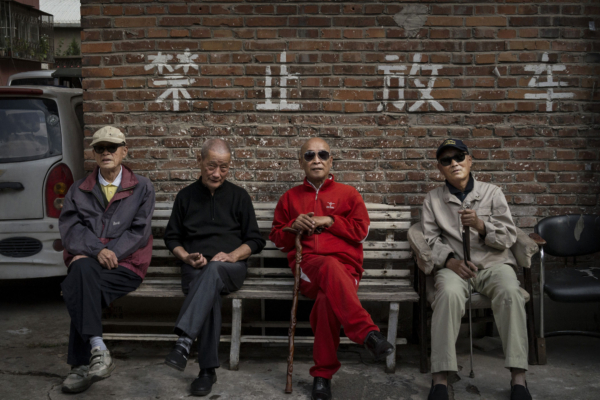
Recently, in Shanghai, on the one hand, there is difficulty for young and middle-aged people to find employment, while on the other hand, the Chinese Communist Party’s official response to the aging population is to promote the employment of elderly people. The Shanghai authorities recently put forward a plan to support the so-called “active aging” of the elderly, stating that “elderly people not retiring but staying active” has become an important force to make up for the shortage of labor and preemptively defend against the impact on young people’s employment. This move has sparked widespread criticism and discontent online. Some experts point out that this is the authorities’ way of avoiding addressing the issue of elderly care.
The Shanghai Municipal Civil Affairs Bureau and 28 other departments jointly issued the “Implementation Plan of Shanghai Municipality on Building a Social Participation Support System for the Elderly to Promote Active Aging,” emphasizing “comprehensively encourage and support elderly people to continue participating in economic and social development, leveraging their experience advantages, and contributing ‘silver power.'”
According to a report from the official Shanghai media outlet “Liberty Daily” on March 19, officials from the city’s Civil Affairs Bureau claimed, “The active participation of elderly people not retiring in social development is not only a choice to enrich their own lives but also an important force to address the structural shortage of labor.”
In May last year, the Chinese Communist Party’s Ministry of Civil Affairs and 19 other departments jointly issued “guiding opinions” to support the employment of elderly people. The Shanghai authorities stated that Shanghai’s “Implementation Plan” is a detailed operation of this policy.
Regarding Shanghai’s introduction of the support plan for “not retiring but staying active,” mainland Chinese netizens expressed skepticism and ridicule:
“The problem is that many young people in Shanghai are from other places, and this policy will make them leave.”
“People start losing jobs at 35 and then re-employ at 60.”
“We should first solve the employment issues of middle-aged people before discussing this.”
“Is there such a big labor shortage in Shanghai?”
“Many physical labor positions are in need of workers, but those jobs don’t offer social benefits. This allows retirees to work without having to pay social security.”
“They don’t want those who are 40 years old, but want 60-year-olds to work. This world is too fragmented.”
Since 2022, the youth unemployment rate in China has significantly risen, reaching a peak of 21.3% in June 2023. Subsequently, the authorities stopped disclosing the youth unemployment rate. On January 17, 2024, after “adjustments,” they released the urban labor force unemployment rate that didn’t include students. Official data shows that the latest youth unemployment rate (excluding students) as of December 2025 was 16.5%, but it is believed that the official figures do not accurately reflect the true situation since some “potential unemployed” groups were excluded.
The Chinese authorities predict that the number of college graduates this year will reach 12.7 million, an increase of 480,000 from last year. The social crisis caused by youth unemployment continues to attract attention.
Regarding the impact of elderly employment on young people, official media cited “experts” as saying, “We cannot absolutely say that the young and the old won’t compete for jobs, but in China this issue is more complicated and far less severe than outsiders imagine.” “Young people tend to prefer new industries like the internet, while the elderly are still concentrated in traditional sectors.” “It should be recognized that aging is not a social burden but a population dividend of healthy longevity.”
The Shanghai official media also argued that as aging societies emerge, many countries have passed legislation to promote elderly employment to alleviate the burden of eldercare. Japan, for example, has the “Employment Stability Law for the Elderly,” which protects the employment rights of people aged 60-65.
Political commentator Li Linyi stated that China should not be compared with Japan. Japanese society follows a “rich before old” model, having become a high-income country upon entering an aging society (with per capita GDP exceeding $30,000), where many elderly people have retirement pensions, savings, and assets to support themselves, making employment more supplemental rather than a “necessity for survival.” China, on the other hand, experiences “old before rich” coupled with rapid aging. Its per capita GDP is only around $12,000-$13,000, far below Japan’s level at the time, and its pension system is already significantly underfunded.
In 2025, data showed that the average monthly pension for urban and rural residents was only 287 Chinese yuan, with a huge disparity between urban and rural areas. The minimum standard for basic pension increased by only 20 yuan to 163 yuan in 2026, showing extremely low security levels for elderly people in rural areas.
On September 13, 2024, the Chinese National People’s Congress passed a gradual retirement age extension plan. Starting from January 1, 2025, the legal retirement age for male workers will gradually increase from the original 60 years to 63 years, while the retirement age for female workers will change from 50 years and 55 years to 55 years and 58 years, respectively. This adjustment will span 15 years, with retirement age increasing by one month for every four months. The minimum payment period to receive the basic pension will be raised from 15 years to 20 years, adding six months each year.
As early as August 24, 2022, the official Chinese Elderly Association launched the Chinese Elderly Talent Network. The website is intended to establish a database of elderly talent and a service platform for elderly talent information, providing a platform for elderly people to re-enter the workforce. A job posting on the website indicated that a McDonald’s in Beijing was seeking retired service staff, requiring women over 50 years old and men over 60 years old (with retirement certificates) to work flexibly for 4 to 5 days a week, 4 to 8 hours a day, with a monthly salary ranging from 1800 to 3500 yuan.
According to a report from Shanghai’s official media yesterday, official data shows that by the end of 2025, the population aged 60 and above in China had exceeded 320 million, and the number of over-age workers reached between 87 million to 120 million, mainly engaged in labor-intensive industries such as catering, sanitation, security, and construction. Data from a leading recruitment platform shows that the percentage of job seekers aged 55 and above is increasing annually in the double digits.