
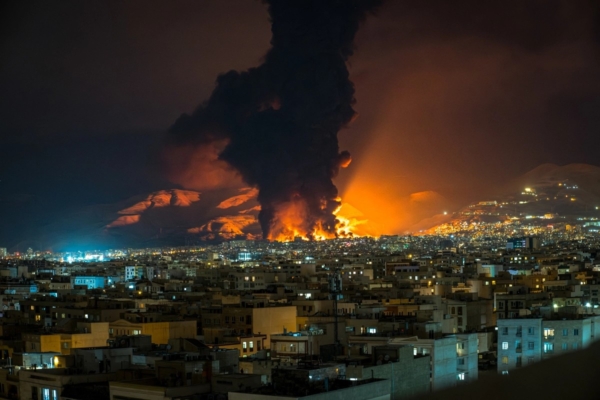
Recent reports from Iran indicate a heightened crackdown by the Iranian authorities on civilians, political prisoners, and anyone suspected of dissent amidst ongoing conflicts with the United States and Israel. The Iranian regime has cut off the internet and restricted phone communications, leading to limited information flowing out of Iran.
Reports suggest that the Iranian Islamic Republic authorities have increased pressure on civilians, political prisoners, and individuals suspected of holding dissenting views. The national police chief has stated that security forces have been authorized to use lethal force against specific criminal activities.
Residents from various cities in Iran have reported tight security deployment, with officials warning the public against any form of protests or criticisms. Iranian judicial and political figures have openly warned that expressing dissent could be viewed as collusion with foreign hostile forces.
On March 4th, Iranian Justice Minister Gholamhossein Mohseni Ejei classified protest activities as part of foreign-supported hostile actions, warning that anyone accused of undermining national stability or supporting hostile forces would face severe punishment.
Other officials have used stronger language, suggesting that individuals perceived as aligning with foreign hostile forces could be considered a threat of war.
On March 5th, Islamic Revolutionary Guard Corps (IRGC) commander Salar Velayatmadar issued a warning on national television, cautioning parents of students that if their children support the U.S. or Israel, “we will deliver the final blow to them.” Many young people were reportedly killed during anti-government uprisings that occurred in December 2025 and January.
Police also announced strengthening enforcement measures. On March 5th, the Iranian national police chief stated that under the official wartime security situation, security forces have been authorized to use lethal force against certain criminal activities.
Iranian human rights organization “Dadban,” which documents detention situations in Iran, expressed that the state of war has exacerbated the conditions of Iranian prisoners, particularly political prisoners.
Reports from the notorious Evin Prison in Tehran, which detains many political prisoners, indicate a deterioration of administrative order within the facility. According to information from prisoner’s families, some prison guards have abandoned their duties, and inmates are still confined to small spaces with strict limitations on food, water, and medical services. Despite the volatile security situation, political prisoners are reportedly being denied bail.
Ali Asadollahi, a political prisoner at Evin Prison, was reportedly on track for release according to his sister Shailin Asadollahi’s Instagram video. However, following the recent attacks, prisoners were suddenly transferred to an undisclosed section.
Apart from prisons and security agencies, a climate of intimidation has also affected Iranian citizens abroad.
On March 9th, five members of the Iranian women’s national football team obtained humanitarian visas in Australia. Previously, the team had refused to sing the Iranian national anthem during an international match on the Gold Coast in Australia, sparking concerns among supporters and activists that they could face repercussions upon their return to Iran.
Although communication from Iran is restricted, limited contact with individuals inside Iran indicates that many civilians are closely monitoring the situation’s development. Some individuals within Iran have expressed heightened anxiety in their daily lives due to air raid alerts and the uncertainty brought about by the war.
In a conversation, a 48-year-old Iranian man described the atmosphere during nighttime air raids to the Persian version of the Epoch Times.
“The sounds at night are terrifying, and the attacks are intense,” he said.
“It seems like the skies over Iran are now completely controlled by the U.S. and Israel, as if they are no longer in the hands of the Islamic Republic regime.”
He also expressed hope that the air raids could lead to a change in the regime.
“We find some comfort in the fact that ordinary people have not been targeted,” he said.
“That’s why many of us are willing to endure these hardships if it ultimately leads to the downfall of the Islamic Republic.”
Others hope for an end to the war, stating they do not wish for the air raids to continue.
“War is terrible,” a 68-year-old woman from Iran told the Persian version of the Epoch Times.
After the U.S. and Israel initiated air raids on Iran on February 28th, Iran’s Islamic Republic promptly severed the internet in most regions of the country and restricted phone calls. While most people within Iran could not receive calls from outside the country, calls from inside Iran to the outside were possible.
The war erupted following multiple rounds of failed international negotiations regarding Iran’s nuclear program.
In response to the airstrikes by the U.S. and Israel, the Iranian regime launched missiles and drones at Israel and neighboring countries hosting U.S. military bases.
The U.S. and Israel advised Iranian civilians to stay at home during the air raids and indicated that they would have the opportunity to take to the streets, rise up in resistance, and change the regime.
According to the Norway-based human rights organization “Hengaw,” by the end of the tenth day of the war, at least 4,300 people had lost their lives, including 390 Iranian civilians and 3,910 Iranian military personnel. The Epoch Times could not independently verify these figures.
As of now, seven U.S. soldiers and thirteen Israelis have lost their lives in the conflict.