
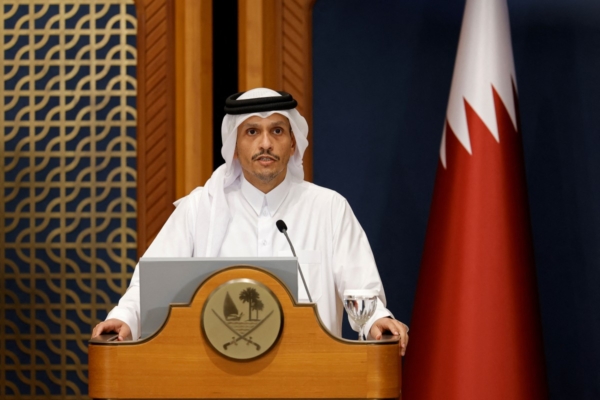
Qatari Prime Minister and Minister of Foreign Affairs Sheikh Mohammed bin Abdulrahman Al Thani condemned Iran’s attempt to drag Middle Eastern countries into war during a press conference on Thursday, March 19. He strongly denounced Iran’s attacks on energy facilities in the region and called for an immediate halt to such actions.
“We emphasize the need to fully implement relevant United Nations Security Council resolutions, which clearly call for Iran to cease its attacks and to stop escalating regional conflicts,” he said.
Sheikh Mohammed also stressed that diplomacy must be based on mutual respect, but Iran’s “aggression” has eroded trust. He rejected Iran’s claims that the attacks were targeted at American assets in Qatar and the region.
“The most powerful evidence is that yesterday’s Iranian attack targeted Qatar’s natural gas facilities, which are a source of income for the Qatari people, but its impact extends far beyond the Qatari people as it also affected millions of people being assisted by Qatar,” Sheikh Mohammed said.
Iran launched an attack on Qatar’s energy hub Ras Laffan Industrial City on Wednesday, resulting in significant losses. Qatar subsequently expelled Iranian embassy officials. Sheikh Mohammed described this as a “destructive behavior,” indicating Iran’s pursuit of “aggressive policies” and “dangerous escalations.”
“This war must stop immediately, aggressive actions must cease immediately, because everyone knows who will benefit from this war and dragging the Middle East into conflict. Unfortunately, what is currently happening serves those agendas,” he stated.
On Thursday, foreign ministers from Arab and Islamic countries held a consultative meeting in Riyadh, the capital of Saudi Arabia, and issued a joint statement urging Iran to immediately stop the attacks while reaffirming countries’ right to self-defense under international law.
The ministers strongly condemned Iran’s deliberate use of ballistic missiles and drones to attack civilian areas and critical infrastructure in the Middle East. Representatives from Saudi Arabia, UAE, Qatar, Turkey, Egypt, Jordan, Kuwait, Bahrain, Lebanon, Pakistan, Azerbaijan, and Syria attended the meeting.
They noted that countries targeted by Iran’s attacks included Gulf states, as well as Jordan, Azerbaijan, and Turkey. The attacks aimed at residential areas, oil facilities, desalination plants, airports, and diplomatic institutions. They emphasized that such actions “cannot be justified under any pretext or in any way.”
The ministers reiterated that countries have the right to self-defense under Article 51 of the United Nations Charter. They emphasized that the future of relations with Iran depends on Iran’s respect for other countries’ sovereignty, non-interference in their internal affairs, and not using or developing military capabilities to threaten regional countries.
The ministers also urged Iran to cease supporting, funding, and arming affiliated militias operating in Arab countries, warning that such actions would destabilize the region. They cautioned Iran against trying to disrupt international navigation, including in the Strait of Hormuz and the Bab el Mandeb strait, emphasizing the importance of maintaining maritime security.