
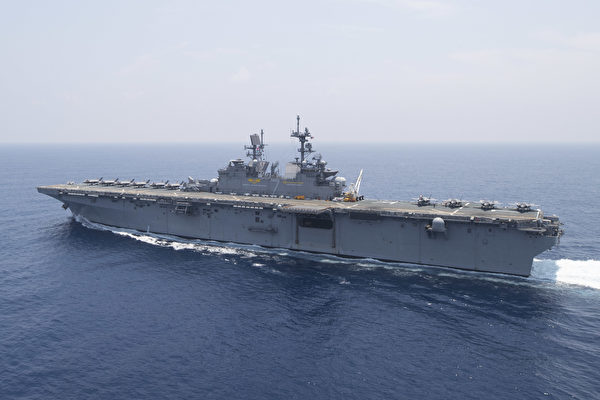
At least one US Navy ship carrying more than two thousand Marine Corps personnel is heading towards the Middle East, sparking speculation that the move signifies further strengthening of military deployment in the region and the deployment of US ground forces.
Satellite images show that on March 15, the US Navy’s amphibious assault ship “USS Tripoli” (LHA 7) and its two escort vessels are sailing southwest along the South China Sea. A day later, the ship appeared in the waters near Singapore.
According to AIS tracking data obtained by CNN, the amphibious assault ship USS Tripoli was approaching the southwestern edge of the South China Sea near Singapore on Tuesday, March 17.
US Navy ships usually turn off their AIS transponders while sailing. Making their location public in busy waters near Singapore helps ensure navigational safety.
The USS Tripoli, part of the “America” class of amphibious assault ships, has been a core of the Navy’s experimental “lightning carrier” concept, showcasing the flexibility of such ships to conduct missions with larger carrier-based aircraft squadrons, carrying fixed-wing and rotary-wing aircraft piloted by Marine Corps and Navy aviators.
The USS Tripoli is carrying the expeditionary unit of the 31st Marine Expeditionary Unit (MEU) stationed in Okinawa, Japan. This rapid-response unit, consisting of approximately 2,200 Marine Corps personnel and Navy sailors, includes ground and air combat forces.
The Wall Street Journal reported that these reinforcements of Marine Corps personnel will be transported to the Middle East by the USS Tripoli. Officials also told CNN that this unit will be deployed to the Middle East, but did not disclose the specific deployment location or purpose.
It is currently unclear whether the two escort vessels of the USS Tripoli will continue to the Middle East.
The Marine Expeditionary Unit (MEU) is composed of four parts: a command element, ground combat element, aviation combat element, and logistics combat element. MEUs are typically used to carry out missions requiring ship-to-shore transitions, such as evacuations and amphibious operations like raids and assaults. They also include ground and aviation combat forces, with some units receiving specialized training in special operations.
Marine Corps units may take up to two weeks to fully deploy.
Although it resembles an aircraft carrier, the USS Tripoli is actually an amphibious assault ship capable of carrying dozens of aircraft, including F-35 fighter jets, MV-22 Osprey tiltrotor aircraft, and MH-60S Seahawk helicopters.
The USS Tripoli is approximately 844 feet long. In comparison, the world’s largest warship, the aircraft carrier USS Gerald R. Ford (CVN 78), is about 1,106 feet long.
The missions MEUs can execute include (but are not limited to): peacekeeping operations, humanitarian aid and disaster relief, security operations, non-combatant evacuation operations, reinforcement operations, amphibious assaults and attacks, tactical deception operations, seizing and securing airfields and ports, show of force operations, reconnaissance and surveillance, and capturing and reclaiming offshore energy facilities.
The USS Tripoli amphibious assault ship is based in Sasebo, Japan, essentially functioning as a small aircraft carrier.
It is the lead ship of the amphibious readiness group, which typically also includes the amphibious transport dock ships USS New Orleans and USS San Diego. On Tuesday, CNN’s maritime tracking website was unable to confirm whether these two small ships were accompanying the USS Tripoli.