
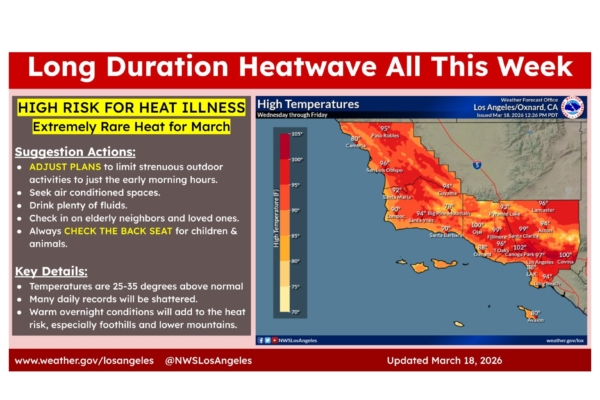
This week in Southern California, an uncommon extreme heatwave resembling midsummer weather has struck. Los Angeles has experienced consecutive days with temperatures soaring above 90 degrees Fahrenheit (32.2 degrees Celsius), while areas in the San Diego desert and some valley regions briefly surpassed 100 degrees Fahrenheit (37.8 degrees Celsius) starting from Wednesday.
The regions under high-temperature warnings issued by the National Weather Service (NWS) also include the Central Coast and the San Francisco Bay Area. Additionally, unusually high temperatures have been observed in southern Nevada, most parts of Arizona, and some areas in New Mexico. The Denver area in Colorado may also face hot weather later this week.
According to the NWS, on Wednesday, multiple locations in Los Angeles County and parts of Ventura County reached triple digits in Fahrenheit. The previous day, downtown Los Angeles recorded a high of 98 degrees, breaking a record dating back to 1914. Temperature records since 1978 were rewritten at LAX, Burbank, Long Beach airports, and other sites like Los Angeles International Airport.
Southern California, Nevada, and Arizona have all experienced temperatures 20 to 30 degrees above normal during this heatwave. Meteorologists at NWS Oxnard elaborated that offshore winds have pushed the high temperatures from inland mountainous and desert areas towards the coast, causing coastal regions of California to heat up by 10 to 20 degrees, and even up to 25 degrees. Cities like San Francisco, Los Angeles, Palm Springs, and Sacramento could potentially set monthly high temperature records this week.
Phoenix is forecasted to reach 106 degrees Fahrenheit (41 degrees Celsius) on Friday and Saturday, significantly surpassing the historical March high of 100 degrees. The capital of Colorado, Denver, might reach 90 degrees, breaking their monthly high temperature record. Additionally, elevated temperatures have been observed in Las Vegas, Salt Lake City, and the largest city in New Mexico, Albuquerque.
According to data from the National Oceanic and Atmospheric Administration (NOAA), since December of last year, 420 counties in the western United States, including Texas, Arizona, New Mexico, Utah, Wyoming, and the southern parts of California, have experienced the warmest winter on record.
This week’s unprecedented heatwave in the region is attributed to the “heat dome” effect over the western U.S.
Meteorologist and journalist Bob Henson told the San Francisco Chronicle that there is a warm current conveyor belt in the North Pacific that has led to the formation of high-altitude high-pressure systems in the western U.S. At the same time, abnormally intensified polar jet streams across the Northern Hemisphere have resulted in an abnormally strong and stagnant heat dome over the western U.S.
Moreover, the extreme temperatures in most parts of the southwestern U.S. and the Rocky Mountains over the past two years have accelerated soil moisture evaporation. In some areas of California, the Southwest deserts, and mountain regions, only a small portion of the soil moisture is at normal levels. The dry land almost entirely converts the solar radiation into heat, rapidly warming the air near the surface and enhancing the high-pressure ridge aloft. This cycle of soil and atmosphere impacts each other.
The heatwave in Los Angeles is expected to persist until Friday. Anyone is at risk of heatstroke, with children, the elderly, residents without air conditioning, and outdoor enthusiasts at higher risk.
To prevent heat-related illnesses, the NWS Los Angeles/Oxnard office urgently advises limiting strenuous activities to early mornings or evenings, wearing light and loose clothing, staying in air-conditioned spaces, avoiding direct sunlight, staying hydrated, and checking on elderly neighbors and family members.
The heatwave can rapidly increase the temperature inside vehicles, caution should be exercised to ensure the well-being of children and pets left in parked cars to avoid the risk of heat-related fatalities. Nighttime temperatures are also anticipated to be elevated, posing health risks.
The NWS anticipates the high temperatures to persist throughout the week, with the high-pressure ridge expected to weaken next week, alleviating the scorching weather.