
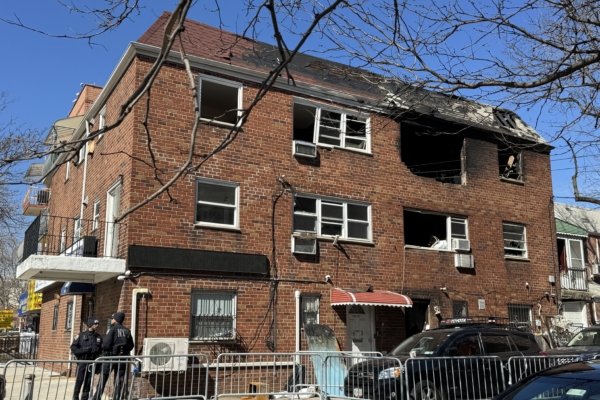
On March 18, the fourth-level fatal fire at the Flushing University Point D Boulevard residences entered its third day, with the cause of the fire still under investigation. When the building was inspected by the New York City Buildings Department in January of this year, it was found that the corridors on floors 1-3 were filled with extension cords. A hearing on “dangerous extension cords” was scheduled for March 17, but a deadly fire broke out the day before.
It’s worth noting that just four days before the fire (March 12), the court had ruled in favor of the landlord in an eviction case involving tenants of the building. The landlord was granted a victory and issued an eviction order for the tenants, with the enforcement of the eviction postponed until October of this year. However, just four days after the ruling, the fatal fire occurred. There were suspicions on social media of malicious retaliation. It was learned on Wednesday that the Fire Department and the police are also investigating whether the fire was deliberately set.
The Fire Department had stated that two electric scooters were found in the burning house, but it was uncertain whether they were related to the cause of the fire. On the 18th, a neighbor who goes by the last name Liang informed reporters that, with the consent of the police standing guard outside the burning house, they relocated the two electric scooters from a neighboring townhouse back to the vicinity of the burning house. The scooters were not burned, but their batteries were removed by the Fire Department for investigation.
Neighbor Liang described the burning house as having “a notorious reputation.”
According to government records, the building has long-standing serious and systemic safety and management issues that for some reason sparked the tragic fire that has resulted in the highest number of deaths in Flushing in many years. The property was originally a two-family residence, but since 2012, it has been repeatedly reported for illegal alterations. The basement was divided into multiple rooms, with the entire building reportedly housing up to 60 people in high-density, sublet conditions.
By 2020, the Buildings Department confirmed that it had been illegally converted into a structure resembling single-room occupancy units (SROs), with numerous lockable rooms equipped with individual appliances and cooking facilities, significantly exceeding its original design purpose. At the same time, there were long-standing issues within the building, such as insufficient or blocked emergency exits, locks improperly installed, which directly compromised the ability to escape during a fire.
Concerning electrical and structural safety, residents had complained about hidden electrical boxes behind refrigerators and abnormal wiring. During an inspection prior to the fire, temporary extension cords were found throughout the corridors on floors 1 to 3, creating a clear fire hazard.
Furthermore, in early 2026, the building had already been identified as a “vacant, open, unattended” dangerous structure, with the main door damaged and unable to be locked, allowing unrestricted access, and basic security measures lacking. Additionally, the back of the first floor and the basement had long been converted into illegal gambling spaces, altering the property’s use and further escalating personnel movement and safety risks.
From enforcement records, it can be seen that the issues with the property had not been rectified for an extended period, accumulating over 20 serious violations, numerous fines, and multiple public complaints.
Despite the Buildings Department imposing fines exceeding $300,000 on the owner in 2021 for illegal alterations and issuing partial vacate orders, the owner failed to make effective improvements, even refusing to cooperate with inspections, leading to ongoing violations and deterioration. Until the eve of the fire, the relevant issues regarding dangerous extension cords were pending a hearing.
In a state of long-standing illegal alterations, overcrowded living conditions, serious fire hazards, chaotic electrical systems, and mismanagement, multiple risks compounded, ultimately resulting in the tragic loss of four Chinese lives (including a 3-year-old child).