
Since the mid-1980s, the United States has been tracking the assistance and sales of missile technology provided by the Chinese Communist Party (CCP) to Iran. The brazenness with which the CCP regime and its diplomats continue to feign ignorance of their involvement in Iran’s ballistic missile and drone terror attacks during the ongoing Iran War is staggering.
On March 9, the CCP’s Middle East envoy Zhai Jun met with Gulf Cooperation Council (GCC) Secretary-General Jasem Al-Budaiwi in Riyadh, the capital of Saudi Arabia. According to a report by the Arab News, Budaiwi “expressed appreciation for China’s condemnation of Iran’s attacks on GCC member states.”
This marks the first time CCP officials have condemned a party other than the United States or Israel during the conflict. During a routine press conference on March 11, Chinese Foreign Ministry spokesperson Guo Jiakun stated, “China does not agree with attacks on Gulf countries and condemns all indiscriminate attacks on civilians and non-military targets.”
After decades of supporting the menacing Mullah regime in Tehran, the CCP regime seems willing to criticize Iran’s “indiscriminate attacks” against its neighbors – a small crack in its complicity that has allowed Iran to inflict heavy suffering on its own people and neighboring countries, especially Israel.
Since the mid-1980s, the United States has been monitoring the missile technology assistance and sales provided by the CCP to Iran.
In a speech on September 17, 1986, the late Senator Frank Murkowski warned that China was in serious negotiations with Iran to sell ballistic missiles and related technology. Authors Edward Timperlake and William C. Triplett II cited this warning in their book “Red Dragon Rising: Communist China’s Military Threat to America” (1999).
This marked the beginning of a long-standing missile and missile technology cooperation between China and Iran, including the sale of the M-7 short-range ballistic missile (improved version based on the “Hongqi-2” surface-to-air missile), providing Chinese missile engineers, extensive training for Iranian missile engineers, and exporting missile manufacturing materials such as rocket materials, CNC machine tools, gyroscopes, guidance systems, liquid and solid rocket fuels, etc.
Recently, the CCP faced sanctions from the United States for selling solid rocket engine fuel components to Iran. According to an April 29, 2025, press release, the US Department of Treasury sanctioned six entities and six individuals from China and Iran for their involvement in a network that facilitated the procurement of ballistic missile propulsion components for the Islamic Revolutionary Guard Corps (IRGC) of Iran.
On March 7, 2026, The Washington Post reported that two Iranian container ships had departed from the Gaoqian Port in Zhuhai, China (a major chemical export center), carrying potentially crucial precursors for rocket fuel.
Iran’s arsenal of inexpensive long-range cruise attack drones poses a significant threat to Gulf countries, heavily relying on Chinese-made electronic and engine components.
On March 2, 2026, tech commentator “tphuang” on social media platform X reassured readers about China’s continuous supply of drone components, stating, “Among the many factories producing low-speed drone engines in China, one is booked out until November. This factory (attached image) produces 30,000 engines per day… and is just one of many suppliers. These engines may not be high-end but are sufficient for single-flight needs, extremely low-cost, and relatively easy to manufacture.”
On May 5, 2024, Express reported that British Ministry of Defense scientists discovered an Iranian “Arash-2” suicide attack drone containing a “Chinese guidance system” in the Negev Desert of Israel.
The “Arash-2” suicide drone has a range of 800-1,200 miles and is one of Iran’s many long-range attack drones, including the more well-known “Shahed-136” drone. Most of the 2,300 Iranian drones used in the recent conflict likely incorporated Chinese guidance and engine components.
The long-standing assistance by the CCP to Iran’s missile capabilities enabled Iran to launch the recent missile terror attacks, responding to the “Operation Epic Fury” by the US on February 28, 2026, and Israel’s “Operation Rising Lion.”
After Iran refused to end its nuclear weapons program in the fifth round of Iran-US negotiations, Israel and the US took military action. It was determined in the negotiations that Iran had moved its nuclear weapons program to new underground facilities, with Iranian negotiators admitting they were close to producing ten nuclear weapons.
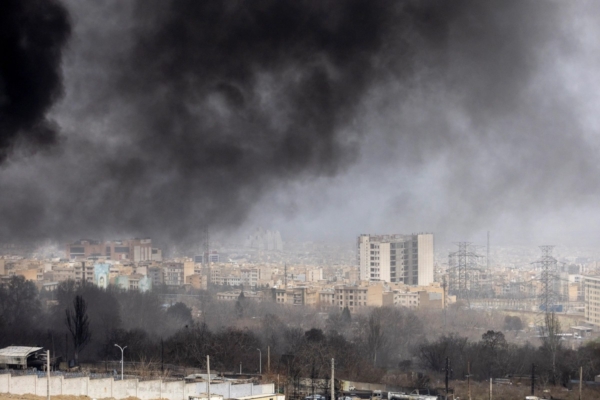
From February 28 to March 13, Iran launched 2,700 drones, 1,196 ballistic missiles, and 28 cruise missiles, totaling 3,924 attacks, causing casualties among personnel from various countries: 10 American deaths and 140 injuries, 12 Israeli deaths, 6 Emirati deaths and at least 130 injuries, 2 Saudi deaths and 12 injuries, and 2 deaths and 10 injuries in Oman.
Iran’s missile and drone attacks have targeted US military installations such as the US Navy’s Fifth Fleet headquarters in Bahrain, the US-operated THAAD radar in Jordan, a command center in Kuwait (resulting in four US Army Reserve deaths), and drone attacks on US embassies in Saudi Arabia and the UAE.
Iran’s missile and drone attacks have quickly escalated into a region-wide campaign of terror targeting civilians, attempting to strain the military partnerships between Gulf countries and the US.
Moreover, the CCP regime is likely assisting Iran in guiding and targeting its missile and drone attacks.
An analyst named “Shivan Mahendrarajah” commented on platform X on February 2, 2026, claiming, “Iran is using China’s advanced satellite network to access continuous, 24/7, all-weather day-and-night imagery, high-resolution videos, signals intelligence (SIGINT), and real-time electronic intelligence (ELINT) for targeting US Navy assets. The ‘Yaogan’ series of military electronic reconnaissance satellites provide precise global and regional geolocation based on electronic emission triangulation, while the ‘Jilin’ satellite constellation ensures continuous high-quality image acquisition. By integrating China’s space-based ISR (Intelligence, Surveillance, and Reconnaissance) capabilities with Iran’s missile systems, a real-time kill chain for ships passing through the Persian Gulf, Oman Gulf, and Arabian Sea has been established.”
While this claim cannot be publicly verified, the “Yaogan” and “Jilin” satellite series are known Chinese reconnaissance satellites that can be instrumental in precision targeting of ballistic missiles and drones.
Furthermore, to achieve accurate guidance, the missile and drone guidance systems purchased by Iran from China are likely capable of receiving navigation signals from the China Aerospace Science and Industry Corporation’s CM-302 missile, an export version of the 180-mile supersonic anti-ship missile derived from the CCP Navy’s active-duty 300-mile range “YJ-12B.”
Though currently remote, if the Iranian terror regime regroups and survives, the CCP may be tempted to start airlifting missiles and/or their components to help Iran prolong this conflict.
Therefore, when the CCP envoy visits, it would be apt to demand a comprehensive report from Beijing on all aid to Iran’s missile, cruise missile, and drone projects. Furthermore, out of caution, inquiries should be made about whether the CCP plans to provide more advanced missiles to arm Iran, and whether CCP surveillance and navigation satellites are guiding Iran’s missile attacks.
A more prudent approach would be not to wait for Beijing’s denial and vague responses; instead, present the envoy with a compensation list directly, demanding reparation for lives lost and damages incurred.
The above perspectives reflect the viewpoint of the author, Rick Fisher, a senior researcher at the Virginia-based International Assessment and Strategy Center (IASC).