
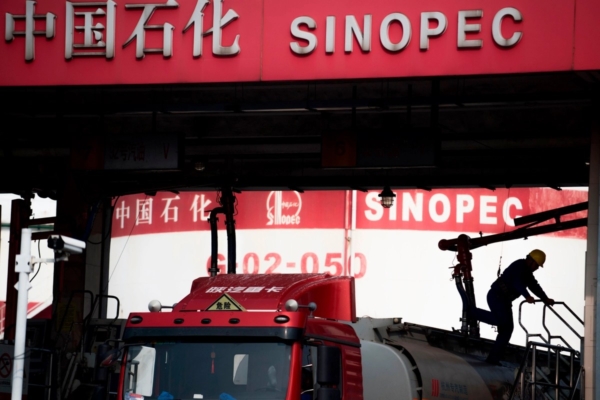
In recent times, the Iran war in the Middle East has disrupted international oil supplies due to sanctions, exposing deeper vulnerabilities within China’s economy. The attacks by the United States and Israel on Kharg Island, a key hub for Iran’s oil exports, have disrupted the oil supply that supports China’s low-cost manufacturing industry.
Iran’s regime largely relies on revenue from oil exports, with an estimated 80% to 90% of its oil exports to China. China is the world’s largest importer of crude oil, with an estimated daily import of around 11.6 million barrels in 2025. Analysts estimate that about 2.6 million barrels per day of the imported crude are discounted or sanctioned, including 1.38 million barrels per day from Iran and 389,000 barrels per day from Venezuela, accounting for approximately 17% of China’s total crude oil imports.
Beijing officially denies importing oil from Iran, but reports reveal discrepancies. The General Administration of Customs in China lists Russia, Saudi Arabia, Malaysia, Iraq, and Brazil as the top crude oil importers in 2025, excluding Iran from the official list. Columbia University’s Center on Global Energy Policy has exposed deceptive practices, showing that the volume of “Malaysian” crude oil imported by China greatly exceeds Malaysia’s actual production in 2024.
China’s economy, dominated by manufacturing and exports, heavily relies on cheap oil. Iranian oil has historically been priced $8-11 per barrel lower than Brent crude, benefiting Chinese independent refineries. However, replacing Iranian oil with market-priced oil would result in billions of dollars in additional costs for these refineries. Lower energy prices have reduced manufacturing costs in China, enhancing competitiveness for Chinese enterprises.
As China’s export sector faces increasing pressure, this price advantage becomes crucial. By 2025, net exports may contribute up to one-third of economic growth, the highest since the late 1990s, yet profit margins have significantly declined. The percentage of manufacturing companies operating at a loss is projected to double from 15% in 2018 to 30% by 2025.
Since October 2022, China’s Producer Price Index (PPI) has been in negative territory for 38 consecutive months, mostly between -2% and -3%. Despite slight industrial output growth, there has been limited improvement. In November 2025, industrial profits declined by 13.1% year-on-year, erasing much of the earlier profit gains in the year.
The economic impact of losing discounted crude oil primarily affects China’s independent refineries, concentrated in Shandong Province. These “teapot refineries” rely on affordably priced sanctioned oil, processing around 1.3 million barrels per day of Iranian oil. Unlike larger state-owned refineries, smaller refineries lack extensive strategic reserves and struggle to cope with sudden interruptions in raw material supply.
The case of disrupted Venezuelan oil supply serves as a warning. In 2025, China imported 389,000 barrels per day of Venezuelan oil. With stricter shipping regulations and crackdowns on shadow tankers by Washington, it is expected that crude oil shipments to China could decrease by up to 75% by early 2026. Similar restrictions on Iranian oil supply could lead to production cuts or shutdowns in refineries, causing domestic fuel supply shortages and price hikes for gasoline and diesel in China.
A study published on ScienceDirect quantified the impact of oil shortages on China’s GDP: a 25% shortage could lead to a 121.2% increase in domestic crude oil prices, a 67.8% increase in finished oil prices, and a 0.7% GDP decline, with losses accelerating with higher shortages. The American Action Forum in Washington estimates that conflicts in the Gulf region and US military interventions in Venezuela have effectively cut off nearly one-fifth of China’s oil supply.
China does have some crude oil reserves, with an estimated 1.2 billion barrels in onshore storage as of January 2026, equivalent to about 108 days of imports. Additionally, around 50 million barrels of Iranian oil are stored in or en route to China and Malaysia by early March 2026. These reserves buy time but do not address the fundamental structural issues.
Continued US pressure on Iran and Venezuela has disrupted discount mechanisms, increased transaction costs, narrowed price differentials, and intensified fluctuations in marginal oil prices. Market-priced alternative oil from Brazil, Canada, Iraq, or the Gulf region will shrink or eliminate the profit margins that have sustained the operation of teapot refineries.
For China, losing these discounted oil sources is a significant blow, coinciding with a slowdown in economic growth, declining manufacturing profit margins, and ongoing trade tensions with the United States.