
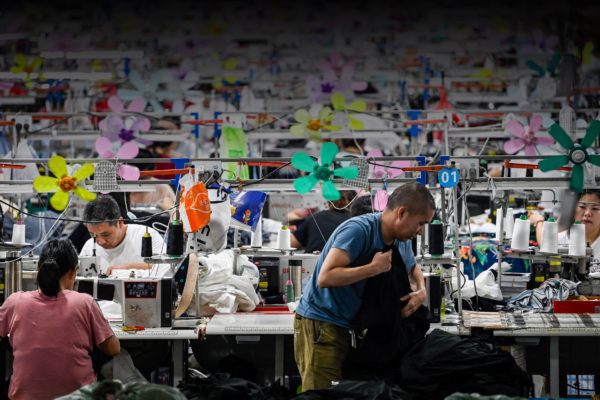
The European Union has announced that it will cancel the tariff exemption for small parcels (valued at less than 150 euros) starting from July 1, imposing a fixed tariff of 3 euros (approximately 3.5 US dollars) on e-commerce small parcels entering the EU. However, some officials have expressed concerns that this policy may not be strong enough to prevent the influx of cheap goods from China.
According to statistics from the European Commission, 90% of the 58 billion low-value parcels received by the EU in 2025 originated from China. Proportionally, the number of low-value parcels from China has more than quadrupled in the past three years. In 2022, the EU received approximately 14 billion low-value parcels; by 2024, it had increased to 46 billion; and in 2025, it reached 58 billion, which is 4.1 times the number in 2022.
Christian Vanderwaeren, the top official of Belgian customs, recently warned that the EU’s plan to cancel the “de minimis” rule (goods valued at less than 150 euros exempt from tariffs) may have minimal effects on reducing the influx of low-value parcels entering the EU.
He stated that while the rule change may “simplify” procedures, he believes it will not have a significant impact on the influx of goods into Europe because the price increase will not be substantial enough, ultimately leading to consumers paying more. Vanderwaeren recently elaborated on his views to the Financial Times.
The United States has already eliminated tax exemptions for small parcels from China, prompting many Chinese e-commerce businesses to shift their focus to Europe. Liège Airport in Belgium, which specializes in handling e-commerce goods, receives a majority of its shipments from China. In January 2026, Belgian customs processed a daily average of 4.7 million declarations, equivalent to 41 declarations per second, surpassing the average level in 2025.
In 2025, Belgian customs processed 1.3 billion e-commerce declarations (accounting for about 22% of the total volume of low-value parcels in the EU), averaging around 3.6 million declarations per day. The daily average of declarations in January 2026 was approximately 3% higher than the daily average in 2025.
Due to the large volume of declarations, Belgian customs can only physically inspect 0.006% of declarations per day, about 216 items – equivalent to 1 in every 20,000 parcels. The actual inspection results were shocking, with 30% of B2C goods found to have irregularities. B2C refers to goods sold directly from businesses to consumers. For example, when you purchase items from websites like Taobao or Shein, where Chinese sellers ship directly to your home, it is considered a B2C small parcel.
Irregularities include unsafe or counterfeit products, as well as discrepancies between import declarations and the actual contents of the parcels. Another common issue is falsely labeling the country of origin or underreporting the economic value on parcels to evade tariffs.
In 2025, Belgian customs discovered 25,840 counterfeit items, a 64% increase compared to the same period the previous year. In addition to identifying 1,963 products with safety violations, they also uncovered 1,919 cases of undervaluation, resulting in the recovery of 3.3 million euros in tariffs, taxes, and fines.