
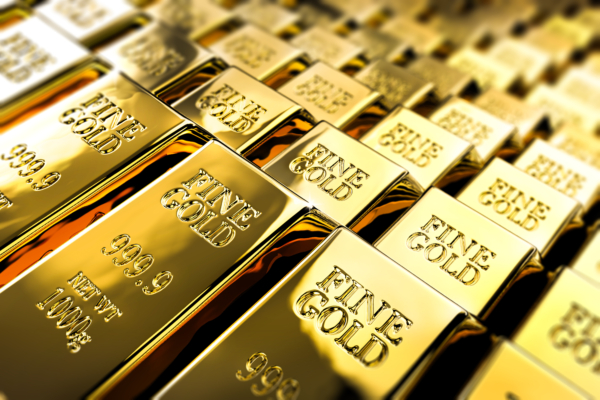
On March 17th, Eastern Time, the international gold price fluctuated around $5000 per ounce throughout the day. As of now, spot gold and COMEX gold futures have fallen but are still trading near $5000 per ounce. On March 18th, the domestic gold consumption market in China continued to fluctuate, with the topic of “some brand jewelry prices falling for 6 consecutive days” trending online.
With the international gold price declining, domestic brand jewelry prices in China have been falling for several days in a row. Several financial reports point out that the pressure on gold prices in recent days is related to factors such as expectations of higher interest rates, a stronger dollar, and other factors.
Public information indicates that as of March 18th, Zhou Shengsheng’s 24k gold jewelry was priced at 1547 yuan/gram, a decrease of 3 yuan/gram from the previous day; Laomiao’s 24k gold jewelry has fallen for 6 consecutive trading days, currently priced at 1550 yuan/gram, a decrease of 2 yuan/gram from the previous day.
“Red Star News” reported that domestic spot gold and jewelry prices have simultaneously declined. Jewelry prices have dropped from a recent high of 1600 yuan/gram to around 1550 yuan/gram, with Zhou Dafu’s price at 1557 yuan/gram and Laofengxiang’s price at 1542 yuan/gram. Prices of major brand jewelry have generally fallen to the range of 1540 yuan to 1560 yuan per gram.
Despite the decline in jewelry prices, as major brands maintain stable labor fees (ranging from 80 to 150 yuan per gram), the overall cost of purchasing gold for consumers has decreased slightly less than the drop in spot gold prices.
Song Xiangqing, Vice Chairman of China Business and Economics Association and founder of Ward Bond, analyzed that the recent drop in gold prices is mainly due to a significant decrease in expectations for Federal Reserve rate cuts, a stronger dollar, and solid US bond yields, along with profit-taking at high levels and temporary easing of Middle East risk aversion, which has significantly pressured non-interest-bearing assets like gold.
Unprecedentedly strong labor market data in the US in early 2026 caused market expectations for a Federal Reserve rate cut in the first half of the year to plummet from around 80% to 45%. This shift in expectations directly boosted the 10-year US bond yield to over 4.5%, imposing significant holding cost pressure on non-interest-bearing assets (gold).
Analysts say that the core factor behind this round of decline is the upcoming Federal Open Market Committee (FOMC) meeting. The FOMC meeting on March 19th will be the focus of this week. Given the significant previous rise in gold prices, with substantial short-term profit-taking accumulation, some funds are choosing to stay on the sidelines ahead of the crucial meeting, leading to increased selling pressure.
On mainland Chinese social media, many netizens are actively discussing the recent decline in gold prices.
Weibo user “Crystal Expert”: Domestic gold shops collectively lowered prices, with many brands directly reducing prices by more than 20 yuan per gram, a significant decline from a few days ago. Big names like Zhou Dafu and Zhou Dasheng are all adjusting downwards.
Weibo user “Memories of Yesterday”: It seems that gold is not stable recently, which presents an opportunity for those in need of buying jewelry. However, for some investors, it may not be so friendly, considering the instability of gold prices. It’s important for everyone to make rational investments in gold jewelry since it’s often difficult to predict price movements.
“Momos Army”: Gold has tripled in value since 2022. Long-term market enthusiasm for speculation on the substitution of the US dollar, panic in the US and Japanese bond markets, and concerns about the bursting of the A-bubble have all supported the rise in gold prices. However, dollar substitution is a long process, and in the short term, gold has shifted from an investment to speculation, resulting in a flood of speculative funds. US bonds pose a problem, but that doesn’t guarantee a collapse; at least it hasn’t happened in history.
In the medium term, gold is currently at a reasonably high price level, but the probability of a gold bubble forming is high. The so-called bubble will also see overshooting, with the long-term influence of three anxiety factors still in play. Attention needs to be paid to the situation in the Middle East; if inflation expectations intensify, gold will face certain pressure.
In early March 2026, as regional ceasefire negotiations made partial progress, the “war premium” supporting gold prices surged towards $5400 quickly diminished. Technical analysis reveals that once gold broke below the key support level of $5200, it triggered a large number of stop-loss orders from quantitative trading.
On March 2nd, London spot gold prices briefly peaked at a new high of $5419.32 per ounce, then significantly retreated and fluctuated downwards. Up to now, the accumulated drop in the first half of March is close to 8%.
Regarding future gold price performance, Cao Shanshan, a senior researcher at the COFCO Futures Research Institute, believes that unexpected tighter-than-expected global monetary policy is dampening the bull market cycle for gold, weakening conflict hedging premiums, and disrupting the original rhythm; incremental hedging on the oil supply side is reducing the linked effect on oil prices, causing insufficient momentum and a weak rhythm in gold price pulses.