
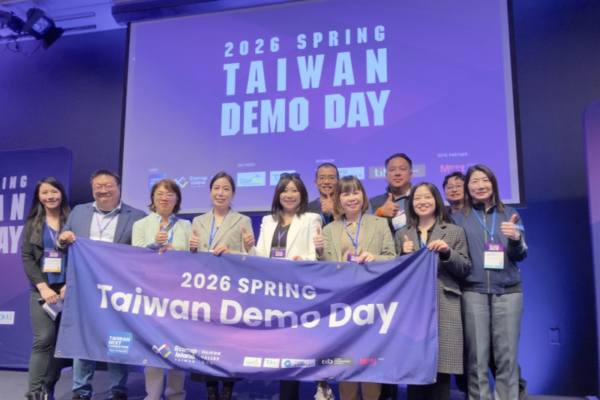
On March 14 (last Saturday) afternoon, the “Taiwan Demo Day” 2026 Spring Edition was held at the Computer History Museum in Mountain View City. The event brought together 12 Taiwan-US AI and technology start-up teams, investors, and industry representatives, with a total attendance of over 1,000 people.
The event was jointly organized by Taiwan Next Foundation and Startup Island Taiwan Silicon Valley Hub, aiming to showcase Taiwan’s start-up strength on the eve of the NVIDIA GTC conference, and to deepen the exchange and cooperation between Taiwan and US technology and capital markets.
Katie Hsieh, founder and CEO of Taiwan Next Foundation, stated during the opening speech that Taiwan Demo Day aims to bridge the entrepreneurial ecosystems of Taiwan and Silicon Valley, promote talent, funding, and corporate resource exchanges, and garner more international attention for Taiwanese start-ups. The foundation has long been building a bridge for Taiwan-US innovation, connecting global entrepreneurs and investors through entrepreneurial activities and community platforms.
According to Hsieh, the Silicon Valley hub gathers top global technology capital and entrepreneurial resources. If Taiwanese start-ups can establish connections here, it will be crucial for expanding into international markets.
Su Yu-li, Vice Director of Startup Island Taiwan Silicon Valley Hub, mentioned in his speech that the hub is dedicated to assisting Taiwanese start-ups in establishing a presence in the United States, covering fundraising, business cooperation, and market expansion. Through the Demo Day platform, Taiwanese teams can directly connect with Silicon Valley investors and industry resources.
Currently, the Silicon Valley Hub has more than 50 Taiwanese start-up members, and about 70% of them have already established a foothold in the United States. Su pointed out that while Taiwan’s start-up technological prowess is strong, adjustments are needed in the business models to adapt to the US market, such as transitioning from the common project-based fee structure in Asia to subscription-based or usage-based models. The Silicon Valley Hub is committed to helping its members quickly adapt to the “American model”.
During the event, statements were given by Liu Yan-rong, Chairman of StarFab, and Karen Yu, Chief Innovation Officer of Industrial Technology Research Institute (ITRI), emphasizing that the global AI industry is at a crucial development stage. Taiwan’s advantages in semiconductors and technology supply chain are beneficial for AI start-ups to accelerate technology validation and market penetration. Both individuals believed that this event played a pivotal role.
Karen Yu pointed out that the main challenge facing Taiwanese start-ups currently is the “Scaling Gap,” which pertains to transitioning from technology development to the global market. She mentioned that ITRI is working with accelerators and international innovation networks to assist AI start-ups in expanding into overseas markets and increasing international visibility.
One of the highlights of the event was the TAI1 AI Accelerator promoted by co-organizer StarFab. Launched in May 2025, this project combines NVIDIA Inception’s start-up resources with Taiwan’s industrial chain advantages to accelerate the development of AI start-ups in areas such as manufacturing, healthcare, and robotics with industry partners.
During the demo presentation segment, the 12 teams presented their projects covering Agentic AI, Physical AI, smart manufacturing, medical technology, and logistics management, including automated dining company Yo-Kai Express, AI robot software company Red Bot Intelligence, smart glasses developer CancerFree Biotech, AI fitness technology company Clarq AI, and logistics platform 3drens.
For example, Andy Lin, the head of Yo-Kai Express, demonstrated the automated dining equipment that combines AI and robot technology. The company uses NVIDIA technology to develop intelligent culinary robots capable of automatically making ramen, which are currently deployed in various venues in the United States, Japan, and Taiwan.
The event concluded with a networking session between start-up teams and investors, facilitating connections between new businesses and venture capital funds, and corporate partners.
The organizers indicated that they will continue to deepen Taiwan-US entrepreneurial cooperation through events like Demo Day, providing more international opportunities for Taiwanese start-ups in the future. ◇