
The results of the Nepalese general election have been announced, with the reformist political party – the National Independent Party (RSP) – winning a landslide victory. This comes at a time when the relationship between Kathmandu and Beijing has become delicate. Recently, a university in Nepal set fire to materials containing speeches by Xi Jinping, causing an uproar at the Chinese Embassy.
On the evening of March 14th (last Saturday), the Manoharhan Technical College in the Morang district of Nepal burned old books and waste materials, including hundreds of copies of “Xi Jinping: The Governance of China”, while cleaning the library and storage rooms to make space.
Videos related to the incident have been circulating on social media. One video shows a book by Chinese leader Xi Jinping being burned along with other books, with someone holding up Xi Jinping’s work towards the camera, mentioning “China.”
“Xi Jinping: The Governance of China” contains Xi’s speeches from recent years, which have been not only distributed domestically in China but also translated into multiple languages and distributed in dozens of countries and regions worldwide as part of China’s external propaganda.
According to a report by the “Kathmandu Post” on March 17th, after the video of burning the Chinese leader’s works went viral, the Chief Administrative Officer of Morang District, Yuvaraj Kattel, called related media outlets requesting the removal of the video, stating that it could harm Nepal-China relations. The official confirmed that the Chinese Embassy in Kathmandu had issued a diplomatic note to the Ministry of Foreign Affairs on Sunday, asking the Nepalese government to investigate and deal with those involved. Informed sources revealed that the local government in Morang district and the police in Province 1 are investigating the case.
It is still unclear why the technical college had so many copies of Xi’s books. The college has ties to the Nepal Communist Party (Unified Marxist), and it is named after the late Nepalese communist party leader and former Prime Minister Man Mohan Adhikari.
Citing the initial reporting by Live News Raftar, editor of the publication stated that while many of Xi’s books were destroyed by fire, many other books still remain stored at the university. An insider mentioned that the college is planning to destroy some sensitive or corruption-related documents. Dr. Rekha Shrestha, the college’s Director, responded that these books had been lying idle for years and were burned due to being infested with insects.
However, most of the burned or partially burned books were almost new. The college authorities explained that burning the books was to free up space in the laboratories.
Following the circulation of related videos online, some netizens commented, “It’s worth watching the subsequent reactions: embassy involvement, demands for investigations, requests for video deletion. When a book can trigger such reactions, the problem may have existed beyond just the book.” Others expressed doubts about the democratic content of Nepal’s new regime and made remarks about the embassy handling the situation themselves.
The timing of the book-burning incident is sensitive as it coincides with the recent results of the Nepalese general election. The reformist party – the National Independent Party (RSP) – clinched a resounding victory. The leader of this emerging party, Balendra Shah, is likely to become the youngest Prime Minister in Nepal’s history. Meanwhile, the Nepal Communist Party (Unified Marxist) led by former Prime Minister Oli suffered a major defeat.
Several recent incidents have affected Nepal-China relations, such as corruption cases associated with the Biratnagar International Airport project involving Chinese state-owned enterprises and Nepal’s decision early this year to cancel the telecom tariff bidding and the 5G contract involving the Chinese company Huawei.
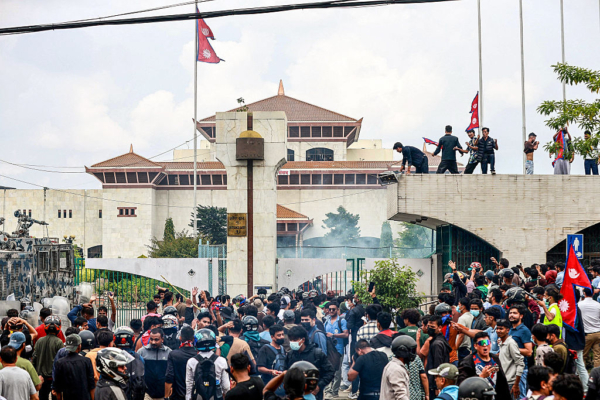
Last year, during the anti-corruption protests led by Generation Z in Nepal, dozens of people lost their lives due to the authorities’ crackdown. This nationwide uprising forced the pro-China former Prime Minister Oli to resign.
During the protests, demonstrators publicly burned photos of Chinese leader Xi Jinping. Protesters stated, “It’s absurd to have the picture of the Chinese President hanging in the offices of the party that is bleeding the Nepali people dry.” They emphasized that placing hope in such leaders to improve the country is as ridiculous as doing something fundamentally impossible. Subsequently, they threw Xi Jinping’s photo into the fire.