
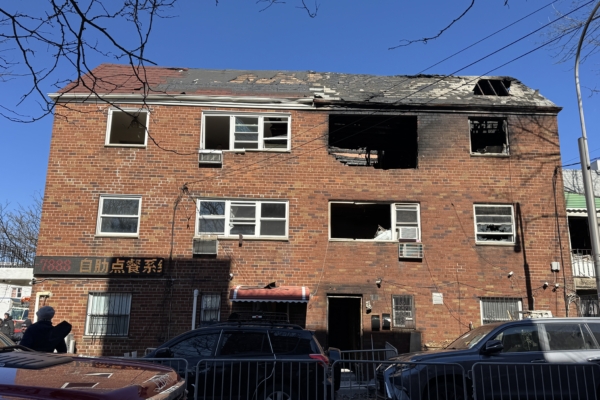
A devastating four-alarm fire broke out on March 16th in a three-story residential building at the intersection of Point Avenue and Avery Avenue in Flushing, Queens, claiming the lives of 4 individuals and injuring 12 others. The tragedy shed light on a series of violations that had accumulated over the years within the building – ranging from illegal alterations and overcrowded subletting to the conversion of the back of the first floor into a gambling den and blocked emergency exits. These issues had long posed risks that ultimately led to the deadly fire.
According to records from the Department of Finance and the Department of Buildings, the property owner, surnamed Yee, a Chinese individual, had purchased the property in July 2016 and had amassed over 20 serious violations since then. However, the issues with the property did not begin in 2016. As early as 2012, there were complaints about illegal alterations, with reports in May 2012 indicating that the basement had been divided into at least eight rooms. In August of the same year, it was reported that the entire building had been illegally altered, accommodating at least 60 tenants.
In June 2020, the city’s 311 hotline received complaints that the building had been converted into multiple single-room occupancies (SROs) and rented out to tenants on the second, third floors, and basement. On August 4th, after an inspection, the Department of Buildings confirmed that the legal structure was designated as a two-family residence but had been altered to house seven families. The property had added 5 single rooms, 9 bedrooms, equipped with locks, beds, TVs, refrigerators, cooking facilities, resembling independent suites.
Inspectors classified these violations as severe, significantly increasing the risk of fires and impediments to evacuation. On that day, multiple violation notices were issued, and partial evacuation orders were issued, requiring tenants on the second and third floors to vacate.
On July 20, 2023, the New York City Police Department requested an inspection from the Department of Buildings due to suspicions of illegal occupancy and unsafe emergency exits. The inspection revealed that the back of the first floor had been converted into a gambling establishment, a stark contrast to what was listed as a “doctor’s office + storage space” on the permits. The emergency exits on-site were found blocked, locked, or improperly installed. The Department of Buildings prioritized the case and issued ECB violation tickets on the same day.
The Department of Buildings arranged for a reinspection of the aforementioned serious violations on December 17, 2025, with the case being handled by a special task force. However, when inspectors arrived on January 2, 2026, they were unable to enter, and the owner had not submitted any “corrective proof” for the previous violations. As a result, the Department of Buildings issued additional ECB violation tickets on January 5, 2026.
On January 7, 2026, the Department of Buildings received another complaint, stating that the building was now in a state of “vacant, open, and unattended.” Inspectors were dispatched to the site and found that the locks on the building were broken, unable to be secured, the door frames were loose, and the doors could not close properly, leaving the entire building accessible to anyone. The following day, the Department of Buildings issued an A6 violation for the “vacant, open, unattended structure,” confirming that the building had become a property lacking basic safety protections.
Additionally, according to records from the Queens Civil Court, the city had filed a lawsuit in April 2023 to recover the accumulated unpaid fines from the property owner.
The lawsuit indicated that the Department of Buildings had issued 5 violation notices around August 4, 2020, demanding the owner’s attendance at an OATH hearing on February 9, 2021. After the hearing, OATH ruled that the owner had violated the regulations, imposing a fine of $60,000 for each violation. However, the owner had failed to pay any fines, and with the administrative appeal deadline expired, the city applied to the court for enforcement under the “New York City Charter,” seeking a total of $300,000 in fines.