
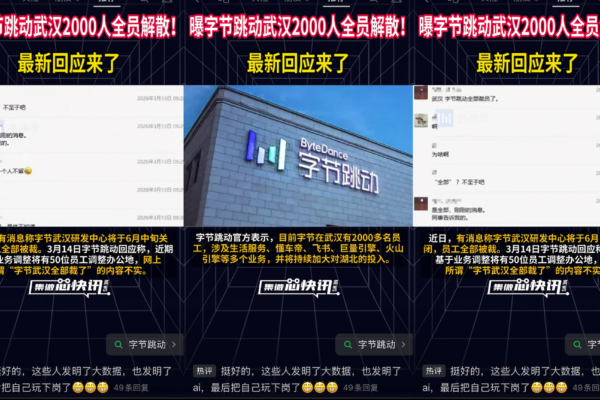
Recent reports have emerged claiming that the Wuhan Research Center under the Chinese internet giant ByteDance is undergoing a “complete dissolution.” Despite the company quickly denying these rumors, the event is still seen as another signal of the Chinese Communist Party’s tightening grip on the private economy. With political control strengthened and the economy facing a downturn, the operating environment for Chinese tech companies is undergoing profound changes.
In recent days, several screenshots of social media chats have been circulating on the Chinese internet, alleging that around 2,000 employees at ByteDance’s Wuhan Research Center will be collectively dismissed in mid-June. This news quickly spread within the tech industry, drawing attention.
ByteDance responded on March 14, stating that the “rumors are false” and mentioning that only about 50 employees had their office locations changed due to business adjustments. However, the market remains skeptical of this claim. A WeChat user named “Leaf Drifting” commented, saying: “My colleague’s wife works at ByteDance, and their entire department was cut at the end of last year.” There are also rumors that the company provides certain compensations to laid-off employees.
A programmer from a company in Beijing, Xiao Liu, told reporters that in the current environment, there is often a gap between the public responses of companies and internal adjustments. The industry generally has become cautious about future prospects: “I have been unemployed for half a year now. I have sent out hundreds of resumes without any responses. I can’t find a job now.”
Xiao Liu also mentioned that one of his friends was laid off by ByteDance last summer: “One of my classmates was laid off by ByteDance. My friend said his department laid off over twenty people.”
ByteDance, founded by Zhang Yiming in 2012, rapidly expanded relying on platforms like Toutiao, Douyin, and TikTok. From 2016 to 2021, the company consistently grew in terms of user base and commercialization, with its valuation surpassing $300 billion at one point.
An academic from Guangdong, who goes by the pseudonym Zeng Ming, told reporters that ByteDance initially relied on technology and market growth. He said, “The company originally grew based on algorithms and user development, not on leveraging power resources. When the CCP began to pay attention and intervene, the business environment of the company changed.” Analysis suggests that this change signifies a shift for businesses from being market-oriented toward needing to adapt to power boundaries in operations.
Multiple interviewees pointed out that since 2022, the Chinese authorities have implemented stricter regulation on platform economies, while companies face continuous pressure on tax and capital fronts.
A scholar from Jiangsu who goes by the pseudonym Zhu Mu told reporters, “Job cuts are just the surface phenomenon. The tax authority frequently audits, demands additional taxes, and requires profit sharing, all of which increase the burden on companies. Some companies are finding it hard to maintain their original scale.” He believes that this change has surpassed general regulatory boundaries. He said, “This is more like a form of resource redistribution through administrative means, requiring companies to continuously adapt to new requirements.”
Financial commentators have pointed out that amid rising fiscal pressure, similar practices are gradually emerging across various industries under the CCP’s authority.
Chinese internet writer Bao Li stated that internet platforms, holding a large amount of user data, are always under significant regulatory scrutiny. She told reporters that within the current system, companies not only need to operate but also bear additional policy requirements. “Previously, companies focused on growth; now it’s more about how to sustain operations. With increased uncertainty, companies find it hard to make long-term plans.”
Many professionals in the industry reflect that downsizing, recruitment freezes, and business adjustments are widespread. Analysis suggests that this reflects declining business expectations, impacting market confidence.
The space for the development of private enterprises is shrinking. From companies like Alibaba and Tencent to the recent personnel adjustment news from ByteDance, the development trajectory of the Chinese internet industry is undergoing changes. The growth model that previously relied on market and technology-driven methods is gradually being replaced by a system focused on policies and control.
Some insiders in the tech industry have stated that the waves at ByteDance’s Wuhan Research Center reflect not just individual company adjustments but a broader shift in the operating environment of the private economy. With the CCP dominating resource allocation and strengthening control, business boundaries are increasingly determined by power rather than the market.
Analyses indicate that the CCP’s ongoing escalation of control over private capital is reshaping the operating logic of the Chinese tech industry. When companies prioritize “survival” over “innovation,” industry vitality has significantly diminished, leading many tech companies to contract their operations to adapt to the constantly changing policy environment.