
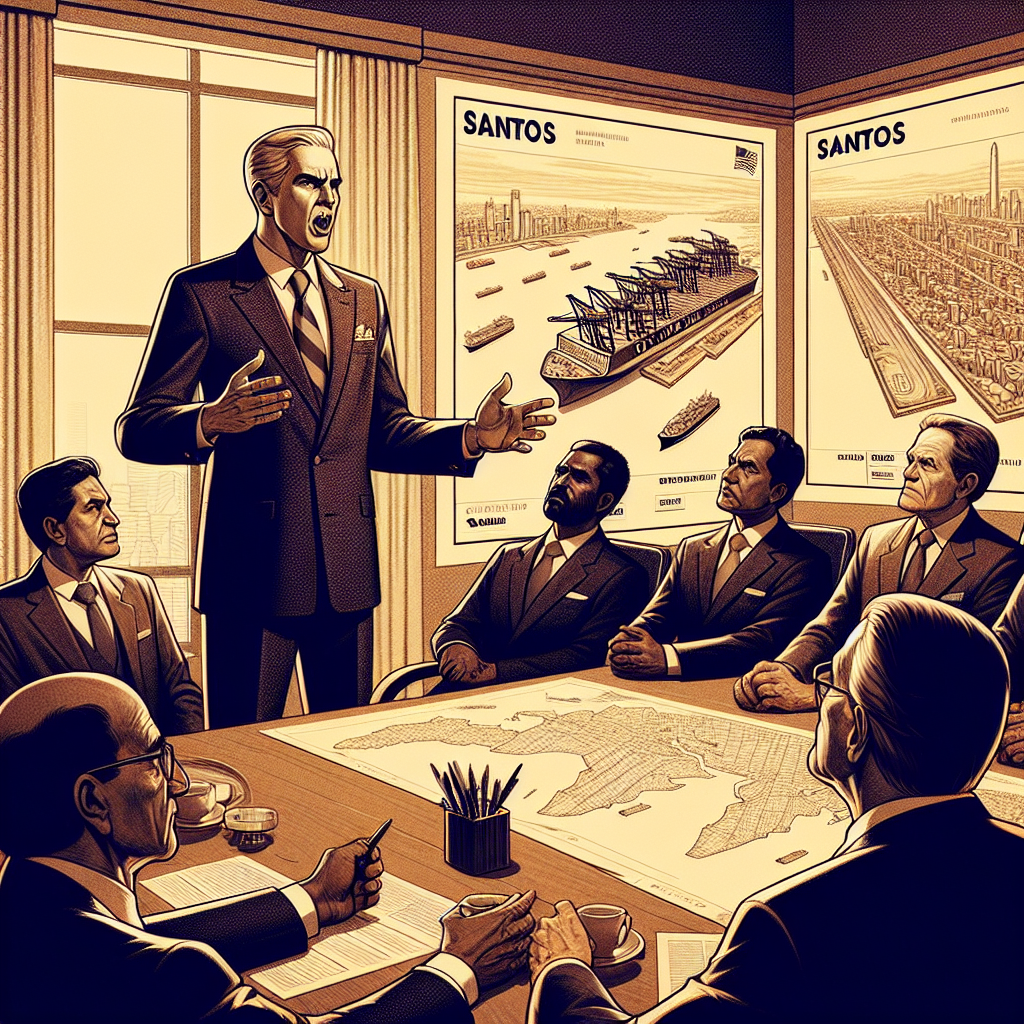
The United States’ top diplomat publicly opposes Chinese-owned companies acquiring the operational rights of Santos, Brazil’s largest port.
US Consul General in São Paulo, Kevin Murakami, told senior executives in the Brazilian port industry that he does not want Chinese companies to win the 25-year concession to operate the container terminal at Santos Port, citing its strategic importance.
According to local media Folha de S.Paulo, three business executives stated that Murakami spoke at an event hosted by Santos Port media group Grupo A Tribuna on March 5, saying that Brazilian ports should not “fall into unwelcome (entities’) hands.”
Murakami informed attendees that the terminal holds strategic significance for the United States, especially in combating organized crime.
Murakami’s remarks were widely interpreted as a warning against Chinese-owned businesses. Reportedly, no American companies participated in the bidding for the port.
The US Embassy acknowledged concerns from Washington regarding Beijing’s involvement in key port auctions in Brazil, considering it involves “sovereignty, security, competition, and strategic influence,” but denied any pressure or interference with Brazil.
This issue is seen as a new frontline in the competition for infrastructure and port control between the US and China in Latin America. The Trump administration previously expressed objections to Chinese investments in Peru’s Chancay Port and the Panama Canal.
The planned Tecon Santos 10 terminal is set to increase Brazil’s global container handling capacity by 3.25 million standard containers, propelling Brazil’s global container throughput ranking from 45th to 15th.
The project’s contract period is 25 years, with a minimum investment of 6.4 billion reais (approximately 1.1 billion US dollars) and a bidding guarantee of 500 million reais (about 95 million US dollars).
Chinese companies have shown a strong interest in this terminal project. The state-owned Chinese enterprise COSCO held a video conference with Brazilian officials in 2025 to express their bidding intention. Another Chinese company, China Merchants Port, sent a vice president to Brasília in early 2026 to discuss the matter.
Previously, the Brazilian Court of Audit and Port Authority had set a two-stage bidding rule to exclude existing terminal operators, leading to protests and lawsuits from companies like COSCO, alleging that it stifles competition and reduces Brazil’s fiscal revenue.
COSCO holds a minority stake in a fund related to the existing Santos terminal, with a share of less than 5%.
Other potential bidders interested in the port operating rights include Philippine port operator ICTSI, Singapore’s PSA International, Brazil’s JBS Terminais, and some Arab sovereign wealth funds.
Due to controversies and rule changes, the bidding activities for Santos Port will be postponed to the second half of 2026. The Brazilian government has indicated a possible reevaluation of rules limiting shipping companies.