
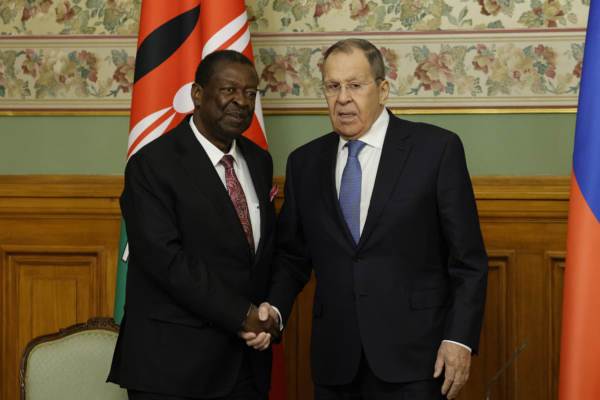
Kenya’s Foreign Minister Musalia Mudavadi announced on Monday (March 16) in Moscow after a meeting with Russian Foreign Minister Sergei Lavrov that an agreement has been reached between the two countries. The Russian military will cease recruiting Kenyan citizens to participate in military actions in Ukraine.
At a press conference attended by Mudavadi and Lavrov, it was explicitly stated that Kenyan nationals will no longer be eligible for conscription.
“We have now reached an agreement that Kenyans will no longer be recruited through the Russian Ministry of Defense… There will be no further recruitment actions,” Mudavadi emphasized.
According to Reuters, the welfare of Kenyans currently in Russia, especially those involved in “special military operations,” was discussed. Mudavadi added that Kenya will provide consular services to citizens in need of assistance through regular diplomatic channels. He stressed that the partnership between Kenya and Russia should not only be seen in the context of the conflict in Ukraine but as broader relations between the two nations.
The diplomatic move comes at a highly sensitive time. Anger has been escalating in Kenya over the deception of its citizens being lured to the battlefield.
A report submitted to parliament by the Kenyan National Intelligence Service (NIS) in February estimated that over 1,000 Kenyans had been recruited to fight for the Russian side, five times more than previously estimated.
The report detailed how recruitment networks used false promises of civilian jobs (such as electricians, plumbers) offering monthly salaries of up to 350,000 Kenyan Shillings (approximately $2,715) and high bonuses. However, upon arrival in Russia, victims were coerced into signing Russian military contracts in Cyrillic and sent to the front lines.
Kenya’s Deputy Foreign Minister Korir Sing’Oei publicly condemned the act of treating Kenyans as “cannon fodder.” As of February, 89 individuals were on the front lines, 39 were hospitalized, 28 were missing, and at least one person had been confirmed dead.
BBC reported that the leader of the Kenyan parliamentary majority, Kimani Ichung’wah, accused illegal recruitment agencies, corrupt officials at Kenyan airports and immigration offices, and even officials from the Russian Embassy in Nairobi and the Kenyan Embassy in Moscow of collusion in using tourist visas to transport victims out of the country.
Russian Foreign Minister Lavrov maintained Russia’s established position during the talks but with a more conciliatory tone than before.
Lavrov stated that Kenyan citizens currently serving in the Russian military had all signed contracts “voluntarily” and claimed that Russia had “not coerced anyone to recruit.”
He also mentioned that the Russian Ministry of Defense was investigating specific cases that have raised concerns among “our Kenyan friends.”
According to the Associated Press, the Russian Embassy in Kenya previously issued a statement vehemently denying involvement in recruitment activities and labeling the accusations as “misleading propaganda.”
In the wake of this scandal, the Kenyan government has shut down approximately 600 illegal recruitment agencies. Ukraine’s intelligence department estimates that apart from Kenya, over 1,700 individuals from 36 African countries are currently serving in the Russian military, and countries like Ghana are also facing similar issues of their citizens being deceived into joining the conflict.