
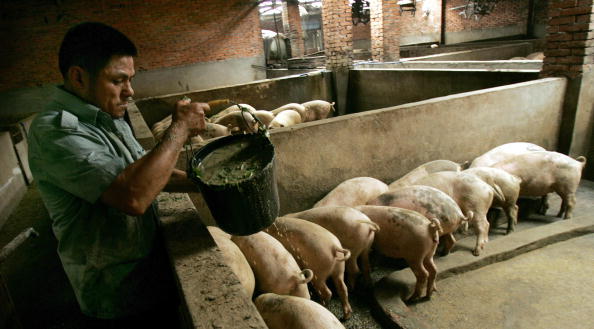
On Monday (16th), the price of domestic live pigs in mainland China fell to a new low in nearly 7 years, approaching 5 yuan/jin (500g), causing losses for pig farmers. Pig breeders are faced with the dilemma of either selling at a loss or spending more money on feed. What’s even more despairing for breeders is that despite the 10-month decline in pig prices, there is still no sign of a rebound in the future.
According to “China Pig Farming Network”, on Monday (March 16), the average price of domestic hybrid pigs fell to 10.29 yuan/kg (5.15 yuan/jin), approaching the 5 yuan/jin threshold, a 29.7% year-on-year decrease from 14.63 yuan/kg during the same period last year, and a 16.75% decrease from February.
This price level not only broke through the industry’s psychological defense line but also hit a seven-year low since 2019. The lowest pig price in nearly 10 years occurred in the second quarter of 2018, at around 9.92 yuan/kg, with the current pig price only about 30 cents/kg higher than the historical low point.
The average loss per head of the self-raised and self-fed model in the industry has expanded to around 283 yuan, and this situation has been ongoing for several weeks. With feed prices continuing to rise recently, breeders are facing increased losses, inevitably leading the industry into a phase of “continued cash outflow and collective losses”.
“Without believing in any price rebound, now is a double-bottom in the cycle. March and April will be even tougher; small retail investors will exit the market, this round is truly wiping out half of the retail investors, forcing the entire industry to reduce capacity. Breaking five yuan is not the bottom but a point of despair,” said the self-media “Xiao Xue Discusses Wealth” was very pessimistic about the future pig price trend and the prospects of pig breeders.
He recently posted a video on the social platform Douyin, saying, “Those who can’t hold on should leave early; if you can, persevere. Whether you can turn things around in the second half of the year, depends on who can stay alive first. This cold spell is more terrifying than you can imagine; it will get colder, more harsh, and more desperate.”
The current decline in pig prices began in May 2025 and has been ongoing for 10 months. According to the National Bureau of Statistics of the CPC, from May 2025 to February this year, pig prices have decreased by 4.1%, 14.6%, 19.3%, 26.4%, 26.0%, 27.9%, 25.9%, 24.3%, 19.0%, and 18.7% year-on-year.
Pork prices have also fallen in sync with pig prices. From May last year to February this year, the prices of pork (boneless pork) in wholesale markets decreased by 0.4%, 11.4%, 15.3%, 22.5%, 22.6%, 22.7%, 21.4%, 20.2%, 17.0%, and 13.4% year-on-year.
Under the double pressure of plummeting pig prices and rising feed prices, small pig breeders are experiencing deep losses.
On Monday (16th), the blogger “The Swallow Who Raises Pigs” tearfully said in a video, “With pigs priced at 4.8 yuan, 5 yuan, when I saw these pigs at my house, I cried inside the pigsty for a long, long time. This is not a joke or a pity sale; this is the cruelest reality for us pig farmers. What can you do when the pigs are already this big?”
The self-media figure “Xiao Xue Discusses Wealth” posted a video last week on the social platform Douyin, saying, “Pig prices have completely fallen below 5 yuan, without any suspense, without any resistance, directly exposing a psychological bottom line of all breeders. Many regions, including Northeast China, North China, and Northwest China, have fallen to 4.7 yuan. This is not about a callback or squeezing but a bloody account.”
He continued, “The average cost of self-raising is close to 6.5 yuan, losing more than 200 yuan per head. The longer you hold onto them, the more you lose. If you don’t sell, you’re just burning feed money every day, and both options are dead ends!”
The blogger “Veterinarian Animal Welfare Manufacturer” said in a video, “Why are there so many losses? The main reason is the scissors effect. On one hand, pig prices continue to decline, while on the other hand, feed costs remain high, making it difficult to make a profit. This high input, low output situation for breeders directly results in an average loss of 463 yuan per head for pigs bought for fattening.”
The WeChat official account “Pig Expert” and the self-media figure “Pig Guan Baba” recently analyzed that in this industry reshuffle, the differentiation between small and medium-sized breeders and leading companies is becoming more evident. For small and medium-sized breeders raising fewer than 500 pigs per year, the triple constraints of costs, diseases, and capital pose significant challenges, making their situation very difficult.
They mentioned that many people have to accelerate their exit from the industry, with the number of scattered breeders in some northern regions already decreasing by 20% year-on-year.
While pig farmers struggle to survive, major pig farming conglomerates are also deeply mired in loss situations.
The latest sales report for January and February 2026 shows that major pig breeding companies are facing a situation of “increased quantity but reduced price”, with pig prices falling leading to a general decline in sales revenue.
According to financial media, 19 listed pig breeding companies disclosed the sales report for January and February, with a total of 30.43 million pigs slaughtered during that period, a 9.9% year-on-year increase. The industry leader, Muyuan Shares, led the industry with 11.612 million heads slaughtered during the period, with sales revenues of 10.566 billion yuan and 6.405 billion yuan in January and February, respectively, a 11.93% and 23.98% year-on-year decrease.
From January to February, Wens Shares and New Hope slaughtered 5.66 million and 2.61 million heads, respectively. Similar to Muyuan Shares, the sales revenue of these two leading pig enterprises also decreased.
In February, Wens Shares’ sales revenue reached 3.956 billion yuan, with a year-on-year sequential decrease of 15.58% and 15.79%, hitting the lowest revenue level since the same period in 2025. New Hope’s revenue in February decreased by 7.42%.
Behind the continuous decline in pig prices is the dual pressure of oversupply and weak demand.
An analysis by “Pig Farming Network” stated that breeders are facing deep losses, with an average loss of about 283 yuan per head for self-raised and self-fed pigs. The continuous rise in feed costs, with high prices of corn and soybean meal, further exacerbates the industry’s cash flow pressure. The market is in a game between supply and demand: on one hand, breeders are reluctant to sell at low prices, and sporadic secondary fattening support the pig prices; on the other hand, there is still significant pressure on the supply side, with consumption in the off-season, and a slaughterhouse operating rate of only about 27.5% to 31.98%.
In addition, the prices of the two main feed ingredients, soybean meal and corn, continue to rise and have reached their highest levels since August 2024, further increasing the cost pressure on breeders.
In the short term, a significant rebound in pig prices is unlikely, with fluctuations mainly at the bottom. In the medium to long term, one would have to wait for a recovery in consumption, depletion of frozen stocks, and gradual adjustment of production capacity for the market to truly reverse.
Looking ahead at future pig prices, a private equity fund manager told the financial media, “Reducing capacity is not an immediate process, especially considering the natural 10-month fattening cycle for pigs. Coupled with the current high inventory, rising feed costs, weak pig meat consumption in the off-season, and restrictions on secondary production, short-term pig prices are likely to continue to decline.”
The live hog futures market is bleak, reflecting a continued downward trend in pig prices in the long term. According to “First Financial”, the main contract for live hogs has been exploring new lows recently. On March 16, the LH2605 contract for live hog futures closed at 10,860 yuan, down 3.14%, hitting a historic low since the contract was listed, reflecting the market’s pessimistic expectations for future prices.