
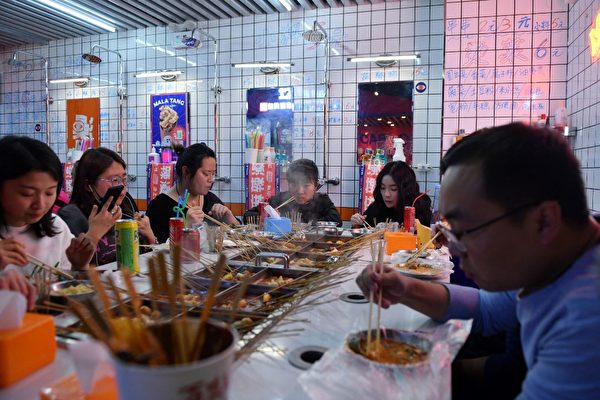
Recently, a chain brand focusing on Northeastern traditional flavors, Liu Wenxiang’s Spicy Hot Pot, has been embroiled in a public opinion storm. Following reports by the media exposing issues of “duck meat masquerading as beef and pork” in multiple stores in Fujian, this brand that has rapidly expanded in recent years quickly climbed the trending charts.
Public records show that Liu Wenxiang’s Spicy Hot Pot originated from a small shop at the gate of a school in Jiamusi, Heilongjiang. The brand began offering franchising opportunities in 2017 and has since expanded rapidly.
Data indicates that as of January 2025, there were around 1800 franchised stores. By January 2026, the number of stores had exceeded 2800. In the hot pot industry, its store scale has ranked at the forefront.
Unlike some chain brands that require unified ingredient distribution, this brand, apart from standard base and seasoning ingredients, allows franchisees to procure a large amount of ingredients themselves, and store decoration is also permitted for franchisees to mimic designs. This model has lowered the cost of opening a store, facilitating rapid expansion through franchising.
According to reports from various media outlets, in multiple Liu Wenxiang’s Spicy Hot Pot stores in Xiamen and Zhangzhou, Fujian, some ingredients labeled as “beef” and “pork” on online food delivery platforms and in-store are actually made of cheaper duck meat. This sparked surprise inspections by market supervision departments in various cities on Liu Wenxiang’s Spicy Hot Pot stores.
According to Jiupai News, a staff member from Liu Wenxiang’s Spicy Hot Pot responded to the controversy by stating that the exposure was isolated to certain stores, and they have requested those stores to suspend operations for rectification, with some canceling contracts with franchisees and ending collaboration.
Currently, the procurement price for pure beef rolls is around 28 yuan per kilogram, while the duck meat used for substitution is wholesaled at only 7 yuan per kilogram, a price difference of up to four times. Some store employees even boldly questioned undercover media reporters, saying, “Beef costs thirty to forty yuan per kilogram, we sell it for twenty yuan per kilogram, do you think it could be real beef?”
On the evening of March 14, market supervision departments in various locations in Fujian conducted surprise inspections on hot pot stores, with some implicated stores required to rectify immediately.
Video footage of the surprise inspection at Liu Wenxiang’s Spicy Hot Pot stores revealed that a product labeled as “Genuine Beef Bacon Slices” on the online platform was found to be a “beef-flavored product” with the ingredient list showing “duck meat”. Furthermore, the inspected stores were found to have issues such as messy warehouse environments, improper storage of unpackaged products, and uncleared expired items.
According to a report by the Daily Economic News, on the afternoon of March 15, visits to multiple Liu Wenxiang’s Spicy Hot Pot stores in Beijing found that many stores were conducting post-kitchen cleaning and organizing of refrigerated cabinets. Meat slices and rolls products were relatively few in the refrigerated cabinets and on online platforms, with most dishes being smooth and slippery meatballs.
Lin Yue, Chief Consultant of Lingyan Management Consulting and an analyst in the catering and fast-moving consumer goods industry, stated that the rapid expansion of Liu Wenxiang’s Spicy Hot Pot primarily relies on two “selling points”: one is the unconventional approach, emphasizing the “heavy taste” and “stickiness” of Northeastern-style spicy hot pot to differentiate the brand; the second is the relaxed nature of the franchising system—aside from specified base and seasoning ingredients, a large portion of ingredients are procured by franchisees themselves, and even the store decoration can be personalized. This to some extent alleviates the initial investment pressure on franchisees.
However, Lin Yue analyzed that the lack of control in the core ingredient supply chain has placed the brand in a state of “uncontrollable” monitoring of franchise stores. To seek profits, franchisees have more room for imagination, with the issue of using duck meat as a substitution for beef being the root cause. Moreover, the loose regulations for store design have led to inconsistent store image standards, rapidly depleting brand value and reputation.
“If these structural ‘top-level designs’ are not well done, the ‘time bombs’ will detonate more quickly,” he said. “Driving fast will inevitably increase the risk of ‘crashing’.”