
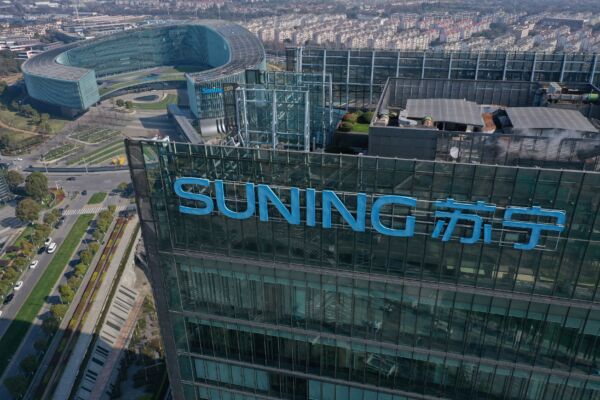
Recently, an announcement from the Nanjing Intermediate People’s Court revealed that Zhang Jindong, who has been in charge of Suning for 30 years, has had his personal assets wiped out. He transferred the equity of all 38 Suning-related enterprises he held for free, covering a huge debt of 238.712 billion yuan (RMB). He has become the first founder of a large private enterprise to have his assets cleared due to restructuring.
According to reports by Chinese media such as Sina Finance, in January 2025, the Nanjing Intermediate People’s Court formally accepted the bankruptcy reorganization application of Suning Group and 38 related companies. On January 4 this year, the court approved the restructuring plan and began implementing the transfers.
It was reported that on February 26, the Nanjing Intermediate People’s Court issued the (2023) Su 01 Po 23 Announcement of Completion of Debt Restructuring Execution, the 238.712 billion yuan total debt involving Suning Yigou and related parties had been completely executed. As the joint guarantor, Zhang Jindong’s personal equity, real estate, financial assets, and collectibles have all been disposed of through judicial auctions or agreements to fully repay the debt, resulting in his personal assets being completely cleared.
Not only did Zhang Jindong transfer 100% of the equity of the 38 Suning-related companies, but he also transferred all 4.15% of the indirect shares he held in Suning Yigou. Even though the 16.4 billion shares of Suning Yigou stock he owned (with a market value of about 28.86 billion yuan) had already been pledged or frozen, he still had to relinquish all income rights. There are no assets that his wife and he can independently dispose of, so all of them were put into a trust.
Creditors have temporarily suspended chasing Zhang Jindong’s personal guarantee obligations. However, this suspension is not permanent, and if the trust operation falls short of expectations or the asset disposal does not meet the standard, all responsibilities will immediately resume. Zhang Jindong essentially used his entire fortune to ensure the rebirth of Suning.
After the restructuring, Zhang Jindong, whose assets have been cleared, still holds the nomination rights for five seats on the new Suning Group’s board of directors and four seats on Nanjing Zhongcheng’s board, retaining the core operational decision-making power. If the asset revitalization does not meet expectations and the performance continues to decline, Zhang Jindong will immediately lose the nomination rights, and his personal guarantee obligations will be reactivated.
Zhang Jindong, who once had a fortune of hundreds of billions, has now become a leader without assets, bearing full responsibility, setting a precedent in China’s restructuring of large private enterprises where the founder’s assets are wiped out.
Financial self-media “Golden Horn Finance” expressed that this retail industry tycoon, who had clashed with Liu Qiangdong for more than a decade and held the position of Jiangsu’s richest man for seven years, not only lost the empire he had built for over 30 years but also injected all his personal wealth into a restructuring trust, embarking on the difficult path of debt repayment at the age of 63.
Data shows that the debt of the “Suning Group” amounts to 238.73 billion yuan, but the audited book assets are only 96.839 billion yuan, with the asset appraisal liquidation value being as low as 41.005 billion yuan, severely insufficient to cover the debts. If traditional bankruptcy liquidation is carried out, the expected repayment rate for ordinary creditors is only 3.5%, meaning for every 100 yuan lent, only 3.5 yuan can be received back.
In order to prevent this giant ship from sinking directly, Zhang Jindong chose a quasi-“sacrifice” method: equity clearing, all working members. In summary, the core logic can be summed up in eight words: equity clearing, all working members.
In terms of specific operations, external shareholders such as Zhang Jindong have completely transferred their rights for free into the “Suning Debt Restructuring Special Trust,” almost clearing the rights of the original shareholders; Zhang Jindong and his spouse have also put their Suning Yigou stock income rights and all personal assets into the restructuring trust for debt repayment, in exchange for creditors’ temporary suspension of chasing personal guarantee obligations. Creditors have been transformed into trust beneficiaries, gradually recovering their own money through asset operation profits and disposal proceeds.
In addition, since Zhang Jindong and his family are in the junior position of the trust plan, they can only receive profits after the senior and general share portions are fully realized. As Zhang Jindong’s family provided personal guarantees for some of the Suning-related debts, they must bear joint liabilities. This can be seen as a long journey of debt repayment.
In 1990, 27-year-old Zhang Jindong founded Suning Appliances. By employing strategies such as off-season stocking and offering low prices, Suning grew from a small air conditioning store on the streets of Nanjing to gradually breaking the monopoly of state-owned commercial markets.
In 2004, Suning Appliances went public on the Shenzhen Stock Exchange, becoming the first stock of the home appliance chain and reaching a market value of billions. Around 2010, Suning’s annual sales peaked, with Zhang Jindong becoming Jiangsu’s richest man. Since its establishment, Suning has grown from a small air conditioning store in Nanjing to a business empire covering retail, real estate, sports, finance, and more.
After 2011, Suning began aggressive expansion.
After receiving a strategic investment of 28.3 billion yuan from Alibaba in 2015, Suning embarked on a spree of cross-border acquisitions: acquiring Jiangsu Shuntian Football Club in 2015, Inter Milan Football Club in 2016, Tiantian Express in 2017, and investing in Evergrande Real Estate and Wanda Commercial. In 2019, it acquired Wanda Department Store and Carrefour China. Its investments spanned finance, real estate, sports, culture, technology, media, and express delivery, but none of them were successful, leading to a decline in operations and financial crisis.
Suning began to adjust starting in 2018, divesting loss-making units such as Su’ning Small Stores and Su’ning Financial Services. In 2020, Suning’s liquidity crisis became apparent, with Zhang Jindong subsequently selling Suning Yigou shares for 14.8 billion yuan but losing control. In October 2021, Suning Group’s privately placed bonds issued through an internal platform defaulted, and the debt crisis came to the fore, ultimately leading to bankruptcy reorganization.