
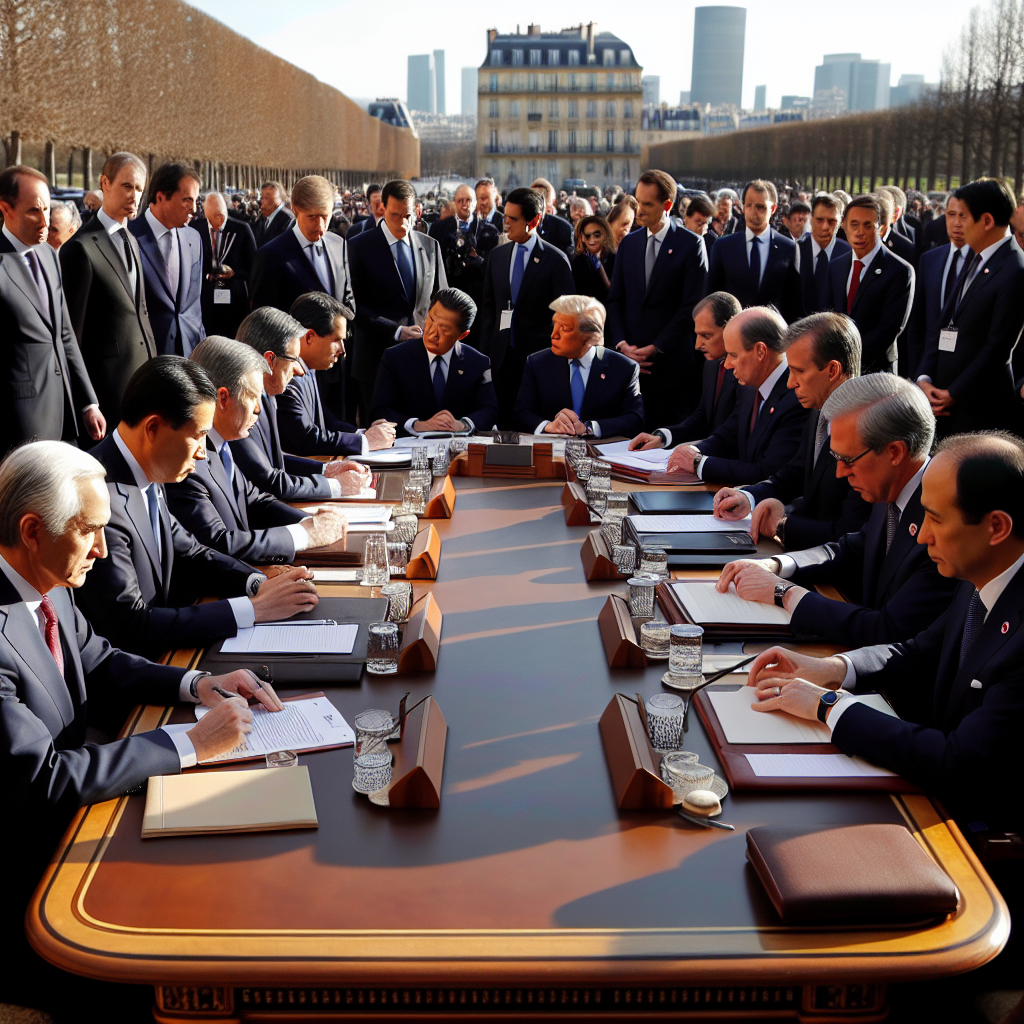
High-ranking officials from the United States and China arrived in Paris on Sunday, March 15th, for a new round of talks aimed at resolving issues in the trade truce agreement between the two countries. The purpose of the discussions is to lay out concrete plans for a possible summit between U.S. President Trump and Chinese Communist Party leader Xi Jinping at the end of March in Beijing.
According to reports from Reuters, an insider revealed that the two sides will hold the talks at the headquarters of the Organisation for Economic Co-operation and Development (OECD) in Paris.
Leading officials from both sides include U.S. Treasury Secretary Benson and Chinese State Council Vice Premier Ho Lifeng. The talks are expected to focus on U.S. tariff adjustments, China’s export of rare earth minerals and magnets to the U.S., U.S. high-tech export controls, and China’s purchase of American agricultural products. While some industries are obtaining rare earth exports from China, U.S. aerospace and semiconductor companies are facing increasing shortages of critical materials.
U.S. Trade Representative Greil will also participate in the talks. Last year, the U.S. and China held a series of talks in several European cities to ease tensions and prevent a near-collapse of trade between the two countries.
During an interview with CNBC on Friday, March 13th, Greil remarked that one of the focal points of the Paris talks would be the issue of rare earths.
William Chou, a senior researcher at the Hudson Institute in Washington, stated that in the negotiations in Paris, the “immediate U.S. priorities are likely to be securing China’s purchase of agricultural products and gaining more access to China’s rare earth resources.”
Throughout the Paris talks, both sides are expected to assess the fulfillment of commitments made between Trump and Xi Jinping after declaring a trade truce in Busan, South Korea last October.
Greil and Benson have brought a new thorny issue to the Paris talks: a 301 investigation targeting China and 15 other major trading partners, accusing them of overcapacity. This investigation could prompt the Trump administration to announce a new round of tariffs on these countries within the next few months. Greil has also initiated a similar investigation into forced labor practices in 60 countries, including China, which could lead to the U.S. banning imports of certain goods.
These investigations are aimed at revitalizing Trump’s tariff pressure on trading partners. Last month, the U.S. Supreme Court ruled that Trump’s globally imposed tariffs under emergency laws were invalid. This ruling effectively reduced Trump’s tariffs on Chinese goods by 20 percentage points, but he promptly announced a 10% increase in global tariffs, including on Chinese goods, under another trade law. Additionally, the Trump administration may impose further tariffs on Chinese goods based on the findings of the 301 investigation in the coming months.
On Friday, March 13th, the Chinese government condemned the U.S.-initiated investigations and vowed to retain the right to take countermeasures.
Trade analysts between the U.S. and China noted that due to limited preparation time and the U.S.’s focus on confronting Iran alongside Israel, the likelihood of a significant breakthrough in trade remains limited, both at the Paris talks and the Beijing summit.
Scott Kennedy, a Chinese economic expert at the Center for Strategic and International Studies in Washington, stated, “I think at least both sides have a lowest common denominator goal, which is to have a meeting that to some extent maintains a stable overall situation, avoids a rupture in relations, and prevents a re-escalation of tensions.”
Kennedy added that President Trump may want to achieve some results during his trip to Beijing, such as Beijing’s commitment to purchasing new Boeing planes, buying more U.S. liquefied natural gas and soybeans, but to accomplish these goals, he may need to make some concessions in terms of U.S. export controls.
Kennedy suggested that the Trump-Xi meeting in Beijing will likely “appear to make progress on the surface, but in reality, it may not be much different from the situation of the past four months.”
An insider informed Reuters that White House officials may still choose to delay the Boeing deal to minimize the need to make concessions to Beijing, while retaining some transactions to be announced at a future Trump-Xi meeting on U.S. soil. Trump and Xi Jinping are expected to hold four meetings this year.