
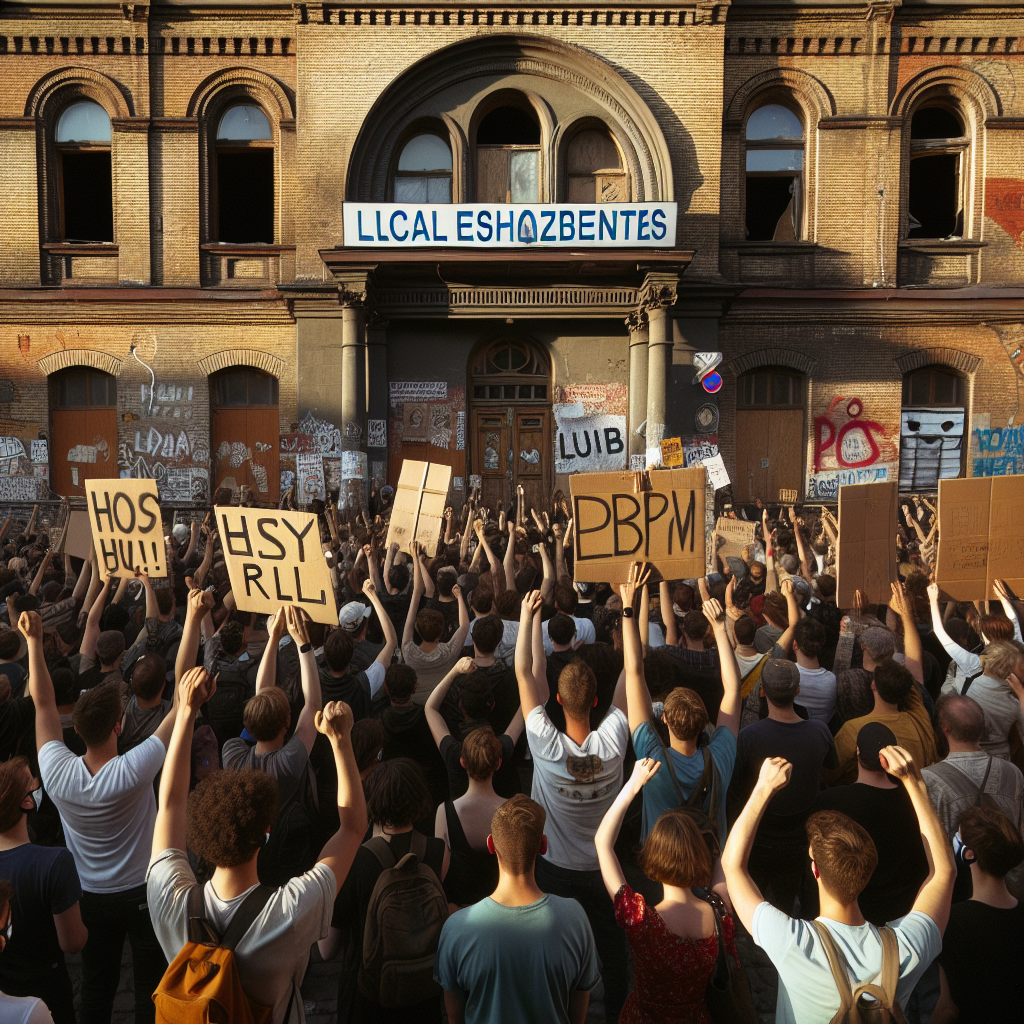
In Cuba, shortages of goods and an escalating energy crisis have sparked strong public discontent towards the authorities. On Saturday, March 14, protesters in the central city of Morón breached and vandalized the local Communist Party headquarters.
After enduring eight consecutive days of prolonged power outages, residents of Morón in Ciego de Ávila province, central Cuba, took to the streets in the early hours of March 14. Banging pots and pans, they protested against the soaring food prices and ongoing power cuts brought about by the Cuban Communist Party regime.
Videos circulated online showed an increasing number of protesters gathering, with anger driving some towards the local Communist Party office building.
Protesters entered the building, moving tables, chairs, files, computers, furniture, and portraits of Communist Party leaders onto the streets, setting them on fire, leading to cheers erupting on the scene. Witnesses said the cheers reflected the long-standing dissatisfaction of the people towards the authorities.
This wave of protests is not an isolated incident. Last week, a group of students gathered at Havana University to protest the worsening energy crisis that severely disrupted their studies. Moreover, many people have resorted to using long-neglected bicycles as their primary mode of transportation due to the energy shortage.
A resident who preferred not to disclose their name told AFP that the energy crisis has led to the closure of hotels in the town. The suspension of the tourism industry, a major source of income and employment for the area, further exacerbates the economic hardships of the residents.
It is worth noting that this protest occurred just hours after Havana authorities confirmed they were negotiating with the United States and attempting to seek a solution through dialogue.
Cuban officials later confirmed the incident, stating that “a small group of people” had vandalized the party headquarters building in Morón by throwing rocks at the entrance, moving furniture onto the streets, and setting them on fire, resulting in the arrest of five individuals.
Cuban Communist Party Secretary-General and President Miguel Díaz-Canel took to social media to attribute the recent intensified power outages, shortages of goods, and energy crisis to the U.S. blockade over the past few months.
In fact, Cuba is currently facing a cycle of rolling blackouts and extreme shortages of food, fuel, and medicine, closely linked to the precise economic blockade and geopolitical pressure from the United States. The Trump administration and its team have not resorted to traditional military intervention but have opted for a strategy of cutting off crucial resources to undermine the Cuban Communist regime.
These tactics are additional pressure on top of the 60-year-long embargo. Due to Havana’s heavy dependence on imported fuel for electricity, the targeted oil blockade has pushed Cuba’s fragile economy to the brink of collapse, affecting waste disposal, hospital emergency operations, public transportation, education, and other systems.
Under immense pressure, Havana authorities have unprecedentedly made concessions to the U.S. government. On March 13, Díaz-Canel announced talks with the U.S. government to seek a solution, without providing details of the negotiations. At the same time, he hinted at the imminent release of 51 Cuban political prisoners but did not disclose specific names.
Furthermore, the Havana regime formally approved the entry of the Federal Bureau of Investigation (FBI) into Cuba to investigate the late February incident of a Florida speedboat intruding into Cuban waters, leading to a firefight between the two sides. The regime’s actions are widely seen as a signal of surrendering sovereignty to the U.S. in exchange for survival space.
President Trump has not concealed his desire for regime change in Cuba, stating on March 9 that Cuba is in “deep trouble” and hinting at a possible “friendly takeover.”
U.S. Secretary of State Marco Rubio touched on the issue of regime change in Cuba on February 25, saying, “Cuba must change, but it is not necessary for it to change all at once or overnight. Everyone here is mature and practical.”
He further added, “They (the Cuban regime) need thorough reform. If they are willing to undergo comprehensive reforms to create economic and political freedom for the Cuban people, then the U.S. certainly welcomes that.”