
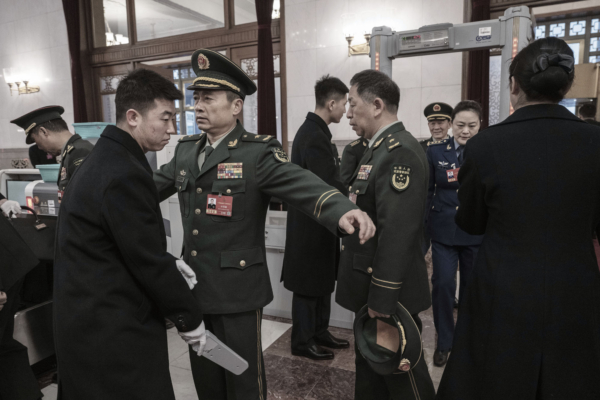
Xi Jinping Attends National People’s Congress Military Delegation Meeting and Delivers Speech
On March 7, Xi Jinping attended the meeting of the national people’s Congress military delegation and delivered a speech. The CCTV footage showed that only four active-duty generals were present, namely: Vice Chairman of the Central Military Commission Zhang Shengmin, Minister of National Defense Dong Jun, Commander of the Central Theater Command Han Shengyan, and Commander of the Eastern Theater Command Yang Zhibin.
In March 2025, a total of 41 active and retired generals attended the meeting of the national people’s Congress military delegation. At that time, Han Shengyan and Yang Zhibin were still major generals. This year, compared to last year, the number of generals attending the meeting of the national people’s Congress military delegation has plummeted sharply, with 37 fewer generals in attendance.
This sharp decline in the number of generals attending the meeting of the national people’s Congress military delegation has been particularly prominent since the Fourth Plenary Session of the 20th Central Committee held last October. Among the 20th Central Committee members, a total of 33 generals were absent from the Fourth Plenary Session, with 22 of them being generals.
Among them, 8 generals have been officially removed from their positions, expelled from the party, the military, and transferred for judicial trial, including: member of the Political Bureau of the CCP Central Committee and Vice Chairman of the Central Military Commission He Weidong, member of the Central Military Commission and former director of the Political Work Department of the military Miao Hua, former executive deputy director of the Political Work Department of the military He Hongjun, former executive deputy director of the Joint Operations Command Center of the military Wang Xiubin, former Commander of the Eastern Theater Command Lin Xiangyang, former Political Commissar of the Army Qin Shutong, former Political Commissar of the Navy Yuan Huazhi, and former Commander of the Armed Police Force Wang Chunning.
The remaining 14 generals are “missing,” including: Minister of the Equipment Development Department of the Military Commission Xu Xueqiang, Secretary of the Political and Legal Affairs Committee of the Military Commission Wang Renhua, Political Commissar of the Eastern Theater Command Liu Qingsong, Commander of the Western Theater Command Wang Haijiang, Commander of the Southern Theater Command Wu Yanan, Commander of the Northern Theater Command Huang Ming, Political Commissar of the Central Theater Command Xu Deqing, Commander of the Army Li Qiaoming, Commander of the Strategic Support Force Ju Qiansheng, Political Commissar of the Information Support Force Li Wei, former Political Commissar of the Rocket Army Xu Zhongbo, Political Commissar of the Rocket Army Xu Xisheng, Commander of the Navy Hu Zhongming, and Political Commissar of the Armed Police Force Zhang Hongbing.
Eleven generals (Central Committee members) attended the Fourth Plenary Session, namely: member of the CCP Political Bureau and Vice Chairman of the Central Military Commission Zhang Youxia, member of the Central Military Commission and Chief of Staff of the Joint Staff Department Liu Zhenli, member of the Central Military Commission and Secretary of the Discipline Inspection Commission Zhang Shengmin, deputy chief of staff of the Joint Staff Department Xu Qiling, Minister of National Defense Dong Jun, Political Commissar of the Southern Theater Command Wang Wenquan, Political Commissar of the Western Theater Command Li Fengbiao, Commander of the Central Theater Command Wang Qiang, Commander of the Air Force Chang Dingqiu, and Political Commissar Guo Pu school, President of the Military Academy Yang Xuejun, and one attending general, Political Commissar of the Army Chen Hui.
Out of the 12 generals who attended or participated in the Fourth Plenary Session, many of them quickly found themselves “missing” or under investigation.
On December 22, 2025, the Central Military Commission held a promotion ceremony for generals. Only four generals attended, with Zhang Youxia, Zhang Shengmin, and Liu Zhenli sitting on the stage, and Dong Jun sitting below the stage. Along with the newly promoted generals Han Shengyan and Yang Zhibin, a total of six generals attended. All other generals were “missing.”
On December 23, 2024, the Central Military Commission held a promotion ceremony for General Chen Hui, attended by 20 generals. Just a year later, 17 generals, including General Chen Hui who was recently promoted, and a total of 17 generals, were unable to attend the promotion ceremony in 2025.
On January 24, 2026, Generals Zhang Youxia and Liu Zhenli were officially removed from their positions.
During the convening of the “Two Sessions” of the CCP in March 2026, only the mentioned four generals remained in the public eye.
At the end of the 20th CCP National Congress, there were more than 40 active-duty generals, and in just three years, without fighting a war, the number of active-duty generals in the CCP, from the Central Military Commission to the 15 military departments, to the Navy, the Army, the Air Force, and the Rocket Force, to the Eastern, Western, Southern, Northern, and Central Theater Commands, to military academies, nearly all active-duty generals in the CCP were wiped out. This is an extremely rare occurrence in the 98-year history of the CCP’s military formation.
Xi Jinping has thus acquired a new nickname, called “General Slayer.”
I believe there are at least four reasons for this:
During the reign of the CCP dictator Jiang Zemin, as Jiang had no military achievements, no outstanding political achievements, mainly relying on sycophancy and “political seniority,” stepping on the blood of the June 4th students to rise to the highest CCP power position, in order to garner the loyalty of officials to serve him, Jiang advocated a “rule by corruption” policy, allowing officials to engage in rampant corruption, promoting and using a group of severely corrupt individuals, leading to rampant buying and selling of official positions in the CCP officialdom.
At that time, the unwritten rule in the CCP officialdom was: if you do not run errands, you will be demoted or transferred; if you only run errands without delivering, you will stay in place; if you run errands and deliver, you will be promoted and used.
In the military, the CCP political bureau member and Vice Chairman of the Central Military Commission Guo Boxiong and Xu Caihou, promoted by Jiang Zemin, led the rampant buying and selling of official positions in the military from top to bottom. From recruiting soldiers, to promoting and appointing, all the way to promoting generals, everything had to be facilitated by money, with those offering more money being given preferential treatment. The entire military became a large marketplace for the trade of power, money, and favors.
An April 2016 report by “China Newsweek” revealed that Guo Boxiong’s son, Guo Zhengang, once boasted, “More than half of all military officials were promoted by my family.”
Before his death, Xu Caihou told investigators, “Among the top officials in the major regional commands, there were only two who did not give me money.”
What does Xu Caihou mean by “top officials in the major regional commands”? This includes the Vice Chief of the General Staff of the Central Military Commission, the Deputy Director of the General Political Department, the Secretary of the Central Military Commission Discipline Inspection Commission, the heads of the General Logistics Department, General Equipment Department, Navy, Air Force, Second Artillery Corps, the military and political leaders of major military regions holding the rank of general, and the military and political leaders of the military colleges. In other words, almost all senior military leaders in the entire military gave money to Xu Caihou!
In 2015, Xi Jinping initiated military reforms, but did not reform the corrupt system that led to serious corruption in the CCP’s military, merely reallocating power and benefits, allowing senior generals personally promoted by Xi to occupy key positions where they could buy and sell official positions at will.
In August 2017, Xi Jinping promoted Miao Hua to be Director of the Political Work Department of the Joint Staff Department.
Miao Hua’s appointment as Director of the Political Work Department of the Military Commission came on the heels of the downfall of his predecessor, Zhang Yang. Zhang Yang, a member of the Central Military Commission and Director of the General Political Department, was the first Director of the Political Work Department of the Military Commission after Xi’s military reform in 2015.
On August 28, 2017, Zhang Yang was suspended and placed under “organizational conversation” to investigate allegations that he was involved in the cases of Guo Boxiong and Xu Caihou. On the morning of November 23, Zhang Yang committed suicide by hanging himself at home.
After Zhang Yang’s death, he was expelled from the party, the military, and stripped of his general’s rank.
The official CCP report stated, “After investigation, Zhang Yang was found to have seriously violated the party’s political discipline and rules, organizational discipline, integrity discipline, and national laws and regulations, suspected of bribery, corruption, and possession of a large amount of unexplained wealth, with extremely severe circumstances and extremely negative impacts.”
After taking office as Director of the Political Work Department of the Military Commission, as Xi’s chief architect of “political building of the military,” and the person Xi promoted and used for the selection of senior generals in the military, Miao Hua should have taken Zhang Yang’s lesson to heart and set an example of “absolute loyalty” and “integrity.” However, seven years after Zhang Yang’s suicide, Miao Hua followed in Zhang Yang’s footsteps with severe corruption.
On November 24, 2024, Miao Hua was officially suspended for investigation.
On October 17, 2025, Miao Hua was officially expelled from the party and the military, and sent for judicial review, on charges of “serious violations of party discipline, suspected of serious duty crimes, with a particularly large amount of money involved, extremely serious in nature and extremely serious in impact.”
On October 18, 2025, the CCP military newspaper editorial stated that Miao Hua’s “faith collapsed, loyalty was lost, seriously betraying the trust of the central party leadership and the military commission, seriously undermining the principle of the party commanding the gun and the system of the chairman of the military commission.”
In summary, Miao Hua’s problems can be attributed to political and economic issues. Politically, he deviated from Xi’s “political building of the military”; economically, in simple terms, he engaged in the sale of official positions.
After being investigated, during the first night in detention, Miao Hua reportedly confessed manically and initially exposed over 80 military personnel. Subsequently, with the cooperation of his three secretaries, he provided information on up to 1300 military personnel.
It was after Miao Hua’s arrest that a wave of active-duty generals were either being investigated or went “missing,” resulting in a dramatic decrease in the number of active-duty generals making public appearances.
The CCP official report stated that Miao Hua was “suspected of serious duty crimes, with an especially large amount of money involved.” It can be inferred that many active-duty generals promoted by Miao Hua had provided him with money.
Miao Hua could not have embezzled a large sum of money all by himself; it was likely a small group committing the crimes. Who might have been in this small group? As per my observations, it might have included at least Miao Hua, He Weidong, and Zhong Shaojun.
In August 2017, Xi Jinping promoted Miao Hua to be the Director of the Political Work Department of the Military Commission because Miao Hua came from what was called Xi’s main branch in the military – the 31st Group Army. Xi had worked in Fujian for 17 years, establishing close relationships with many military officers from the 31st Group Army stationed there. Miao Hua had spent over 30 years in the 31st Group Army, from serving as a soldier to becoming the Director of the Political Department of the 31st Group Army. By then, Xi and Miao had become close. After Xi became the Chairman of the Central Military Commission, Miao Hua was promoted and used by Xi, first as the Political Commissar of the Lanzhou Military Region, and then cross-services as the Political Commissar of the Navy.
Miao Hua’s predecessor Zhang Yang, who was promoted and used by former Vice Chairman of the Central Military Commission Xu Caihou, was Xu Caihou’s protege. Miao Hua was seen as Xi’s true confidant in the military.
In August 2017, Miao Hua took office as Director of the Political Work Department of the Military Commission, the same month that Zhong Shaojun, who had long been close to Xi, was appointed as the Director of the General Office of the Central Military Commission, the chief controller in Xi’s military. Zhong Shaojun also held the positions of Director of the Reform and Organization Office of the Central Military Commission, the Office Director of the Central Military Commission’s Leading Group for Deepening National Defense and Military Reform, and a member of the Military Election Committee. Zhong Shaojun was one of Xi’s most important assistants in personnel selection and employment in the military.
After Miao Hua took office, he became an important confidant aiding Xi in assembling the “Xi family army” in the military. Zhong Shaojun became Xi’s number one confidant in the military. Since then, Miao Hua and Zhong Shaojun might have become “partners.”
By 2022, after the 20th CCP National Congress, He Weidong, handpicked by Xi, was promptly promoted to the CCP Political Bureau member and Vice Chairman of the Central Military Commission. He then became the Commander of the Eastern Theater Command, and it was likely that he was recommended by Miao Hua.
After He Weidong became a member of the CCP Political Bureau and Vice Chairman of the Central Military Commission, managing the Political Work Department of the Military Commission, He Weidong and Miao Hua became “partners in selection and employment.”
After the 20th CCP National Congress, Xi’s subordinates quickly grew into three important aides in personnel selection and employment — He Weidong, Miao Hua, and Zhong Shaojun.
In the process of aiding Xi with selection and employment, He, Miao, and Zhong might have formed a small group; you recommend someone, I confirm it; I recommend someone, you approve it; after He, Miao, and Zhong came to an agreement, they then reported to Xi. Thus, under Xi’s watchful eye, He, Miao, and Zhong likely utilized their unique positions, forming a “shared benefit” community of interests in the selection and appointment of senior generals across the military.
After the downfall of He Weidong and Miao Hua, rumors surfaced repeatedly about Zhang Shaojun being investigated.
On December 25, 2025, Tsai Shensun, a commentator residing in the United States, revealed that he received confirmation that Zhong Shaojun had been arrested.
As more and more senior generals fell from grace or went “missing,” the problem of the He-Miao-Zhong clique engaging in the buying and selling of official positions might gradually unravel.
The active-duty Generals Zhang Shengmin and Dong Jun, after He Miao’s fall from power, have thrived. Reports of Dong Jun being investigated surfaced, but he has so far escaped punishment. Why? There could be three possible reasons: he voluntarily revealed Miao Hua’s transgressions and distanced himself from him; he conducted a self-review and turned in some money and possessions; and his immediate predecessors as Ministers of National Defense, Wei Fenghe and Li Shangfu, were also investigated. If he were to be investigated, this would make three consecutive Ministers of National Defense facing scrutiny, an embarrassment for the CCP internationally. Therefore, out of face-saving considerations, Xi may have chosen to retain him for the time being.
Due to the connection with the Miao Hua affair, Dong Jun has not yet been appointed as a member of the Central Military Commission or a State Councilor. It is still uncertain whether he will be investigated in the future.
Generals Han Shengyan and Yang Zhibin were not originally Xi’s military confidants. After experiencing round after round of military purges, Xi does not trust anyone and it’s unlikely he trusts Han and Yang. Currently, as the large-scale military purges continue, their chances of survival are unclear.
Xi Jinping has entered into a vicious cycle of “purge – feeling insecure – continuing purge – feeling even more insecure – purging again.”
On March 7, Xi warned at the National People’s Congress Military Delegation meeting: “There must be no one with a disloyal heart to the party in the military, and no place for corrupt individuals to hide. The fight against corruption must be resolutely advanced.” This indicates that Xi will continue the great purge within the military.
Who will be the next active-duty general brought down by Xi? Let us wait and see.