
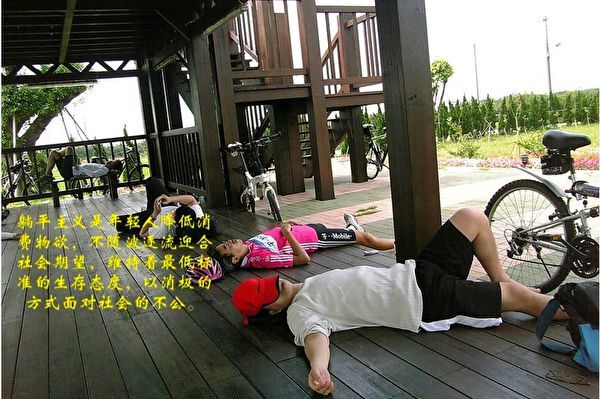
In recent years, among the youth in China, the phenomena of “lying flat” and “low-desire lifestyle” have become widely discussed societal trends. More and more young people are no longer pursuing high-paying jobs but are seeking a “normal job” that can sustain their daily lives. Analysts believe that this seemingly “downgraded” choice is not only related to the difficult current job market but also reflects a silent judgment and protest against society’s confidence and the system.
One popular online comment pointed out the mentality of the “lying flat” culture: “We are tired of the refined, fast-paced, and efficient way of life imposed on us. We just want to live a life lying down wherever and whenever we want.”
This series of short videos has become the starting point for the trend among Chinese youth from “lying flat” to becoming “mouse people.”
This lifestyle attitude originates from “lying flat” and is considered a continuation of the “lying flat” culture, seen as an escape from the high-intensity work and social competition pressure. Against the backdrop of a slowing economy and high youth unemployment rates in China, more and more young people are choosing to opt-out of the “struggle” battlefield and enter a mode of “degeneracy.”
According to Wu Shaoping, a human rights lawyer based in the United States, in an interview with Da Ji Yuan, “This current ‘lying flat’ trend is a forced lying flat. The vast majority of young people do not have the financial support or assistance from family, nor do they have social help. At the same time, they are facing a series of life difficulties like unemployment, marriage, housing, and more.”
In Wu’s view, the changes in the mindset of the youth reflect a gradual loss of societal confidence.
He described that over a decade ago, Chinese society generally believed in the saying “Strive to change fate.” At that time, through hard work in education or work, many people still had the opportunity to improve their lives and change their social status. However, there has been a noticeable shift in recent years.
“Seven or eight years ago, many young people were still full of hope, but in just a short decade, people went from hope to disappointment, then from disappointment to hopelessness, and finally into despair.”
In his opinion, as social stratification gradually solidifies and individual efforts struggle to bring about significant change, the narrative of “struggle to change fate” gradually loses its persuasiveness. He pointed out, “The children of ordinary people basically have no way to change their fate through their efforts alone.”
Under the influence of factors such as bureaucratic systems, connections, and corruption, social resources are gradually concentrating on a minority group, to the point where “even finding an ordinary job may require connections.”
Under the amalgamation of multiple pressures, many young people are forced to lower their life expectations. Wu Shaoping said, “They only seek a job that can provide food and clothing, maintaining their lives and activities at the lowest cost.”
Hong Puzhao, former Deputy Executive Director of the Mainland and Regional Development Research Center at Taiwan’s Donghai University, summarized three emerging social phenomena in China in a piece for Up Media:
Firstly, young people are no longer blindly pursuing high-paying positions in large corporations but are seeking a “regular job” that allows them to leave work on time and get paid on time. Secondly, bathhouses have become public spaces for some young people to temporarily escape competition pressure. Finally, low-cost “boomerang travel” has quickly gained popularity on social media, as young people use careful planning of connecting flights and transfer rules to experience temporary sensory pleasures on a minimal budget.
Hong believes that if these phenomena are only seen as lifestyle trends, the social significance underlying them is underestimated. These behaviors are actually a form of “risk contracting”: when the future is filled with uncertainty, young people tend to reduce their investments and expectations to avoid taking on greater life risks.
Behind the shift in the mentality of the youth is the increasingly grim reality of employment. Official statistics show that in December 2025, China’s youth unemployment rate was around 16.5%, peaking at 18.9% in August of the same year. Since the end of 2023, the National Bureau of Statistics of the Communist Party of China has adopted a new statistical method that brought down the unemployment rate from its historical high of 21.3%. However, most observers believe that the pressure of youth unemployment still looms heavily.
In 2025, the number of new graduates in China reached a historical high of 12.22 million, and the annual scale of graduates is expected to remain above tens of millions for the next decade. Meanwhile, industries that in the past absorbed a large number of highly educated talents such as real estate, internet, education, and finance have generally reduced their recruitment in recent years.
In the first half of 2025, there was a 22% decrease in job vacancies for university students compared to the previous year, while the number of job seekers increased by 8%.
The authorities’ statistical methods themselves have come under scrutiny. By current standards, anyone who works more than an hour during the investigation week is considered “employed.” Therefore, some analysts, when assessing youth employment in China, often add a correction estimate of about 10% to 15% to the official unemployment rate to attempt to reflect “hidden unemployment” or the population of “low-degree employment,” such as workers with severe mismatch of education and positions or part-time employees who work only a few hours a week.
Professor Zhang Dandan from the National Development Institute at Peking University once estimated that if approximately 16 million young people who were not actively job-hunting were included in the statistics, the actual youth unemployment rate could be much higher than the official data.
The imbalanced structure of the labor market is exacerbating the employment dilemma among the youth.
With the contraction of the internet and education and training industries, a large number of university graduates are being forced into low-skilled service industries. For example, over 20% of the delivery riders on platforms like Meituan and Ele.me possess a university degree, including tens of thousands of master’s degree graduates.
At the same time, more and more young people are turning to seek stable positions within the system. In 2025, approximately 3.7 million people applied for the civil service examination in China, but there were only about 38,000 positions available. The China National Nuclear Corporation recruited 1,730 positions, receiving over 1.2 million resumes, resulting in a competition ratio of 150:1.
Editor-in-chief of “The Poems of 64,” and writer in the Library of Congress, Jiang Pinchao, told Da Ji Yuan that these trends are related to the increasing concentration of power and resources in China in recent years. He stated, “Xi Jinping’s monopolization of power and the economy has led to the formation of a new privileged class. After the formation of this privileged class, fair competition is stifled.”
He believes that while the beginning of the market economy in the reform and opening-up period allowed many lower-class citizens the chance to improve their lives through entrepreneurship, the recent re-centralization of political and economic power has led to a shrinking space for social mobility. “The social mobility space that several generations fought to open has been turned back under Xi Jinping’s reign.”
Jiang believes that the Chinese people still possess a spirit of hard work and perseverance, but under the constraints of the system, this energy cannot be translated into societal drive. He mentioned that during the Cultural Revolution period, youth thinker Ye Luoke criticized the institutional logic of “one’s birth determines one’s fate” in his work “On the Issue of Origin.” However, he was ultimately executed for it.
He expressed concern that as the privilege class solidifies and competition spaces shrink again, society’s questioning of institutional unfairness may accumulate once more.
Analysts argue that as more and more young people lower their expectations, reduce their investments, and avoid taking risks, the issue is no longer just a personal change in lifestyle but a challenge to the societal structure.
In recent years, new terminologies have emerged on Chinese social media to describe these phenomena among young people, such as “internal folding,” “lying flat,” “moisturizing,” and “political depression.” The term “political depression” first appeared during the 2019 epidemic outbreak, later used to describe a collective emotional state of “helplessness and exhaustion” under long-term high-pressure policies and social stress.
Wu Shaoping warned that when an entire generation falls into disappointment or even despair, both societal vitality and innovative capacity could be weakened.
Hong Puzhao pointed out that China’s social stability has largely been built upon continuous economic growth and the belief that “effort can improve one’s life.” However, as economic growth slows and social mobility becomes entrenched, the foundation of maintaining societal confidence is also shaken.
He believes that as the link between effort and reward continues to loosen, the retreat of the younger generation is also considered a “silent judgment” on the system and the future.