
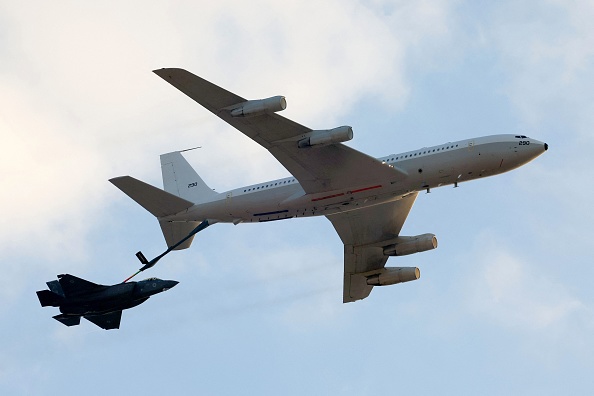
On March 13th, the US Central Command confirmed that four out of the six crew members on board the US KC-135 tanker aircraft that crashed in Iraq the day before have been confirmed dead. Search and rescue teams are still looking for the remaining two individuals. The Command stated that the names of the deceased will be released to the public 24 hours after notifying their families.
The crash occurred at 9 pm local time in Iraq on March 12th. The Central Command stated in a release, “The circumstances of the incident are under investigation. However, the loss of the aircraft was not due to enemy or friendly fire.” This suggests that the accident most likely resulted from non-combat factors.
Another US military tanker aircraft was involved in the incident, which landed safely at Ben Gurion Airport in Israel after sending out an emergency signal prior to landing.
The Boeing KC-135 Stratotanker usually has at least one pilot, a co-pilot, and a boom operator responsible for controlling the refueling boom.
These aircraft were produced by Boeing in the 1950s and early 1960s, have been in service for 60 years, and have been a crucial part of the US military’s air refueling fleet, allowing combat aircraft to carry out longer missions without the need to land.
However, these aircraft come with risks such as large wake turbulence and lack of ejection seats, resulting in low chances of survival for the pilots in the event of a crash.
Analysis suggests that the accident occurred at night, and conducting air-to-air refueling at night carries high risks due to the usual lack of external lighting in combat zones and the close proximity of the two aircraft.
During refueling, the extendable refueling boom of the tanker aircraft needs to be inserted into the receiver aircraft, with the usual horizontal distance between the two aircraft being 15 to 30 meters and vertical distance of 3 to 6 meters.
Accidents involving two tanker aircraft can potentially occur due to the following scenarios:
1. Aircraft flying too close together in the refueling track, leading to loss of control due to wake turbulence.
2. Operational errors while one tanker aircraft is refueling the other.
3. High-intensity missions in combat zones causing airspace congestion and increased risks.
The recent incidents underscore the risks associated with aerial combat and tanker aircraft, especially amid the ongoing conflicts between the US and Iran. Since the outbreak of the war between the US and Iran, seven US soldiers have been confirmed dead in conflicts, with at least four aircraft crashes reported.
Earlier this month, three F-15 aircraft were accidentally shot down by the Kuwaiti air defense system over Kuwait, with all six crew members safely ejected.