
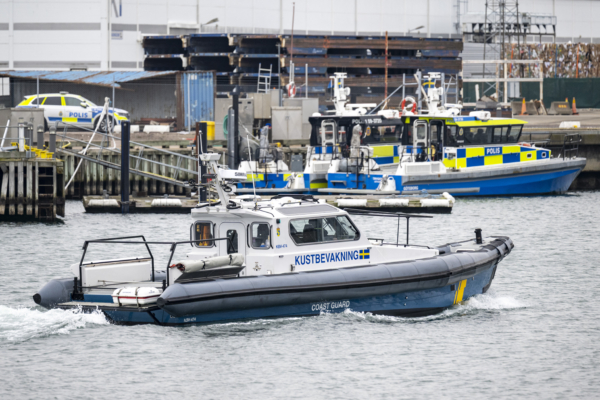
On Thursday, March 12th, the Swedish Coast Guard announced that they had boarded and taken control of an oil tanker suspected to be a “stateless vessel” in the waters of Sweden in the Baltic Sea. Just days before on March 7th, they had discovered another similar cargo ship in the same area. In fact, in the past two months, European and American countries have also identified several “shadow fleet” vessels related to Russia.
The 228-meter-long oil tanker, named “Sea Owl I,” was flying the flag of Comoros at the time. However, the Swedish Coast Guard suspected that the ship was operating under a false flag and that it was included in sanction lists by various authorities including the European Union.
Daniel Stenling, the head of the operation for the Swedish Coast Guard, stated, “These types of vessels pose a significant threat to maritime safety and the environment. Therefore, we have every reason to take action against them.”
Swedish Minister for Civil Protection, Carl-Oskar Bohlin, mentioned on social media platform X that the ship is suspected to be part of Russia’s “shadow fleet.”
The boarding and seizure operation took place off the coast of Trelleborg in southern Sweden. On March 7th, the Swedish Coast Guard had boarded and seized a 96-meter-long bulk carrier named “Caffa,” flying the flag of Guinea, in the same area for suspected false flagging.
During a press conference on March 8th, the Swedish Coast Guard determined the “Caffa” to be a “stateless vessel” under international law. Investigations revealed that most of the crew on board were of Russian nationality, with the vessel previously registered in Russia’s ship registry and currently under sanctions from Ukraine. However, the actual ownership behind it remains a mystery.
Authorities expressed concerns about the vessel’s seaworthiness due to these ships, used for transporting oil, gas, or stolen Ukrainian grains, typically being very old with an average age of about 18 years, nearing their operational limits. Without proper maintenance, the risk of maritime accidents is very high.
One individual related to the vessel is currently under criminal investigation in Sweden to clarify the true identity of the ship and its legal entry into Swedish waters, while further details about the vessel and its crew have not been disclosed.
Minister Bohlin confirmed the situation, stating on platform X, “The ownership structure of the vessel is unclear, and we suspect it is uninsured. It is reported that the vessel changed its flag from Russia to Guinea just last summer.”
In 2025, the Swedish government announced plans to strengthen insurance inspections for foreign vessels to tighten control over Russia’s “shadow fleet” (consisting of old ships with opaque ownership to evade sanctions from the EU, USA, and G7). They instructed the Coast Guard and Maritime Administration to conduct insurance checks on vessels docking at Swedish ports, including those passing through its territorial waters and exclusive economic zone.
Not only Sweden but also French President Macron, in a post on X on January 22nd, mentioned that the French Navy had seized an oil tanker named “Grinch,” flying a false flag, in the waters of Spain and Morocco. The French authorities suspected the tanker to be part of Russia’s sanctioned “shadow fleet.”
The maritime authorities in France confirmed that the search on the vessel “confirmed previous doubts about the legality of its flag.” They found that the “Grinch” oil tanker had departed from the northern Russian port of Murmansk and was subsequently seized by the French Navy during its voyage.
Additionally, in early January, the UK assisted the US in the North Atlantic to seize an oil tanker named “Marinera,” flying the Russian flag. The detained vessel, initially named “Bella-1,” belonged to a “shadow fleet” transporting crude oil for sanctioned countries such as Venezuela, Iran, or Russia.