
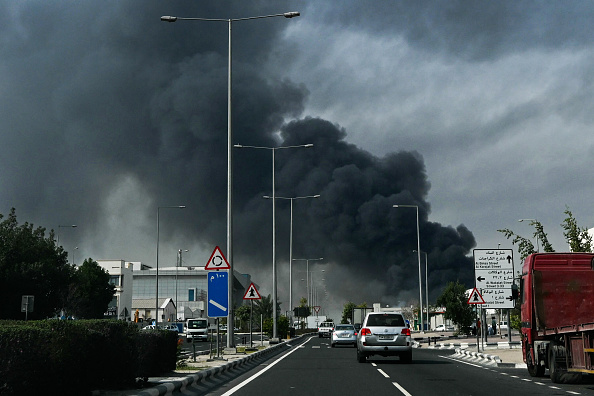
After the United States and Israel took military action against Iran, Iran has repeatedly used drones and missiles to attack the bases used by US military, as well as launching retaliatory attacks against Israel and other neighboring countries in the Persian Gulf region. Under the electronic warfare pressure exerted by Iran against the US and Israel, experts in the industry believe that the increase in the precision of the attacks may indicate a switch from GPS to China’s “BeiDou” satellite navigation system.
Since the joint military action by the United States and Israel against Iran, Iran has been actively retaliating, especially in the early stages by launching a large number of missiles and drones towards US military bases and neighboring countries. Although most of Iran’s missiles and drones have been intercepted, there have been instances where some have managed to bypass air defense systems causing casualties. For instance, according to the US military, six soldiers were killed on March 1st in an Iranian drone attack at Port Shuaiba in Kuwait.
The performance of Iranian missiles and drones seems to have exceeded their past capabilities. Al Jazeera reported that the increased precision of Iranian missiles and drones has raised questions linking this improvement to China’s “BeiDou Navigation Satellite System”.
Intelligence experts in France also share a similar view. Alain Juillet, former head of intelligence at the Directorate General for External Security (DGES) in France, mentioned on a French current affairs podcast that Iran’s precision in missile strikes has significantly improved since the “12-day war” with Israel in June last year, speculating that this improvement could be attributed to Iran gaining access to China’s BeiDou satellite navigation system.
Juillet, an intelligence expert who previously served as the head of intelligence at DGES responsible for economic intelligence for the French Ministry of Defense, remarked, “One surprising aspect of this war is the increased precision of Iranian missiles compared to the ’12-day war’ with Israel 8 months ago, which has sparked curiosity about the guidance systems of these missiles.”
This is not the first time media or professionals have discussed Iran potentially using China’s BeiDou satellite navigation system. Last August, the South China Morning Post reported that Iran was considering utilizing China’s BeiDou satellite navigation system.
The Taiwan Institute for National Defense and Security released an article on March 2nd titled “Why Iran Cannot Effectively Resist the US-Israeli Coalition” on its official website, authored by Lin Chaolun, Deputy Researcher at the Institute for Cybersecurity and Decision-Making Studies. Lin Chaolun wrote, “Iran’s missile system has shifted from GPS to China’s ‘BeiDou-3’ military signals, aiming to enhance precision and anti-jamming capabilities.”
He analyzed that Iran’s adoption of BeiDou could help avoid interference with GPS by the US and Israel. Besides positioning, the BeiDou system can also provide Short Message Communication, enabling direct messaging through satellites. This allows devices like vehicles, ships, and weapons systems to send coordinates, receive instructions, and report statuses without relying on ground communication networks.
However, Lin Chaolun pointed out, “While Iran has introduced Chinese (CCP) air defense systems and satellite reconnaissance hardware and software, the lack of seamless system integration has hampered its defense network when facing strong US electronic warfare pressure and situational awareness advantages, rendering military equipment without effective integration in combat environments akin to scattered sand.”
In conclusion, Lin Chaolun summarized, “Despite China (CCP) continuously exporting military technology and attempting to exert influence in regional conflicts, when directly comparing China’s (CCP) overall military capabilities with the United States, there remains a significant and lengthy gap between the two sides. This comprehensive disparity covering combat experience, system integration, cutting-edge technology development, and battlefield situational awareness capability is the fundamental reason why Iran, despite relying on Chinese equipment and technical cooperation, remains powerless in this conflict.”