
The fourth session of the National People’s Congress (NPC), a political event known as the “Two Sessions,” concluded this afternoon, lasting for several days. Some foreign media outlets have described the entire “Two Sessions” as dull and uninteresting, with experts attributing this to the intense political pressure resulting from power struggles within the Chinese Communist Party (CCP). The government work report presented during the NPC meeting revealed significant economic challenges, particularly regarding the real estate sector, leading to criticism that the government is essentially neglecting this critical issue.
According to reports from CCP state media, the closing session of the 14th NPC took place at 3:00 pm on March 12 at the Great Hall of the People in Beijing, marking the end of the annual political event known as the “Two Sessions.”
Yang Danxu, Director of the China News Department and Beijing correspondent for Lianhe Zaobao, recently commented that the overall atmosphere surrounding the CCP’s “Two Sessions” in the past two years has been relatively lackluster compared to the previous decade, indicating a new normal of subdued activity.
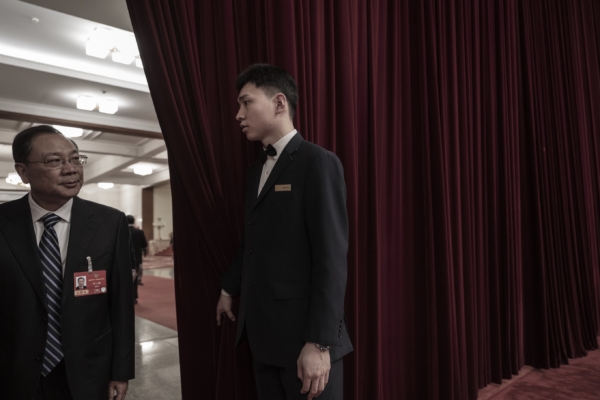
In a report by Ming Pao on March 10, the second plenary session of the NPC held on March 9 displayed a sense of relaxation both inside and outside the venue. The meeting started promptly at 9:00 am, with NPC Chairman Zhao Leji delivering the opening speech. However, some individuals on the presidium were seen rubbing their eyes, yawning, and even using tissues to wipe their noses.
On March 6, Ming Pao also reported that the atmosphere at the “Two Sessions” was dull, with delegates remaining silent. Not only in military matters but also in other discussions, it was challenging to find individuals willing to be interviewed.
Chinese affairs expert Wang He expressed to Epoch Times that the reluctance of individuals to be interviewed reflects a deteriorating political environment in China. The visible power struggle within the top echelons of the CCP has created a tense atmosphere. With figures like Zhang Yuxia and Liu Zhenli falling from grace, the political landscape in the CCP has witnessed significant tremors, and the aftershocks persist. Under these circumstances, the authorities have resorted to applying high-pressure policies on officials.
Wang He pointed out that the record-high number of central government officials ousted last year (65 individuals) demonstrates increasing turmoil, indicating that as the situation worsens, the pressure from the CCP’s top leadership on its members intensifies, depicting a political landscape in China marred by inaction and stagnation.
As internal conflicts within the CCP escalate, the number of absentees at the current NPC session reached 113, marking the highest number of absences since Xi Jinping assumed office in 2012, excluding the period during the COVID-19 pandemic in 2022. The list of NPC Chairpersons and Secretaries General has also seen a reduction of 13 individuals compared to previous years, including several local officials, military generals who were dismissed or investigated, and even national leaders like Zhang Yuxia, He Weidong, and Ma Xingrui.
During the closing session of the NPC, a series of resolutions were adopted, with a rare moment of one dissenting vote and two abstentions when approving the government work report presented by Premier Li Keqiang on March 5.
Commentator Li Linyi remarked that the CCP’s so-called national policies are usually decided following internal power struggles, rendering the NPC and CPPCC sessions merely symbolic gestures as rubber-stamp institutions.
In the government work report of the CCP, the economic growth target for this year was set at 4.5% to 5%. This marks the first time in over three decades that China has aimed for economic growth below 5%, underscoring significant pressures on sustaining economic growth.
Veteran political analyst Chen Pokong, based in the United States, told Epoch Times that since Xi Jinping took office, the Chinese economy has been in a state of continuous decline. With recent developments affecting China’s supply of cheap oil from Venezuela and Iran, coupled with the ongoing trade war with the United States, the future trajectory of the Chinese economy appears increasingly uncertain. Therefore, the CCP’s planned economic growth target of 4.5% is viewed as unreliable.
Observers have noted that many longstanding issues within the CCP remain unresolved. For instance, in the government work report, the focus on “stabilizing the real estate market” has slipped from sixth place last year to tenth place this year, with the rhetoric changing from “continuously pushing to stabilize the real estate market and halt its decline” to “focusing on stabilizing the real estate market.”
Wang He explained that the adjustment in the CCP’s real estate policy rhetoric is a tacit admission of past policy failures without direct acknowledgment. The CCP’s lack of hope in the real estate sector has led to a sort of resignation, akin to throwing in the towel. This shift is influenced by two main factors: first, Xi Jinping’s longstanding push to compete with the United States and promote the transformation of the technology industry, viewing real estate as overly financialized; second, the dominance of private enterprises in the real estate sector, which Xi perceives as undermining CCP authority.
“After the real estate collapse in 2021, Chinese authorities were unwilling to provide genuine market support. The International Monetary Fund proposed that China invest $1 trillion and take five years to comprehensively resolve the issue of unfinished properties, stabilizing the real estate market, but the CCP refused to accept the suggestion. This decision stems from ideological and personal cognitive barriers rather than sound economic policy principles,” he stated.
Wang He indicated that the CCP initially sought to stop the bleeding in the real estate sector, but after several years with no tangible results, their focus has shifted towards so-called “new productive forces,” leaving the real estate sector to deteriorate.
Data from the China Index Research Institute revealed that in February, the sales area of new homes in the top 100 cities in China dropped by 30% month-on-month, while the number of second-hand home transactions saw a 42% month-on-month decrease. Regarding housing prices, second-hand house prices fell by 0.54% month-on-month, with new housing prices dropping by 0.04%, representing the most significant month-on-month decline since December 2022.
The majority of Chinese real estate companies are still grappling with debt cycles. Lu Ting, Chief China Economist at Nomura Securities, stated during a February interview with Chinese media that only a few Chinese real estate companies have truly resolved their debt issues, with many merely extending their debt maturities. Relying solely on debt extensions could lead to a series of underestimated challenges.
The main focus of today’s NPC closing session was the adoption of resolutions outlining the “14th Five-Year Plan” (2026-2030). The document emphasizes the need to “expand domestic demand,” promote consumption, and drive what is referred to as “high-quality development.” Additionally, the term “elderly care” emerged as a prominent topic during this session.
Wang He highlighted that the current Chinese economy faces three major challenges: aside from the direct collapse of the real estate market, there is a lack of consumer spending power among the general population, coupled with low consumer willingness, as well as the accelerating aging population.
“It is widely forecasted that by around 2030 (possibly delayed until 2031), China will enter a stage of super-aged population, with individuals aged 65 and older accounting for over 20% of the population. China’s aging process is characterized by being ‘elderly before being wealthy,’ which is entirely different from the ‘wealth-before-aging’ trajectory observed in developed countries like Japan and Western nations. Due to China’s long-standing implementation of the one-child policy, the population structure has been severely distorted, leading to a vicious, even catastrophic state,” he elaborated.
He further explained that while the CCP aims to develop the “silver economy,” the reality is stark: currently, around 340 million retirees in China receive pensions, of whom about 180 to 190 million are farmers with a monthly average income of just over two hundred yuan, insufficient to sustain a high-end silver economy. This situation could potentially exacerbate living conditions, causing significant economic and social impacts.
He also emphasized that the CCP’s repeated calls for “expanding domestic demand” and “high-quality development” have been largely ineffective. The measures proposed in the “14th Five-Year Plan” remain mostly theoretical and impractical, hindered by the primary obstacle of the CCP system itself: a framework that systematically deprives the majority of the population, perpetuating widespread poverty, constituting a systemic issue.
In 2024, several Nobel laureates in economics pointed out in the book “Why Nations Fail” that the CCP’s system is an “extractive institution,” representing a form of exploitative governance.