
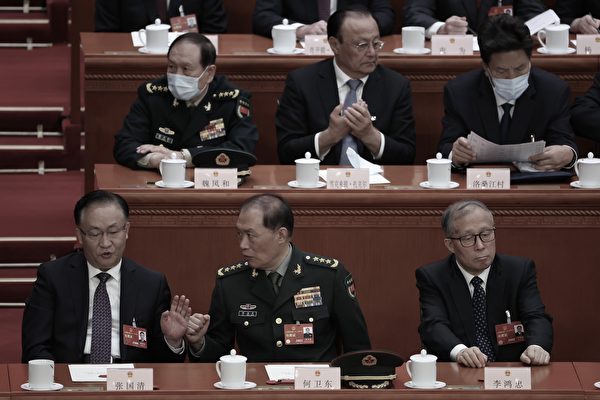
Recently, Chinese Vice Premier Zhang Guoqing has made multiple appearances at various international and domestic events. According to sources within the Chinese Communist Party (CCP) system, Zhang Guoqing is not an ordinary technical bureaucrat; his true background is closely related to the CCP military-industrial complex. Due to his long tenure in charge of the China North Industries Group Corporation (NORINCO), a major player in the military industrial complex, and his key role in the military trade enterprise, he has been dubbed by some observers as the “Vice Premier of the Military-Industrial Complex” controlling the CCP’s military-industrial lifeline.
Since early March, Zhang Guoqing has been attending various public events, including participating in meetings related to the National People’s Congress in Beijing, presiding over occupational safety meetings, and representing Xi Jinping as a special envoy to attend the World Nuclear Energy Summit in France. With tensions in the Middle East escalating, the frequent appearances of this CCP Politburo member with a military-industrial background have sparked external attention.
Having long served in the weapons industry, Zhang Guoqing is well-versed in the CCP’s conventional weapons foreign trade network and military technology system, and has built an extensive network within the military-industrial chain. Recently, he has been identified as playing a crucial bridging role in the military trade exchanges between the CCP and Middle Eastern countries.
According to three sources within the CCP system, following the heightened tensions in Iran, Zhang Guoqing has been directly tasked by Xi Jinping with the core mission of “utilizing his deep military-industrial background to coordinate relevant military supply chains and maintain technological and industrial ties with Middle Eastern regimes such as Iran.”
A source familiar with Chinese military-industrial enterprises, Yao Li (pseudonym), told reporters, “After the Iran situation escalated, Tehran has repeatedly requested support from Beijing, hoping that China would provide items such as drones, unmanned boats, and intelligent mines, for Iran to assemble military products on their own.”
Yao Li stated, “Zhang Guoqing has a deep background in the military-industrial system. He has become a key coordinating figure not only in the CCP’s conventional weapons foreign trade but also in some military technology research and development systems. The role he currently plays at the top level is not just that of a technical bureaucrat but more like a representative of the military-industrial system within the upper echelons of the CCP.”
Public records show that Zhang Guoqing has worked within the China North Industries Group Corporation and held managerial positions at NORINCO, a major Chinese military trade group responsible for weapons equipment and related technology exports.
Yao Li believes that the rise of Vice Premier Zhang Guoqing, known for his ties to the military-industrial complex, signifies Beijing’s increasing focus on global military exports as a strategic core. He pointed out, “Xi has arranged for Zhang Guoqing to oversee industry and security, with the core logic being to allow the military-industrial system to fully ‘go global.’ By selling weapons to countries in Asia and Africa, the CCP not only gains economic benefits but also uses this as a bond to penetrate and grasp the situation in various regions.”
In the current context of CCP’s comprehensive vertical leadership over government institutions, the role of Zhang Guoqing has strategically shifted from internal security governance to external military expansion. This expansion not only involves arms sales but also encompasses accompanying military technology and intelligence cooperation, further tightening technical relations between sensitive partners like China and Iran.
Within the CCP system, insider Jiang Jianming (pseudonym) revealed that when China exports weapons, small arms and riot control equipment typically do not require personnel to be dispatched. However, for heavy weapon systems like missiles, technical guidance or operational assistance must be provided by personnel.
He noted that if Iran were to purchase such heavy weaponry, Chinese personnel would undoubtedly be stationed there because the Iranian Revolutionary Guards might not be able to operate them independently. He metaphorically likened this scenario to a company importing CNC machine tools, where the supplier must come for installation, debugging, and staff training; otherwise, the machine won’t function.
A scholar familiar with the CCP power structure, Liu Jun (pseudonym), pointed out that Zhang Guoqing’s career path from leading the China North Industries Group to ascending to the position of Vice Premier of the State Council and member of the Central Politburo clearly outlines the key role of military-industrial officials in industrial, energy, and national security strategies.
Liu Jun told reporters, “Zhang Guoqing’s elevation to the top leadership is not just a reflection of the rise of ‘technical bureaucrats’ within the system but also demonstrates the continuing influence of the military-industrial complex in current political structures.”
He further analysis stated that against the backdrop of the tumultuous situation in Iran, the CCP is now gaining a front-line perspective through actual combat feedback to deeply analyze the operational characteristics and weapon efficiency of the US military.
Liu Jun emphasized that Zhang Guoqing is one of the few officials within the CCP’s top decision-making circle who simultaneously possesses deep military-industrial background and practical experience in the Middle East. During his earlier tenure at China North Industries Corporation, he was stationed in Tehran, Iran, gradually building local political and economic networks from grassroots positions.
Liu Jun told reporters, “Within the CCP’s top leadership, he is seen as an ‘Iran expert,’ and he is basically leading important decisions related to Iran affairs, with Xi’s significant trust in him.”
Public records show that in May 2004, Zhang Guoqing, then President of the China North Industries Corporation, signed an $836 million contract for the construction of Line 4 of the Tehran Metro in Iran. This project set a record for China’s foreign engineering contracts at the time and further solidified the influence of China North Industries Corporation in the Iranian market.
A technical personnel from a Guangdong network company, Mr. Zeng (pseudonym), revealed that as early as 2016 or even earlier, multiple technology enterprises from Guangdong, Beijing, and Jiangsu had been deeply involved in Iran’s communication network and surveillance system construction. Mr. Zeng pointed out, “This multi-layered cooperation integrating military, infrastructure, and high technology has made China Iran’s core strategic partner in the Middle East. Iran’s current firm stance is to a large extent supported by comprehensive backing from China and Russia.”
According to Mr. Zeng’s observations, China-Iran technical cooperation has extended from general infrastructure to highly sensitive security areas. He stressed, “China is not only assisting Iran in building domestic stability monitoring systems, including hardware like cameras and data analytics support, but also providing surveillance technology targeting the US military’s activities in the Persian Gulf region. This comprehensive technological output has become an invisible pillar of the China-Iran relationship.”
Amid the current volatile international environment, analysts point out that the deepening cooperation between China and Iran in energy supply and defense technology is gradually becoming a significant indicator of how Beijing aims to expand its geopolitical influence in the Middle East. As relations between the US and Iran continue to deteriorate, and armed conflicts in the region escalate, the strategic connection between Beijing and Tehran is perceived to strengthen further.
Some scholars suggest that the ongoing conflicts in the Middle East are forcing the international community to re-examine the cooperation network between China and Iran. As tensions escalate, China’s military-industrial industry’s role in supporting Beijing’s overseas strategies is gradually moving from behind the scenes to the forefront. Some security researchers believe that Beijing is leveraging the changes in the Middle East situation to strengthen cooperation with Iran in energy and military technology, thus expanding its own influence in the region and gaining opportunities for observation and assessment of Western military systems.