
Hello, viewers! Welcome to watch “Century Truth”.
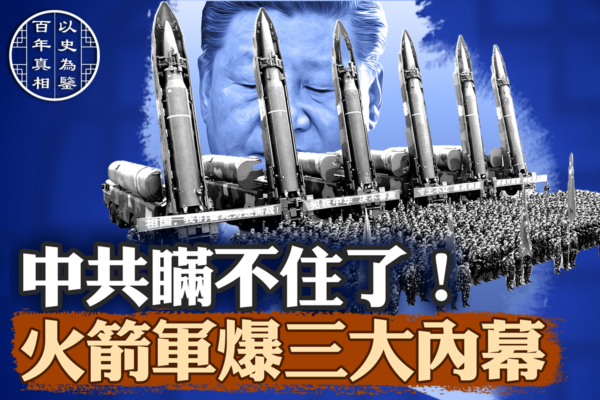
Today, let’s talk about the “Rocket Army’s Shocking Case” of the Chinese Communist Party. This case starts with a report. On October 24, 2022, just after the conclusion of the 20th National Congress of the Communist Party of China, the China Aerospace Studies Institute (CASI) affiliated with the U.S. Air Force University released a 255-page “Chinese Rocket Army Report”. The report was very detailed, covering the composition of the Rocket Army, coordinates, types of deployed weapons, and personal information of senior management.
It is believed that this level of military intelligence is not something that ordinary officials can access. The individuals leaking such high-level secrets must hold significant ranks. Shortly after the release of this report, in April 2023, the Rocket Army case erupted, leading to the downfall of a group of generals and uncovering three major events that the CCP had been vehemently concealing.
So far, at least 13 generals have fallen in the Rocket Army, including 4 generals, 7 lieutenant generals, and 2 major generals.
Among them, 11 generals who have been investigated and dealt with include the first Rocket Army commander Wei Feng and general, the second Rocket Army commander Zhou Yaning, the third Rocket Army commander Li Yuchao, the fourth Rocket Army commander Wang Houbin, former Rocket Army deputy commander Li Chuanguang, former Rocket Army deputy commander and Deputy Chief of General Staff of the Military Commission Joint Staff Department Zhang Zhenzhong, former Rocket Army Chief of Staff Sun Jinming, former Rocket Army Discipline Inspection Secretary Wang Zhibin, former Rocket Army Political Work Department Director Zhang Fengzhong, former Rocket Army Equipment Department Minister Lv Hong, and former Rocket Army Equipment Department Deputy Minister Li Tongjian.
One general who has not been officially announced is former Rocket Army deputy commander Li Guangbin. According to a report by Hong Kong media “South China Morning Post” in July 2023, Rocket Army commander Li Yuchao, deputy commander Li Guangbin, and former deputy commander Zhang Zhenzhong were taken away for investigation by the CCP Central Military Commission anti-corruption agency. Li Yuchao and Zhang Zhenzhong were later notified for handling by the authorities, while the news of Li Guangbin’s investigation has not been disclosed. Up to now, Li Guangbin has been “missing” for more than 2 years, with little possibility of a “safe passage”.
Additionally, on July 4, 2023, retired for 3 years and only 66 years old, the former Rocket Army deputy commander Wu Guohua passed away. Hong Kong media reported that Wu Guohua’s former superior, the son of former CCP Central Military Commission Vice Chairman Zhang Zhen, Zhang Xiaoyang, revealed that Wu Guohua had committed suicide by hanging himself.
Now, with so many generals falling in the Rocket Army’s major case, what are the three major truths hidden behind it?
The first truth is: Xi Jinping, the highest commander and chairman of the Central Military Commission of the CCP, has failed in personnel selection, and corruption has become the biggest corruption issue.
The Rocket Army, established after the 2015 military reforms by Xi, is the fourth military branch after land, sea, and air, a key military force for Xi’s military strategy towards Taiwan, deterrence against the United States, and global dominance. It is capable of launching medium-range, long-range, and intercontinental missiles armed with nuclear warheads from sea, land, and air, conducting strategic operations in three dimensions. Xi referred to it as the “core force of China’s strategic deterrence, the strategic support of China’s great power status, and the important cornerstone for safeguarding national security”.
Given the extreme importance of the Rocket Army, the leader of the Rocket Army must have Xi Jinping personally overseeing, approving, and making final decisions.
However, the results have been upsetting for Xi; the first Rocket Army commander, Wei Fenghe, and the second and third Rocket Army commanders, Zhou Yaning and Li Yuchao, all turned out to be severely corrupt individuals.
After three failures, Xi carefully selected Wang Houbin as the fourth Rocket Army commander. Logically, after three consecutive failures, the fourth should not have gone wrong again. However, it was surprising that Wang Houbin, still turned out to be a severely corrupt individual.
Xi Jinping once said, “corruption in governance is the biggest corruption.” By selecting four Rocket Army commanders, each of whom turned out to be severely corrupt individuals, isn’t this a case of “corruption in governance”? Isn’t this the “biggest corruption”?
Therefore, shouldn’t Xi bear the greatest and irreplaceable leadership responsibility?
The second truth is: corruption in the CCP’s military has reached its peak, and Xi Jinping’s anti-corruption campaign has utterly failed.
Since Xi took office in 2012, he began an anti-corruption campaign. Over the course of the first two terms, over 160 generals were investigated and punished by Xi, surpassing the total number of generals who fell during the CCP’s establishment in 1927 in civil wars, foreign wars, and the Cultural Revolution.
Among them were former CCP Politburo members and Vice Chairmen of the Central Military Commission Xu Caihou and Guo Boxiong, former Central Military Commission member and Director of the Political Work Department Zhang Yang, and former Central Military Commission member and Chief of Staff of the Joint Staff Department Fang Fenghui, senior generals of the military.
After the investigation and punishment of Xu, Guo, Zhang, Fang, the CCP continued to purge its military, aiming to “eradicate the poison” and declared in 2018 that the “anti-corruption struggle had achieved overwhelming victory.” Before the 20th National Congress of the CCP in 2022, it claimed that the “anti-corruption struggle had achieved overwhelming victory and was completely consolidated.”
In 2022, after “three consecutive terms” at the 20th National Congress, Xi Jinping had personally appointed and promoted most of the top leaders of the 15 departments of the Military Commission, various major military branches, five major theater commands, military academies, and so on. Since the official statement claimed that the anti-corruption campaign had “achieved overwhelming victory and was completely consolidated,” one would expect the situation to be clean and upright, right?
However, shortly after the 20th National Congress, the Rocket Army case erupted, quickly spreading to various departments such as the Equipment Development Department of the Military Commission, the Joint Staff Department, the Political Work Department, the Joint Operations Command Center, the Logistics Support Department, the Navy, the Army, the Air Force, the Strategic Support Force, the Joint Logistics Support Force, and the Armed Police Force, leading a wave of CCP generals to fall due to severe corruption. Even Xi’s personally handpicked Politburo member and Central Military Commission Vice Chairman He Weidong, was found to be a severely corrupt individual.
Regarding the Rocket Army, not only were four consecutive commanders accused of being severely corrupt individuals, but even the Rocket Army Discipline Inspection Secretary Wang Zhibin and the Rocket Army Political Work Department Director Zhang Fengzhong, who were dedicated to anti-corruption efforts and political construction, respectively, were also found to be severely corrupt individuals.
All of this reflects the extent of corruption within the CCP has reached its peak, and there is no turning back for the party.
The third truth is: Xi Jinping has transitioned from centralized power (centralized collection) to extreme power (extreme collection), and this road has come to an end.
After taking office, Xi Jinping first seized the highest power that had been in the hands of Jiang Zemin and Zeng Qinghong through anti-corruption efforts, becoming the “core” of Xi; then, through continuous anti-corruption efforts to purge political opponents, he concentrated more power in his hands.
By the time of the 20th National Congress of the CCP in 2022, Xi had become the only General Secretary of the CCP and Chairman of the Central Military Commission to achieve “three consecutive terms” in the 44 years since the CCP’s “reform and opening up.” This marked Xi’s transition from centralized power to extreme power.
Xi’s most “powerful” moment – this power must be in quotes – was at the closing ceremony of the 20th National Congress when he ordered that the former highest leader of the CCP’s party, government, and military, Hu Jintao, be escorted out of the venue. At that time, Hu Jintao had been retired for 10 years and was 80 years old. He had provided tremendous support to Xi and posed no threat to him.
Xi thus sat at the pinnacle of power, overseeing everything, yet, even his most trusted and valued generals, including CCP Politburo member, Central Military Commission Vice Chairman He Weidong, and Central Military Commission member, Director of the Military Work Department Miao Hua, were not managed properly; none of the four Rocket Army commanders personally chosen by him were managed well; and even the 13 generals in the Rocket Army promoted and valued by him were not managed properly.
The first Rocket Army commander, Wei Fenghe, was officially declared to have “collapsed in faith and lost loyalty.” What does this mean? It means that he did not believe in the ideology of Marxism, Mao, Deng, and Xi. Although he verbally proclaimed “absolute loyalty,” in reality, he betrayed that loyalty.
For individuals like He Weidong, Miao Hua, and Wang Houbin, the official statement not only claimed that they “collapsed in faith and lost loyalty” but also added the phrase, “seriously violated the principle of the party commanding the gun and the responsibility system of the Military Commission Chairman.” What does this mean? In simple terms, it means “attempting to seize the power of the party and the state,” acting as “ambitious” and “conspiratorial” individuals against the party, causing chaos in the military, and trying to seize power.
In fact, reaching this point is not surprising. The British historian, political thinker, and Lord Acton once said, “Power tends to corrupt, and absolute power corrupts absolutely.”
By abandoning Deng Xiaoping’s “separation of party and government” and the “decentralization of power” measures, Xi returned to Mao’s totalitarian rule, only to find that even his most trusted and valued generals in the military were deceiving and misleading him.
Who can Xi trust now? Who can trust Xi? Today, Xi has become a lonely figure.
There is a saying in China, “Three strikes and you’re out.” For Xi Jinping, who repeatedly promoted generals who turned out to be failures, wouldn’t any sensible and conscientious official within the CCP system wonder: why should I be “loyal,” “supportive,” “uphold,” or “defend” him?
Yet, surprisingly, the CCP’s official media continues to promote “loyalty,” “support,” “upholding,” and “defending” Xi’s core.
Ultimately, who will be duped by these self-deceiving lies?
That’s all for today’s program. Thank you for watching, and we’ll see you in the next episode.
-Production Team of “Century Truth”