
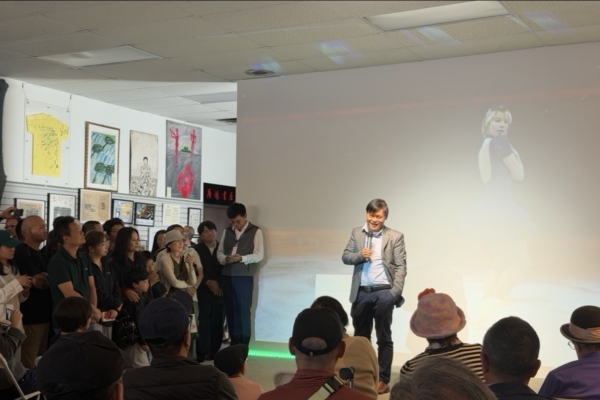
Alysa Liu won the figure skating gold medal at the Milan Winter Olympics, much to the delight of the American people. Chinese parents, in particular, are eager to know: how did Liu Jun, as a single father, lead his daughter to the world champion award ceremony? Last Saturday, March 7th, Liu Jun was invited to share at the June 4 Memorial Hall, and the hall was packed with an enthusiastic audience.
The event was hosted by former 1989 student movement leader Wang Dan, and two “June 4 students” – Chinese pastor Zhang Boli and Chao-Hua Wang, assistant professor at the University of California, Los Angeles were also in attendance. Zhang Boli’s speech was filled with joy, as he read out a long congratulatory poem written on the spot after watching the game, as if his own daughter had become a world champion.
Wang Dan first expressed that in recent years, many people around the world have been paying attention to Alysa Liu’s performance on the ice – with outstanding talent, strong willpower, and elegant posture, she has won glory on the world stage and become a role model for many young people. “For us, this is not just a sports story, but also a story about freedom and dreams,” he said.
In 2022, 16-year-old Alysa Liu announced her retirement after winning bronze at the Beijing Winter Olympics. After two years of self-exploration and contemplation, at the age of 18, she returned to the ice rink and wrote a legend for the figure skating world with her outstanding performance. Her heartfelt radiant smile on the field infected audiences in the United States and globally.
Wang Dan said, people often summarize the Olympic spirit as higher, faster, stronger, but its true spirit is freedom. “Only in an environment that respects individuals, encourages exploration, and allows different voices to exist, can young people truly unleash their potential, pursue excellence, and achieve their dreams.”
Amidst the applause of the audience, Liu Jun recounted the process of accompanying his daughter’s growth.
When Alysa was five years old, Liu Jun took her and her sister to the ice rink to play. Stepping onto the rink for the first time, Alysa stood out from the crowd. While others could only slowly move along the walls, she could run up to chase other kids. Liu Jun said, “She was very natural and stable on the ice, playing on the ice was like walking on land for her.”
Seeing Alysa’s love for ice sports, Liu Jun enrolled her in skating lessons. One or two months later, the rink coach excitedly told Liu Jun that Alysa had great talent and asked if he wanted to enroll her in private lessons. Before Liu Jun could even respond, the eager coach unexpectedly offered a half-price discount.
In the higher standard private lessons, Alysa showed amazing talent. Liu Jun cherished every success of his daughter:
At the age of eight or nine, she could do a double axel; at ten, she became the youngest champion in the intermediate women’s singles figure skating at the U.S. Figure Skating Championships. At eleven, she represented the United States in international competition, at twelve, she became the youngest skater to execute a triple axel, at thirteen, she became the youngest women’s figure skating champion in the U.S., and at fourteen, she even successfully landed a quadruple jump… her future on the ice seemed limitless.
But at the age of sixteen, Alysa suddenly didn’t want to skate anymore. While Liu Jun felt sad, he respected his daughter’s choice. After quitting training, Alysa began working and embarked on a different path in life. However, a fun skiing experience with some friends in early 2024 rekindled her passion for the ice rink.
During that outing, her friends saw her exceptional skills on the snow and encouraged her to try the ice rink again. After giving it a go, she still could perform difficult maneuvers; the following week, she even landed a triple axel. Her enthusiasm for figure skating reignited, and Liu Jun, of course, wholeheartedly supported her.
After rigorous training, in 2025, Alysa won silver by just one point at the national competition and then went on to win the gold at the World Championships in Boston.
“She used to think it was me who made her skate, now she skates for herself,” Liu Jun remembered when his daughter once said to him, “As for you, just be a dad and a spectator now.” Upon her return to the ice rink, she no longer needed her father’s prompting.
Liu Jun believes that Alysa’s ability to achieve the championship is closely related to her long-standing mindset. He said, “She never envies others. When other skaters skate well and outrank her, she applauds for them. I think this quality is very rare.”
Alysa’s relaxed attitude during competitions is another hallmark. “When you watch her compete, whether it’s a team event or individual event, she’s not focused on rankings, very relaxed,” the father said. “The less nervous she is, the better she performs.”
After Alysa descended from the ice rink in the Winter Olympics, there were still two top Japanese skaters waiting to compete, but at that time, Liu Jun felt at least the bronze was secured. Many of the following skaters made mistakes possibly due to nervousness. In the end, Alysa came in first overall.
Despite raising his daughter to become a world champion, Liu Jun humbly refers to himself as “not a very responsible father.” “I can’t send this one to play volleyball every day, or send that one to play basketball… I can’t send every child every day.” He described himself as “free-range,” and the advantage is that it cultivated strong independence and discipline in his children.
To save training costs, the family lived in a one-bedroom apartment with three bunk beds. When he was overwhelmed, Liu Jun sought help. He said, “Once we bring children into the world, we have to be responsible for them. So, at the very least, we must take care of their living, safety, education, and so on.”
During the time he started nurturing Alysa, his law firm was very busy, with many clients to attend to, and he had four other children at home. Taking a little extra nap even became a luxury. He woke up at 4:30 every morning, carried his daughter to the car, took her to the ice rink, and then woke her up. “Year after year, day after day, doing this every day also requires persistence,” Liu Jun said. But he persevered.
Around the time Alysa participated in the 2022 Beijing Winter Olympics, Liu Jun faced tremendous pressure from the Chinese Communist Party, including harassment, surveillance, and even significant monetary temptations, making him worry about Alysa’s safety. And he withstood the pressure.
The audience erupted in applause at Liu Jun’s experience of nurturing his daughter.
During a post-match interview, Alysa Liu once said, “My story starts with my dad’s generation.” She also mentioned her father fleeing China after the June 4 incident. This deeply touched Chinese people who experienced June 4.
Wang Dan stated that Liu Jun, as a father, accompanied and supported Alysa’s journey to the world stage, which is not just a family story but also a legacy of values. “I believe that Alysa’s courage and confidence on the ice must also have originated from the strength and belief of her family.”
Zhang Boli praised Liu Jun for rejecting seduction of money from the CCP, saying, “Poverty cannot be moved, and might cannot be conquered.”
Ms. Xu, whose child is in high school, expressed after the event that what impressed her the most was Liu Jun’s willingness to live in a humble one-bedroom apartment to cultivate his children. She found Liu Jun to be an extraordinary father.
Ms. Xu believes that Alysa Liu’s success is inseparable from the internal “self-driving force.” And Liu Jun’s experience “is something that we Chinese families should think about: how to cultivate children, parents need to learn how to let go, from guidance to companionship, let them know their direction and carve out their own place in the world.” ◇