
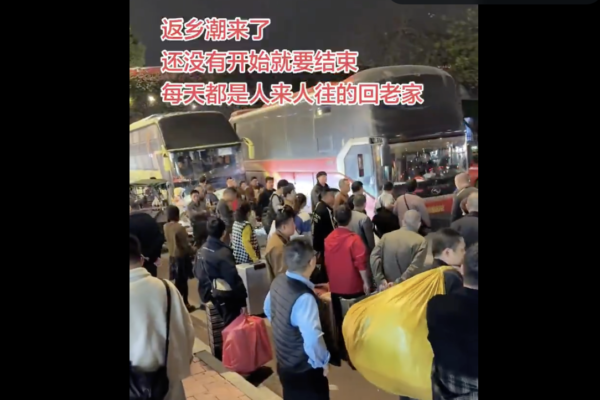
In 2026, the Chinese economy has deteriorated further. Following the end of the Chinese New Year holiday, a wave of people returning to their hometowns has swept across cities from inland areas to coastal regions. Many lament the inability to find jobs and have resorted to returning home to “lying flat,” a term used to describe choosing inactivity. However, some find that even back in their hometowns, they struggle to make a living and would rather wander in the cities.
Those who flocked to southeastern coastal cities in search of employment still find it challenging to secure suitable jobs even after the Lantern Festival and are now boarding trains heading back to their hometowns.
A young man from Yuncheng, Shanxi, using the alias Xiao Ming, told reporters on March 10 that at present, the train stations are filled with people who cannot find jobs and are returning home.
Xiao Ming left home after the fifteenth day of the lunar new year and arrived in Wuhan. However, he found it difficult to find work with salaries only around 3,000 RMB, making it a challenging job market. He expressed his frustration, stating, “I have been in Wuhan for five or six days, still unable to find a job. I plan to go to Guangdong next. If Guangdong doesn’t work out, I won’t go anywhere else. I’ve gone around the whole country, from Wuhan to Zhengzhou, and couldn’t find a job. Beijing is all about security guards, and Tianjin doesn’t have job opportunities; even the locals are working outside.”
On March 8, a Chinese blogger released a video stating that migrant workers in Guangzhou were struggling and starting to head back home.
In a video clip depicting the situation on March 8, many migrant workers who had come to Shanghai for work found themselves unable to secure employment and have opted to return home, resorting to “lying flat.” The man recording the video chuckled, saying, “The first batch of people returning home for the Lunar New Year in 2027, see, many people… (Video link)”
Comments from netizens in the comment section include remarks like, “They are back so early,” “Don’t scare me, I am still on the train,” and “This is not coming home for the New Year, this is coming home to ‘lie flat.'”
In Wenzhou, Zhejiang, after the Lunar New Year, many shoe factories remained closed, leaving numerous migrant workers without work, forcing them to return home to “lie flat.”
A man from Southwest Qianxinan, Guizhou, using the alias Yang Ming, arrived in Yiwu, Zhejiang, on the fifteenth day of the lunar new year in search of work. However, he found the working conditions in Yiwu untenable, with long hours (12 hours a day) but low pay (15 RMB per hour) and decided to return home promptly. He explained, “The working conditions in Yiwu are tough; I went to a textile factory to make socks, but there were hardly any people there. Yiwu is deserted now, especially at night. It’s not worth it to come all this way for a monthly income of three to four thousand RMB; might as well stay home.”
Yang Ming mentioned his travel expenses, spending over 2,000 RMB on high-speed rail fares and more than 200 RMB daily on hotel stays. Despite his efforts, he found that the wages in his hometown were similar, making him feel that this year was more challenging compared to the previous one.
Migrant workers struggling to find employment have also impacted small business owners, as even running a breakfast shop has become difficult. Some small business owners embarked on a brief exploration outside their hometowns but ultimately returned home.
A woman from Beiliu City, Guangxi, using the alias Dong Ning, drove to Wenzhou, Zhejiang, on March 4 with the intention of opening a breakfast shop, only to return home on March 10. She explained, “I couldn’t survive in Wenzhou anymore. I run a business selling breakfast, but this year, there are fewer people, and the rent for the shop is high. Therefore, I decided to come back. It’s tough in Wenzhou; there are fewer job opportunities with many factories remaining shut. It’s challenging to make a living here without making enough money.”
Despite the hardships of finding employment, many young people are reluctant to leave big cities as returning to their hometowns offers even fewer job prospects. For instance, a woman named Xiao Lin, along with two friends, shares a rented apartment in Shenzhen, with monthly rent exceeding 1,000 RMB, their most substantial expense. They diligently search for work every day and even scavenge for recyclables late at night.
Xiao Lin, a migrant worker in Shenzhen, expressed, “The three of us have been here for half a month but still can’t find work. We collect bottles at night, but it’s not easy. We look for jobs during the day, apply for multiple roles like waitressing. We go wherever there’s a temporary job available. We will persevere.”
A Shanghai resident, Mr. Wang, revealed that many unemployed migrants who cannot make a living back in their hometowns prefer to stay in Shanghai, even if it means living on the streets due to strict enforcement against vagrancy. He elaborated, “For those migrant workers who can’t return, they pick up scrap materials in Shanghai to survive. They find a spot under a bridge to sleep, and authorities specifically target them in the night to deport them.”
Xiao Ming, the young man from Shanxi, shared with reporters that he has already spent 3,000 RMB since leaving home. Working outside can barely earn him a monthly income of around 4,000 RMB. Desperate to find a job, he realizes that the lack of work means no food on the table. Coming from a background in urban management back home where he got hit by a vehicle, he decided to seek opportunities outside his hometown.
Xiao Ming emphasized, “Even back in my hometown, finding a job is hard; it’s like waiting to die. I plan to continue my job search.”
Another migrant worker from Zhejiang, Xiao Chen, expressed, “I’ve been here for over half a month but can’t secure a suitable job. I am struggling to put food on the table. Factories are not busy, and they offer low wages, around 16 RMB per hour, with most positions being hourly or piecework roles.”
Hailing from Guizhou, Xiao Chen arrived in Jinhua, Zhejiang, with her young child on the fifth day of the lunar new year but has not found employment. Returning home presents a dilemma, as job prospects are limited there as well.
Mr. Wang from Shanghai disclosed that a significant number of companies and factories in Shanghai have closed down, resulting in layoffs. Many streets have become deserted, impacting both migrant workers and the local youth, leaving most unable to find work.
Mr. Wang commented, “Company owners have fled, leaving buildings deserted. For instance, my son worked at a 5-star hotel, and the owner disappeared over the Lunar New Year without paying salaries. Hence, my son lost his job and had to return home. Also, my sister’s child worked for a tech company that experienced layoffs. Nowadays, young people can’t find jobs, staying at home, relying on us, the elderly, as the government turns a blind eye.”
This article was contributed to by special correspondent Xiong Bin for The Epoch Times.