
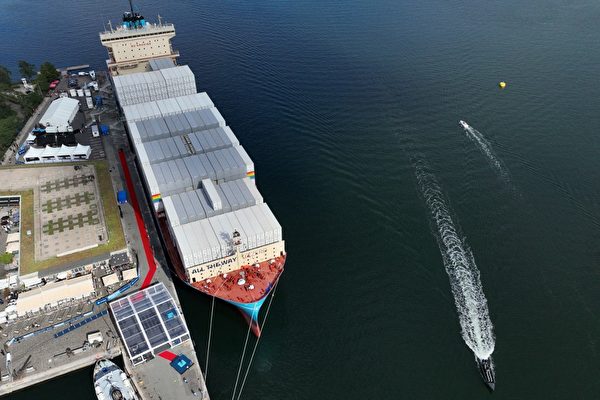
Amid concerns about the disruption of trade due to the Iran war, Beijing summoned top executives from two major European shipping companies to protest against their imposition of additional shipping charges and suspension of cargo services to and from the Middle East.
The Chinese Ministry of Transport stated on Tuesday (March 10) in a brief statement that it has held discussions with Maersk, a Danish shipping group, and Mediterranean Shipping Company (MSC) based in Switzerland regarding their “international shipping business,” but did not provide detailed information.
The National Development and Reform Commission, China’s top economic planning agency, mentioned that they have also conducted talks with these two companies recently.
According to sources cited by the Financial Times on Tuesday, disruptions in trade caused by the Iran war led the two shipping giants to increase costs, raise freight rates, and suspend some routes to and from the Middle East, prompting China’s Ministry of Transport to express concerns about supply chain disruptions and trade stability.
Data released by China’s customs on Tuesday showed that China is the world’s largest exporter, sending goods worth over $30 billion to Middle Eastern countries in the first two months of 2026, with machinery, electronic products, and automobiles being the main exports.
In recent years, as tensions in Sino-American trade have escalated, the Middle East has become an important trade partner for China. Statistics from the Ministry of Commerce show that China’s exports to the Middle East in 2025 grew nearly twice as fast as its exports to other regions worldwide, while total trade with the US decreased by 16.9%.
As China is facing various economic challenges such as weak domestic consumption, exports remain a bright spot in the economy, with China setting its economic growth target for 2026 at 4.5% to 5%, the lowest target in decades, coinciding with the ongoing National People’s Congress in Beijing.
Since the outbreak of the war between the US and Israel against Iran last week, Iran retaliated by launching attacks on ships entering the Strait of Hormuz, virtually halting all shipping in the region and forcing shipping companies to suspend most voyages to Gulf ports.
Maersk has suspended most cargo shipments to and from multiple ports in the Middle East due to the “highly volatile situation” in the region. The group has also imposed high emergency charges on existing bookings and transit cargo from the region to cover costs of alternative routes and warehousing, ranging from $1,800 to $3,000 per 20- or 40-foot standard container.
Mediterranean Shipping Company (MSC) announced last week it would implement an emergency fuel surcharge on major routes and temporarily increase freight rates from Asia to Europe and select African countries.
An insider revealed that with the rising costs due to the shipping disruptions in the region, the shipping companies had no choice but to raise prices. During the Covid epidemic, similar surges in shipping costs occurred, prompting Beijing to request measures from shipping firms.
Both companies are currently operating routes to some ports in Saudi Arabia and Oman. MSC emphasized a land route through Saudi Red Sea ports to Gulf countries on Monday.
Previously, Maersk and MSC were also involved in a dispute over control of ports in the Panama Canal.
Following a ruling by the Supreme Court of Panama that the concession for ownership of a canal terminal held by Hong Kong’s Hutchison Port Holdings was unconstitutional, subsidiaries of the two companies each took control of a terminal owned by Hutchison.
Maersk, MSC, and the Chinese Ministry of Transport did not respond to requests for comments from the Financial Times.