
On Tuesday, March 10th, US Secretary of War Haggerty and Chairman of the Joint Chiefs of Staff General Dan Kane held a press briefing to outline the latest military developments in the “Epic Fury” operation against Iran. Kane stated that the US military used heavy bombs to strike Iran’s underground missile bunkers.
At the press conference, Kane mentioned that the US military recently deployed “dozens of 2000-pound armor-piercing bombs” on Iran’s deeply buried missile launch wells, underscoring the Pentagon’s current focus on targeting underground objectives.
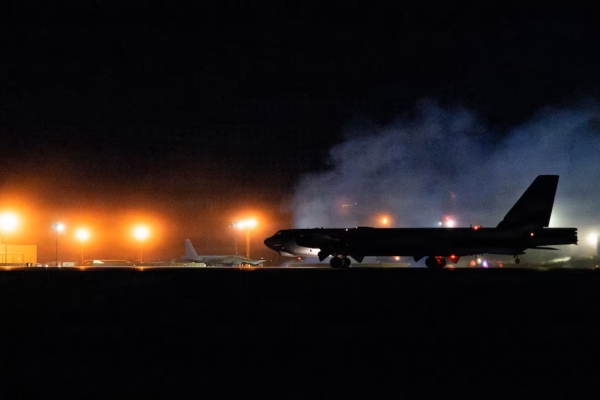
“Strategic bombers recently dropped dozens of 2000-pound GPS-guided armor-piercing bombs on deep-buried missile launch wells in southern Iran. We also targeted several unmanned drone factories to destroy the core of their autonomous combat capabilities,” Kane said at a press briefing held on Tuesday morning at the Pentagon.
Both Kane and Haggerty reiterated that destroying Iran’s missile launch and production capabilities is a top priority for the US military. Kane specifically pointed out that the US is targeting Iran’s military industrial bases, including underground facilities.
Kane stated that the US has made progress in neutralizing Iran’s missile capabilities, but the Pentagon is still planning to address another critical threat – Iran’s underground nuclear facilities, especially those suspected of storing highly enriched uranium.
Iran has spent decades constructing underground bunkers to protect its vast missile arsenal. These massive underground “missile cities” built deep in the mountains and reinforced command centers have become targets for attacks by the US and Israeli forces.
The US 2000-pound BLU-109 armor-piercing bombs, with a one-inch thick steel alloy casing, are designed to penetrate up to six feet of reinforced concrete before detonating with a delayed fuse. These heavy bombs are equipped with Joint Direct Attack Munition (JDAM) tail kits, making them GPS-guided smart weapons capable of precisely targeting bunker entrances.
The Wall Street Journal reported that according to analysts, almost all of Iran’s dozens of missile bases are located underground, but their above-ground structures, roads, and entrances make them identifiable through satellite imagery. The Pentagon and Israeli military have spent several years locating these facilities.
Researcher Sam Lair analyzed that the concept of Iran’s “missile cities” has a fundamental flaw: the originally mobile launch devices are trapped in fixed entrances at known locations, making them easier to target and destroy.