
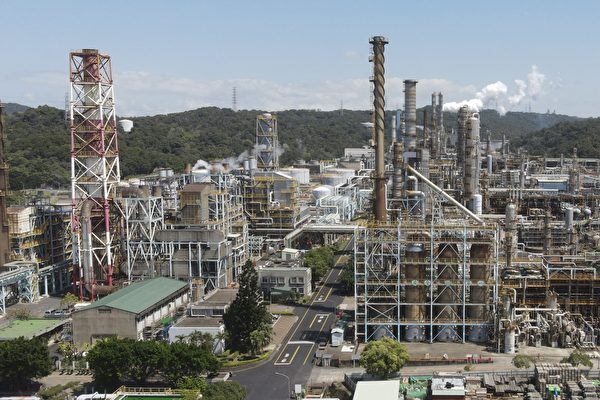
With the continuous surge in crude oil prices, prices of petroleum and chemical products in mainland China have also seen a significant increase, with the prices of chemical raw materials rising by more than 50% on average. This has further squeezed the already tight profit margins in China’s manufacturing industry, putting companies under immense survival pressure. Analysts believe that if oil prices continue to rise, the Chinese economy may spiral from long-term deflation into another vortex: stagflation.
As the conflicts in the Middle East escalate, international oil prices have surpassed the $100 per barrel mark for the first time in nearly four years. On Monday (March 9), the futures price of light crude oil for delivery in April on the New York Mercantile Exchange nearly reached $120 per barrel, marking a more than 30% increase. The international benchmark Brent crude saw a nearly 20% surge during Asian trading hours on Monday, reaching $109 per barrel.
The soaring crude oil prices have led to a significant increase in prices of petroleum and chemical products in mainland China. According to data from commodity information provider “Yeshi She” on March 9, prices of energy products, chemical raw materials, rubber and plastic product materials, as well as textile raw materials, have generally risen, with the prices of chemical raw materials seeing increases of over 50% on average.
The seven-day surge in prices of energy products including liquefied petroleum gas, liquefied natural gas, WTI crude oil, Brent, petroleum coke, diesel, and naphtha are 50.61%, 47.66%, 35.63%, 27.20%, 23.50%, 19.50%, and 19.19%, respectively.
For chemical raw materials such as pure benzene, acrylic acid, isopropanol, dichloromethane, acetone, butylene, and phenol, the seven-day price increases are 88.91%, 87.66%, 63.14%, 59.12%, 58.42%, 55.35%, and 55.12%, respectively.
In terms of rubber and plastic product materials like ABS, PP (filament), PA6, LLDPE, LDPE, HDPE, and PVC, their seven-day price increases are 54.26%, 32.40%, 28.22%, 26.89%, 25.61%, 19.00%, and 18.78%, respectively.
As for textile industry chemical raw materials including acrylonitrile, PTA, polyester POY, polyester FDY, polyester DTY, PTA, and polyester short fiber, their prices have increased by 15.96%, 12.45%, 12.12%, 11.05%, 10.04%, 8.65%, and 7.79%, respectively.
Petroleum and chemical products involve the processing of crude oil by refineries into primary and secondary products. Primary processing entails the physical separation of crude oil (often through fractional distillation), which divides crude oil into naphtha, diesel, paraffin, etc.; secondary processing involves chemical treatments where heavy oils and residues are converted into high-value light products like gasoline, diesel, etc. Products include liquefied petroleum gas (LPG), petroleum coke, aromatics (PX/benzene), and chemical raw materials, extensively used in the manufacturing of plastics, synthetic rubber, synthetic fibers, detergents, paints, and other products.
The surging costs of upstream materials are squeezing profit margins for downstream manufacturers, forcing them to either absorb the increased costs or pass them on to consumers, risking loss of orders in the process.
According to a report by Bloomberg, seven clothing manufacturers in southern and eastern China interviewed stated that the rising raw material prices have further squeezed their profit margins, putting them under survival pressure.
Lily Lu operates an apparel and accessory export company in Zhejiang, with clients including Walmart. She mentioned that the recent price surges have threatened her business, making it hard to sustain. On Monday, a fabric supplier informed her that due to a 10% increase in synthetic fiber costs, prices are expected to rise—moments later, she received another message stating that raw material prices had surged by over 15%.
Lu said, “The meager profit from Walmart orders simply cannot offset the cost pressures from fabric price rises.” She mentioned that for recent orders placed, factories can only bear the increased costs themselves.
Wu Ying owns two factories producing women’s shirts and dresses in Guangzhou. To cope with the rising costs, Wu has begun negotiating with clients to share costs and increased down payments to ease cash flow pressures.
Two suppliers providing goods to the low-cost fashion retailer Shein told Bloomberg that they are striving to negotiate cost-sharing with the company for about half of the 10% rise in raw material costs.
The report indicates that soaring input costs could impact the entire clothing supply chain, potentially leading to higher clothing prices. For manufacturers, the timing couldn’t be worse as global consumer demand remains weak, and the overall Chinese economy continues to struggle, further compressing factory profit margins.
In recent years, weak demand in the Chinese economy, coupled with excess factory capacity, has fueled price competition and long-term internal circulation, resulting in persistent deflationary pressures in the Chinese economy. If crude oil prices and manufacturing raw material prices remain high in the long term, it could alleviate the long-term deflationary pressures on the Chinese economy, but this could also push China’s economy into another vortex: stagflation.
An article by the South China Morning Post on March 8 quoted Su Jian, a professor at Peking University’s Guanghua School of Management, stating that, “Rising oil prices may lead to stagflation in China, which, while helping to increase the inflation rate, could also result in decreased economic growth and increased unemployment.”
He cited examples, such as the Yom Kippur War in 1973 and the Iran Revolution in the late 1970s to early 1980s and subsequent Iran-Iraq War, which triggered stagflation in oil-importing countries. High costs forced factories to cut production capacity and lay off workers, leading to rising commodity prices despite economic slowdown.
Imported inflation refers to the continuous rise in prices caused by external factors such as surging international commodity prices and currency depreciation, which increases production costs for businesses, compresses profits, suppresses consumers’ purchasing power, and may prompt tight monetary policies, ultimately leading to slower economic growth and heightened inflation pressures, exhibiting characteristics of “stagnant inflation”.
Stagflation, short for “stagnation inflation”, refers to the economic phenomenon where stagnant economic growth, high inflation, and high unemployment rates coexist. Simply put, it’s a severe economic ailment where prices rise, but the economy is sluggish, and unemployment rates increase, presenting immense challenges for policy governance.
Jian pointed out that China is a net oil importer, with a significant portion of its oil coming from the Middle East. The blockade of the Hormuz Strait could impact China’s oil supply.
Recently, Lu Ting, Chief Analyst at Nomura Securities in China, mentioned that China is the world’s largest importer of oil and natural gas, with 73% of its crude oil consumption and 40% of its natural gas consumption reliant on imports, of which about 50% of crude oil imports and 16% of natural gas imports require transportation through the Hormuz Strait.