
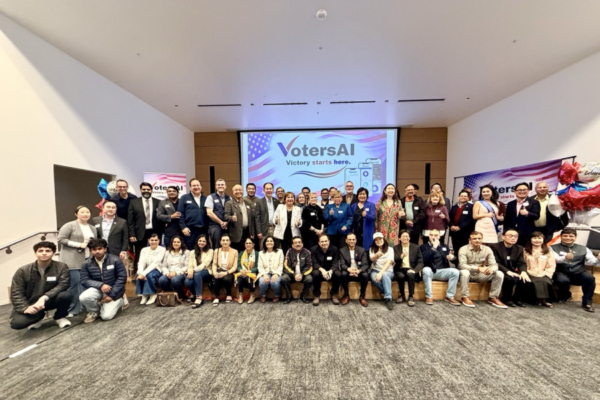
On March 6th, the Bay Area startup company VotersAI held a product launch and ribbon-cutting ceremony in Fremont, introducing an AI campaign management platform aimed at simplifying candidate campaign operations, reducing costs, and improving communication efficiency with voters. The event attracted nearly a hundred Bay Area elected officials and community leaders.
VotersAI is an “integrated political campaign management platform” that integrates voter data analysis, voter communication, and outreach management tools commonly used in campaigns into a single system. This eliminates the need for candidates to use multiple software simultaneously or rely on complex system integrations, reducing dependence on technical teams. The company was founded in August 2025 and is registered as a C corporation in Delaware, currently operating in Fremont.
The platform was co-developed by engineers and campaign consultants with practical campaign experience, combining AI technology with a large voter database to conduct demographic analysis and precise targeting, assisting campaign teams in more effectively planning voter outreach strategies and reducing operating costs.
The development team stated that the system design aims to address pain points in actual campaigns and provide scalable solutions, particularly suitable for environments like the fast-paced, multilingual, and multicultural Bay Area.
CEO Chandra Wagh of VotersAI mentioned that modern political campaigns are increasingly complex and costly, with candidates often needing to use multiple tools that consume significant time and resources. The goal of VotersAI is to enable candidates to manage campaigns more efficiently.
Wagh revealed to the media that his own experience running for Fremont City Council in 2024 highlighted the technological difficulties during the campaign process, inspiring him to create the platform. He noted that candidates typically obtain voter data from county governments in CSV format, requiring technical teams to conduct demographic analysis and classification, such as age and party affiliation. Data then needs to be transferred between different platforms for tasks like sending emails, text messages, or canvassing door-to-door, which not only complicates the process but also poses risks of data leakage or loss.
VotersAI integrates these functions into a single platform, providing organized voter data, segmentation features, and supporting targeted email, text messaging, phone contacts, and canvassing applications. Campaign teams can streamline their operations through a single dashboard, greatly simplifying campaign management processes.
Consultant Margaret (梁潔行) of VotersAI mentioned that political campaigns often involve handling large amounts of voter data, requiring candidates to repeatedly organize and upload data across platforms for messaging, which is time-consuming, labor-intensive, and prone to errors. Through the platform, voter data is pre-organized, demographics can be quickly sorted, and candidates can easily filter specific demographics and generate messages.
She highlighted that AI can even assist in composing promotional content, creating video messages, and providing instant translations into multiple languages, making it easier for candidates to reach diverse communities. Tasks that previously took days to complete can now be done in minutes, allowing candidates to focus more on campaign strategies.
Notable political figures from the Bay Area attending the event included Fremont City Councilor Shao Yang, Milpitas Mayor Carmen Montano, Vice Mayor Garry Barbadillo, Councilor William Lam, Dublin Mayor Hu Xin, Pleasanton Mayor Jack Balch, and Cupertino Vice Mayor Zhao Liangfang.
Mayor Hu Xin of Dublin remarked that VotersAI’s utilization of big data and artificial intelligence technologies makes conveying campaign information to voters easier, lowering the barrier to entry for candidates. She believed that in the past, the complex and costly campaign processes deterred many individuals from participating, while AI technology can simplify campaigns, giving more people the opportunity to engage in democratic elections and promote a fairer and more transparent society.
Mayor Jack Balch of Pleasanton announced his plan to run for re-election in November. He expressed that the platform could help candidates connect with voters, especially by translating messages into different languages, facilitating outreach to multilingual communities. Balch also acknowledged the concerns some voters may have about data privacy, but emphasized that when used wisely, technology can enhance political communication efficiency.
He encouraged voters to actively participate in democratic elections, vote enthusiastically, and allow elected officials to understand the community’s genuine concerns, collectively driving community development.