
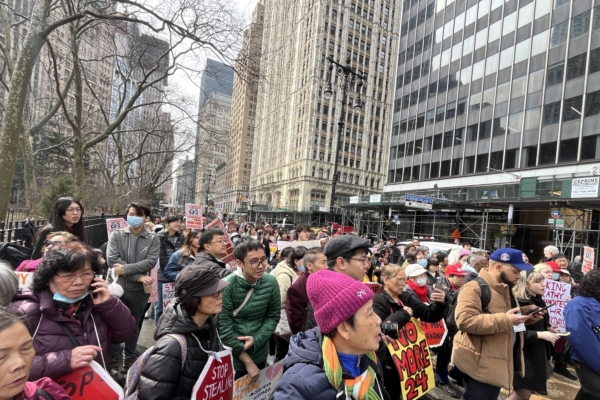
On the occasion of International Women’s Day on March 8th, hundreds of home care workers, community advocates, and elected officials gathered outside City Hall in New York to call for an end to the long-standing controversial “24-hour work schedule” for caregivers. They demanded that both the city and state governments address the issue of caregivers working long hours and push for legislative reforms. Council Member Mattei of New York City stated that the City Council is actively promoting related bills and is confident they will be passed by the end of the month.
At the gathering, several nursing workers shared their experiences, highlighting how the prolonged 24-hour work schedule has taken a heavy toll on their bodies, families, and lives. Advocates pointed out that the current system requires caregivers to work continuously for 24 hours, but in most cases, they are only paid for 13 hours, a situation that has caused strong dissatisfaction among labor groups for many years.
Council Member Mattei of Manhattan’s Chinatown pointed out at the event that both the New York City Council and the state government have not actively pushed for reforms in recent years. He criticized the former City Council Speaker for failing to advance the “No More 24 Act” during his tenure. He also criticized Governor Ho for not addressing the long-standing issues of caregivers facing extended work hours and low wages.
Many Chinese caregivers at the event recounted the health damages caused by years of work. Zhu, who had been working in home care for 8 years, stated that the lack of rest due to continuous 24-hour shifts resulted in insomnia, joint pain, osteoporosis, vision deterioration, and even difficulties in simple tasks like using chopsticks or writing. She described the system as a “chronic injury” for caregivers.
Retired nurse Loya, who worked at a nonprofit organization for over a decade, mentioned that many caregivers struggle to sleep at night due to the frequent care needed by patients, and despite working 24 hours, they are only paid for 13, leading to physical exhaustion over time and a lack of balance in family life. She noted that some nursing companies in New York have gradually transitioned to a two-shift system in response to protests and advocacy from caregivers, but certain institutions have yet to adjust their policies.
Retired nurse Chen spoke on behalf of a group of caregivers, warning that the extended high-intensity work has led many caregivers to pay a hefty price with their health. She emphasized that health is irreplaceable and urged Mayor Mamdani to take action within a week to push through the legislation to end the 24-hour work schedule, or else caregivers will protest daily in front of City Hall starting from March 18 until the bill is passed.
In an interview at the rally, Council Member Mattei expressed his support for reform, citing his personal connection to the issue through his mother, who was a home care worker. He witnessed firsthand the stress that long hours of work imposed on her physical and mental well-being. He deemed it unacceptable for any industry to demand employees work 24 hours while only paying for 13 hours.
Regarding the resistance to the bill, Mattei acknowledged the significant financial and insurance aspects of the home care industry, with vested interest groups holding influence over policy. However, he remained optimistic about the reform efforts.
Addressing concerns about whether the policy changes would burden taxpayers, Mattei clarified that home care services are mostly funded through the Medicaid program and pointed out that other cities in New York State have already adopted two-shift 12-hour or three-shift 8-hour systems, meaning the impact of the reform on public finances is limited.