
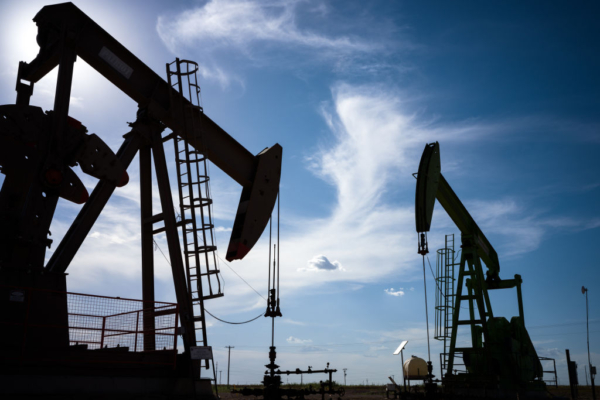
On Sunday, March 8th, due to the ongoing closure of the Hormuz Strait amid the conflict with Iran, major oil-producing countries in the Middle East have started cutting production, leading to crude oil prices surging above $100 per barrel. This marks the first time oil prices have broken the $100 mark since the Russia-Ukraine war in 2022.
As of 6:12 PM Eastern Time in the United States, West Texas Intermediate (WTI) crude oil rose by 18.98%, or $17.25, to $108.15 per barrel. The global benchmark Brent crude oil also increased by 16.19%, or $15.01, to $107.70 per barrel. Last week, U.S. crude oil futures prices surged approximately 35%, marking the largest weekly gain since futures trading records began in 1983.
The last time oil prices crossed the $100 per barrel threshold was after the Russian invasion of Ukraine in 2022.
According to data from the American Automobile Association (AAA), the average gasoline price in the United States rose by 46 cents per gallon compared to a week ago, while diesel prices increased by 83 cents per gallon.
OPEC’s fifth-largest oil producer, Kuwait, announced on Saturday that it would proactively cut oil and refinery production due to fears of Iran threatening the safe passage of ships through the Hormuz Strait. Kuwait’s national oil company did not disclose the specific scale of production cuts.
Three industry insiders informed Reuters on Sunday that the daily production from the three major oil fields in southern Iraq has dropped by 70% to 1.3 million barrels. Before the outbreak of the Iran-Iraq war, these oil fields had a daily production of 4.3 million barrels.
The third-largest oil producer in OPEC, the United Arab Emirates, stated on Saturday that it is “carefully managing offshore oil production to meet storage needs.” Abu Dhabi National Oil Company (ADNOC) mentioned that onshore operations are running normally.
Due to the closure of the Hormuz Strait, with nowhere for crude oil to go, Gulf Arab countries are facing a shortage of storage space and are thus reducing oil production. Tankers are hesitant to pass through the narrow waterway due to concerns of potential Iranian attacks. Approximately 20% of global oil consumption is exported through the Hormuz Strait.
U.S. Energy Secretary Chris Wright stated on Sunday that after the U.S. destroyed Iran’s ability to threaten oil tankers, traffic in the Hormuz Strait will be restored.
“The ship traffic in the Hormuz Strait will soon return to normal,” Wright told CNN, “although the traffic volume has not fully recovered yet, it will take some time. However, even in the worst-case scenario, it will be a matter of weeks, not months.”
As oil prices breached the $100 per barrel mark for the first time in many years, stock index futures dropped on Sunday night.
Futures linked to the S&P 500, Nasdaq 100, and Dow Jones Industrial Average all fell by over 1%. Futures movements do not always predict market trends after the opening.
Last week, the three major stock indexes all turned downwards as investors assess the potential impact on the energy markets. Goldman Sachs informed clients that “the direct impact of a modest rise in oil prices on earnings of S&P 500 component companies should be relatively small, but prolonged severe disruptions or uncertainty will pose more significant downside risks to our forecasts.”