
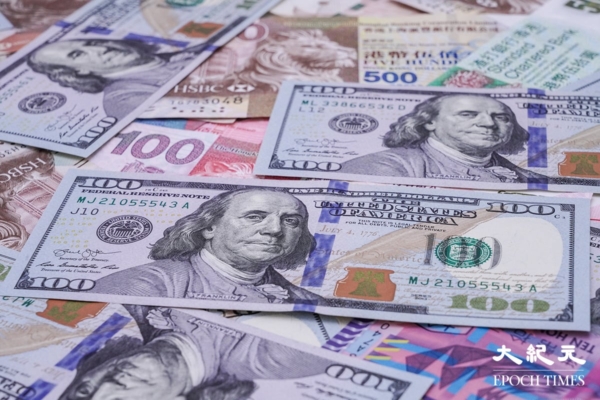
Former Chief Executive of the Hong Kong Monetary Authority, Joseph Yam, recently gave an interview to the media, stating that the Hong Kong dollar is the most stable currency tied to the U.S. dollar, and Hong Kong can still maintain its neutrality. However, the global landscape has changed, and the space for neutrality is gradually disappearing, especially for Hong Kong, which cannot please both sides. With China weaponizing finance, Hong Kong is caught in the crossfire of geopolitical conflicts and will face more impacts.
Joseph Yam’s interview with the Hong Kong Economic Journal and Now TV on March 2 sparked widespread discussion in the financial sector. He claimed that the Hong Kong dollar is the world’s largest “stable coin” tied to the U.S. dollar, and the linked exchange rate system is the core of financial stability in Hong Kong. Despite escalating geopolitical conflicts, Hong Kong can still “maintain neutrality” (balancing the interests and capital flows of both China and the U.S.).
Yam’s argument is based on the fact that Hong Kong holds a large amount of U.S. dollar assets (primarily U.S. treasury bonds), supporting the monetary base of the Hong Kong dollar and maintaining a linked exchange rate system with the U.S. dollar, ensuring a high level of certainty and stability for the Hong Kong dollar in the financial market.
This description uses concepts from the cryptocurrency field to analogize traditional currency mechanisms. The term “stable coin” in the crypto sphere refers to a digital asset linked to a fiat currency (usually the U.S. dollar) with low volatility, supported by specific assets or reserves. Hong Kong’s “Stable Coin Regulations” officially took effect on August 1, 2025. However, equating the Hong Kong dollar with stable coins is essentially borrowing a concept to emphasize the stability of the Hong Kong dollar exchange rate, rather than a legal or technical equivalence.
In practice, due to the linked exchange rate system between the Hong Kong dollar and the U.S. dollar, the issuance of Hong Kong dollars must be backed by equivalent U.S. assets, maintaining the Hong Kong dollar exchange rate within a fixed range (7.75 to 7.85 Hong Kong dollars to 1 U.S. dollar).
This gives the Hong Kong dollar a stability close to the U.S. dollar but it is not a stable coin independently supported by algorithms or asset reserves. The reserves of stable coins can be liquid assets like U.S. treasury bonds, while the support for the Hong Kong dollar system lies in the entire Hong Kong financial system, capital flow freedom, and strict exchange guarantee mechanisms. Therefore, using the term “largest stable coin” to describe the Hong Kong dollar is not a strict equivalence.
Since the establishment of the Hong Kong linked exchange rate system in 1983, it has withstood multiple shocks, such as the Asian financial crisis, and has long provided a stable exchange rate environment, becoming one of the cornerstones of international capital confidence. This fixed exchange rate, tied to the U.S. dollar, has made Hong Kong a currency environment with significantly low exchange rate risks in the eyes of international investors.
However, this system faces challenges in the current international financial turmoil and escalating geopolitical conflicts.
Yam believes that the dominance of the U.S. dollar allows the U.S. to “weaponize” its financial advantage, for example, by exerting pressure on other countries through sanctions and financial restrictions. He emphasizes that China could become the focus of financial competition.
In 2022, he also raised similar concerns, worried that the U.S. might exclude Hong Kong from the global banking and financial transactions system (SWIFT). Due to increasingly tense geopolitical situations and changes in U.S.-China relations, a financial war seems imminent. Yam admits that what he is most concerned about in the future is the appearance of a “financial nuclear bomb” because Hong Kong plays a role in facilitating financial flows between the mainland and foreign entities, which is essential for its status as an international financial center. “What if we can’t use the U.S. dollar anymore?”
From a global perspective, the U.S. has significant international financial influence through controlling the international payment system, sanctions mechanisms, and the U.S. dollar clearing system. On February 28, 2026, the U.S. launched a military operation against Iran, causing market disruptions. The U.S. dollar appreciated against major currencies like the euro, Australian dollar, and Chinese yuan. This phenomenon reflects the integration of the U.S. dollar’s soft power with its hard power.
In recent years, the People’s Bank of China has also been “weaponizing” finance. On one hand, it is accelerating the construction of the Cross-Border Interbank Payment System (CIPS) to reduce dependence on the SWIFT system. On the other hand, it is promoting pilot projects for the digital renminbi in the Belt and Road Initiative regions and expanding settlement shares in regional trade. Additionally, by signing bilateral currency swap agreements with some countries, trading commodities priced in the yuan, and encouraging trade partners to “de-dollarize,” China is gradually establishing a parallel financial network. This strategic layout carries obvious geopolitical considerations, but under the premises of not fully opening capital accounts and still having controlled exchange rates, the international appeal and liquidity flow of the renminbi still face institutional constraints.
Yam suggests that Hong Kong can still navigate between China and the U.S. through its own market and institutional advantages. Over the past few decades, Hong Kong has indeed become an important hub for global capital flows with its open capital market, free port status, rule of law environment, and linked exchange rate.
However, in recent years, international investors have reevaluated Hong Kong’s institutional stability and freedom. Changes in the political environment, regulatory policy adjustments, and closer institutional coordination with the mainland have altered Hong Kong’s “independence” and “neutrality.” Some multinational companies and investors are reassessing Hong Kong’s role as a regional headquarters in certain businesses.
Moreover, the competition among international financial centers is becoming more intense. Cities like Singapore and Dubai have invested heavily in diverse currency products, digital assets, wealth management, and financial infrastructure, narrowing Hong Kong’s development space.
Especially in the face of global macro-environmental changes and fluctuations in the U.S. dollar, the Monetary Authority of Hong Kong needs to stabilize the exchange rate through its reserves and market operations, which may face pressure during extreme volatility. The fixed exchange rate naturally limits the space for monetary policy adjustments in Hong Kong. When global capital seeks higher returns or hedging, volatility may pose a greater challenge to the linked exchange rate system.
To truly maintain its neutrality, not only does Hong Kong require a stable financial system, but it also needs to find its strategic position in the international monetary system and global capital network. However, China has been strengthening political control over the financial system in recent years, placing capital markets under the framework of “national security” and “strategic games.” It is foreseeable that market neutrality will be weakened.
If Hong Kong is pulled into this unilateral logic, it will not only struggle to maintain international trust but may also become a primary pressure point in the power struggles of major countries. If the central government issues non-market administrative orders, will the Hong Kong government comply?