
Hello, viewers! Welcome to “Century Secrets.”
Let me first share with you two poems. The first one goes: “The distant streetlights shine, like numerous twinkling stars. The stars in the sky appear, like numerous streetlights.”
Doesn’t it sound refreshing, romantic, and profound?
Now, listen to the second one: “I shout cheers to you, Marshal Stalin, you are the liberator of all mankind, today is your 70th birthday, I shout cheers to you.”
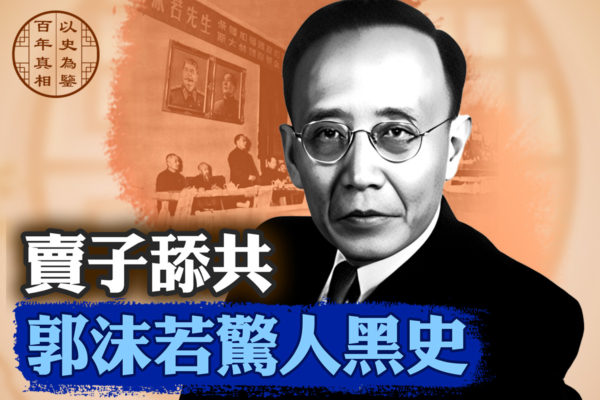
Can you imagine that these two poems with completely different styles are both from the same person, but separated by decades? That person is Guo Moruo, a famous Chinese writer, historian, poet, and archaeologist. Besides these titles, he was also known as the “official writer” of the Chinese Communist Party, “naturally charming,” and the “epitome of all flattery.”
How did Guo Moruo transition from being a fresh and romantic poet to singing praises for dictators? What happened in these decades?
Guo Moruo, originally Guo Kaizhen, was born in 1892 in Leshan, Sichuan, as a descendant of the Tang Dynasty general Guo Ziyi.
Coming from a wealthy family with a successful businessman grandfather, he received a good education from a young age. In 1914, he studied in Japan and obtained a medical degree in 1923. Despite his interest in literature, he pursued medical studies and even attended humanities lectures at the University of Tokyo during sick leave.
In 1921, Guo Moruo published his first poetry collection “Goddess,” including the poem “Street Market in the Sky” mentioned at the beginning of the program.
The romantic and passionate style of “Goddess” swept through the literary world at that time, pioneering Chinese new poetry. Guo Moruo rose to fame, becoming a key figure in the New Culture Movement and reaching the pinnacle of the literary world.
At that time, he was an idealistic young literary artist. So how did he get swept into the political tide?
In the early 20th century, China suffered from oppression by foreign powers, and many intellectuals sought national rejuvenation. Guo Moruo also harbored the dream of saving the nation and sought a path to change his destiny. At that time, the propaganda of Russian communism swept in, attracting many with ideals of “equality” and “liberation,” seen as hope for China.
In 1924, Guo Moruo came into contact with Marx’s theoretical books in Japan, developing a strong interest in communism. In 1925, he met early Chinese Communist Party leader Qu Qiubai in Shanghai, engaging in deep discussions and gradually accepting communist ideology.
In 1926, recommended by Qu Qiubai, he went to Guangdong, serving as the Dean of the Faculty of Arts at the National Sun Yat-sen University. During his time there, he visited the Sixth National Peasant Movement Institute organized by the Communist Party and served as an instructor. The host of this institute was Mao Zedong, profoundly influencing Guo Moruo, strengthening his acceptance of the Communist Party’s ideology.
During his stay in Guangdong, Guo Moruo applied to join the Communist Party. At that time, during the first cooperation between the Kuomintang and the Communist Party, Guo Moruo joined the Kuomintang under the arrangement of the Communist Party and participated in the Northern Expedition of the National Revolutionary Army, serving as Director of the Propaganda Department of the General Political Department, contributing to revolutionary propaganda efforts with great enthusiasm.
In the spring of 1927, the cooperation between the Kuomintang and the Communist Party broke down, and Chiang Kai-shek began purging the Kuomintang. Guo Moruo’s situation became precarious. He sought refuge in Zhu De’s home and wrote a statement, “Please see Chiang Kai-shek today,” describing Chiang Kai-shek as a “rogue, landlord, corrupt official, and warlord.”
In August 1927, Guo Moruo participated in the Nanchang Uprising, also known as the “Nanchang Uprising” in the Communist Party’s terms. After the uprising failed, he, introduced by Zhou Enlai and others, joined the Communist Party simultaneously with He Long.
At the end of 1927, the National Government issued a wanted notice for Guo Moruo. Following Zhou Enlai’s advice, he fled to Japan for refuge. Zhou Enlai suggested that he conduct academic research to build his reputation and eventually emerge as an independent figure to assist the Communist Party in leading the cultural sector.
During his ten years in Japan, Guo Moruo studied oracle bone inscriptions, bronze inscriptions, published some works on textual research, and also translated several books by Marx.
Following the July 7 Incident in 1937, the Japanese government intensified its surveillance on Guo Moruo. Subsequently, Chiang Kai-shek revoked the wanted notice against him, leading Guo Moruo to return to China.
Upon returning to China in 1937, Guo Moruo specifically went to Nanjing to apologize to Chiang Kai-shek, followed by the publication of “Chairman Chiang’s Meeting Record,” highly praising Chiang’s magnanimity.
Why did he do this? It is likely due to a new task assigned to him by Zhou Enlai, enabling him to infiltrate the Nationalist government and undermine it from within. Guo Moruo privately expressed: “Meeting with Chiang Kai-shek, Chen Cheng, and these people is awkward for me emotionally, but after talking with them, I understand the correctness of Comrade Enlai’s instructions.”
Firmly focused on resisting Japan, Chiang Kai-shek remained unaware of the scheme behind Guo Moruo and the Communist Party, appointing Guo Moruo as Chairman of the Politburo of the Military Affairs Committee of the Nationalist government.
This appointment turned out to be a fatal mistake. The “Third Bureau” was the “Culture Bureau,” responsible for the entire artistic team of the resistance, but Guo Moruo’s allegiances lay with the Communist Party. Consequently, the Third Bureau under his leadership gradually became a cultural front for exposing the darkness of the Nationalist government and attacking Chiang Kai-shek through the arts.
His historical dramas such as “Qu Yuan,” “Hu Fu,” “Gao Jianli,” and “Peacock Gall,” seemingly telling ancient stories, actually concealed criticisms of Chiang Kai-shek and the Nationalist government. These plays were widely performed in Kunming, Chongqing, and other places, leaving a profound impact. Mao Zedong personally thanked him in a letter, acknowledging his “valuable revolutionary cultural work.”
During this time, Guo Moruo revived his secret status as a Communist Party member, actively engaging with Zhou Enlai, Deng Yingchao in a party cell.
In 1938, at the suggestion of Hu Feng, Zhou Enlai proposed to the Central Committee to appoint Guo Moruo as the “successor of Lu Xun” and a “leader of the Chinese revolutionary cultural scene.”
During the civil war between the Nationalists and Communists, Guo Moruo moved his entire family to Hong Kong under Zhou Enlai’s orders, taking charge of the leadership of the Hong Kong branch of the All-China Federation of Literary and Art Circles.
After the Communist Party seized power in 1949, Guo Moruo held prominent positions such as President of the Chinese Academy of Sciences, Chairman of the Chinese Writers’ Association, Vice Premier of the State Council, and Director of the Cultural and Educational Commission, exerting influence in various fields such as science, literature, and politics. He became the cultural spokesperson for the Communist Party but gradually fell into the role of a political tool.
In each movement initiated by the Communist Party, Guo Moruo closely followed the Party’s directives. When the Party required self-criticism from intellectuals, he tearfully conducted self-criticisms; when critique was necessary, he fiercely attacked Wu Xun, Hu Shi, Hu Feng, with greater zeal than others. If the Party needed him to rehabilitate a historical figure, he promptly wrote articles to exonerate that figure, including King Zhou of Shang.
Mao Zedong admired Li Bai, and Guo Moruo praised Li Bai greatly. Mao disliked Du Fu, so Guo Moruo disparaged Du Fu, declaring him a “full-fledged landlord.”
In 1957, traveling to Moscow with Mao Zedong in an airplane, Guo Moruo wrote a poem saying, “Inside and outside the plane, there are two suns.”
In November 1949, on Stalin’s 70th birthday, Guo Moruo wrote a congratulatory poem “I Shout Cheers to You,” which opened this episode, lauding Stalin as “eternal” like Marx, Engels, and Lenin, proclaiming, “The power of the atomic bomb before you is child’s play; the threat of biological warfare is mere idle talk in front of you. Your light warms the Arctic and Antarctic to become warm currents; your moisture turns the Sahara Desert into fertile soil.”
Between 1959 and 1962, a period dubbed the “Three Years of Natural Disasters” by the Communist Party, which was essentially a severe famine caused by the “Great Leap Forward,” resulted in sixty million deaths from starvation nationwide. Yet, Guo Moruo created a series of embellished poems praising the Communist Party, such as “In the socialist east wind, we see the blooming of spring again, enemies rot day by day, we prosper,” and “Brilliant flowers blooming, achievements in ten years surpass a thousand,” sparking controversy. Even his own son dubbed him the “greatest cultural screen” of society.
In 1966, the Cultural Revolution swept the nation, shattering countless families. Guo Moruo, due to his close ties with the Communist Party, managed to evade direct harm, but tragically, his two sons did not escape such fate.
His second son, Guo Shiying, gifted in poetry and passionate, harbored doubts about communism, believing Mao Zedong Thought should be viewed with a balanced perspective. He privately criticized his father as a “cultural screen.”
In 1963, Guo Shiying and several classmates from Peking University formed an underground literary society, expressing reflections on communism through poetry. Later, a member of the society reported Guo Shiying for engaging in “reactionary activities” and privately disclosed the criticisms of Guo Moruo and Yu Liqun by the young members to Yu Liqun, leading Guo Moruo and Yu Liqun to report their own son.
Guo Shiying thus fell under accusations of “opposing the Communist Party” and “opposing socialism,” and was sent for re-education through labor.
Subsequently, due to repentance and good behavior, Guo Shiying was released from re-education ahead of schedule to study at the China Agricultural University.
In April 1968, Guo Shiying was falsely accused of espionage and treason by radical students at the Beijing Agricultural University for speaking English while on the phone with his girlfriend. He was detained, severely beaten, and a few days later, he fell from a building, dying at the age of 26. His arms were found tied behind his back when he hit the ground, remaining a mystery of whether it was suicide or homicide.
It is said that three days before Guo Shiying’s death, Yu Liqun begged Guo Moruo to request help during a banquet hosted by Zhou Enlai, but throughout the evening, Guo Moruo sitting next to Zhou Enlai remained silent.
After his son’s death and faced with his wife’s anguish and accusations, Guo Moruo remained silent for an extended period, finally uttering, “I did it for the good of the motherland!”
Guo’s younger son, Guo Minying, with a strong affinity for music, self-taught and gained admission to the Central Conservatory of Music. However, due to listening to Western classical music, he was reported for being “pro-foreign,” leading to a direct order from Mao Zedong stating, “Similar matters should be strictly dealt with.”
Guo Minying reluctantly left the conservatory and enlisted in the navy. Initially excelling in his military service, the onset of the Cultural Revolution and his lack of understanding of many aspects of it plunged him into further personal turmoil. In April 1967, he suddenly committed suicide.
Within a year, Guo Moruo lost his two sons, enduring indescribable pain in his heart. He copied his son Guo Shiying’s diary page by page on announcement paper, creating eight books filled with the anguish of losing a child.
Yet, in public, he never questioned the Cultural Revolution, even writing poems praising Jiang Qing as a “good example of learning” and labeling the Cultural Revolution as the “ten-year spring breeze and rain.”
However, shortly after fervently praising the ten-year Cultural Revolution, the Gang of Four was arrested, and the era ended. Guo Moruo promptly wrote poems criticizing the Gang of Four for “seizing power of the Party,” branding Jiang Qing as “comparable to Empress Wu Zetian.”
In June 1978, Guo Moruo passed away in Beijing.
That’s all for today’s program. Thank you for watching. If you have any thoughts on Guo Moruo’s life, feel free to leave us a message. Don’t forget to like, share, and subscribe if you enjoyed our program. See you next time.
Production Team of “Century Secrets”