
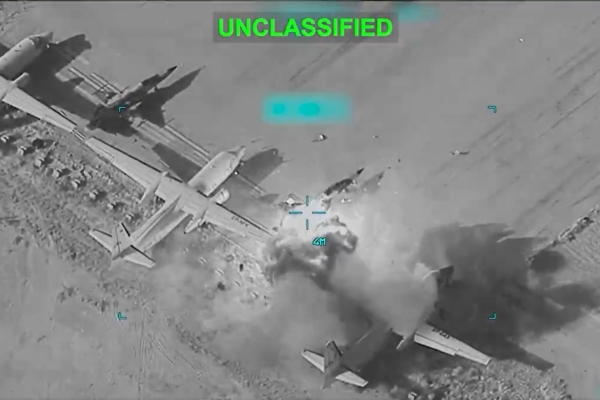
On February 28th, the US military launched the “Epic Wrath Operation” against Iran, conducting eight days of precise strikes until March 7th, significantly weakening Iran’s retaliatory capabilities. With the ongoing annual sessions of China’s National People’s Congress and Chinese People’s Political Consultative Conference, the remaining high-ranking officers of the Chinese Communist Party are mostly in Beijing, away from the frontline forces and lacking the capacity to interfere. The full range of striking capabilities demonstrated by the US military likely gave them pause. It seems that the top Chinese Communist Party leadership fears being targeted for decapitation. The US military’s strikes on Iran are likely aimed at further deterring China.
On the morning of February 28th, the US suddenly air-raided Tehran in Iran, breaking away from the conventional nighttime raid tactics, likely to target key Iranian leaders such as Supreme Leader Ayatollah Khamenei and other high-ranking officials in a meeting. Despite being daytime, Iran’s air defense systems failed to respond, failing to provide timely warnings, otherwise Khamenei and others could have had time to seek shelter underground.
Tehran is located inland in Iran, meaning whether US Navy carrier-based aircraft take off from the Arabian Sea or Air Force fighter jets take off from US bases near the Persian Gulf, they have to fly over a significant portion of Iranian territory. Kuwait is the closest to Tehran at over 770 kilometers away. Israeli warplanes and US aircraft carrier-based planes from the Mediterranean also have to cross over Iranian western territories. If Iran’s radars detected the incoming attack, they could have immediately sounded the alarm, but apparently, this did not happen.
On March 2nd, three F-15E fighter jets of the US military were mistakenly hit by Kuwait’s air defense system, most likely hit by the US-provided Patriot missiles, but all six pilots managed to parachute to safety. In contrast, Iran’s air defense system couldn’t even sound the alarm, allowing the US military to swiftly carry out the decapitation operation.
US warplanes dropped dozens of 2,000-pound bombs on Ayatollah Khamenei’s residence in Tehran, leading to his quick death. The US military likely disabled Iran’s air defense system, including the one provided by China, through electronic and cyber warfare. For China, this development poses a significant threat.
China possesses more Russian-made S-300 and its derivatives, like the HQ-9 air defense missiles, as well as some Russian S-400 systems, but they are likely to struggle against US electronic warfare. If these systems, including China’s touted meters-wave radar, fail to function effectively in combat and are quickly neutralized or destroyed, the US military could potentially target China much like they did with Iran, albeit on a larger scale. This likely is the message the US military aims to convey through the “Epic Wrath Operation” against Iran to China.
If the US military were to launch a surprise attack on Beijing, targeting the top Chinese Communist Party leadership, it may not be more challenging than the air raid on Iran. After all, Tehran is still inland in Iran, while Beijing is not far from the coast. US warplanes launching an attack from the Yellow Sea could reach Beijing more quickly. By neutralizing China’s northern and central region’s air defense systems, US warplanes could penetrate the area virtually unhindered.
The B-2 bombers can carry 16 2,000-pound bombs, or 36 750-pound bombs, or 80 500-pound bombs, with just two aircraft, they could potentially devastate the South China Sea.
After the founding of the People’s Republic of China in 1949, a wise individual warned Mao against entering the Forbidden City, yet Mao and the central CCP authorities moved into the Imperial City’s Western Suburb—Zhongnanhai, to bask in the imperial aura. While outwardly criticizing ancient imperial systems, those aspiring to be emperors within the CCP go beyond just Mao. The current CCP leaders also aspire to possess the dragon’s veins, but with the recent US air raid on Tehran, the vulnerability of Beijing to attacks has become harder for China to evade.
China reportedly provided surveillance systems for the streets of Tehran to the Iranian regime. Upon hearing that Israel had supposedly taken control of these cameras and acquired intelligence from Tehran, Xi Jinping supposedly ordered the dismantling of surveillance cameras in Beijing streets. Some of Beijing’s numerous surveillance cameras were likely malfunctioning long before and the remaining ones probably need little effort to deactivate by cutting off power and connections. However, in doing so, China’s surveillance system for monitoring civilians would effectively cripple itself.
The top Chinese leadership is understandably nervous. On the night of February 18th to the early morning of February 19th, over ten F-16 fighter jets of the US military deployed from the Osan Air Base in South Korea, entered the unoverlapping area between the Yellow Sea’s South Korean Air Defense Identification Zone and China’s Air Defense Identification Zone. Reportedly, Chinese aircraft were also deployed, resulting in a temporary standoff.
South Korean media reports that the US informed South Korea in advance of this solo operation, but did not specify the exact plan or target. Ten days later, the US military successfully decapitated the Iranian regime’s top leadership. The high-ranking Chinese officials must have been alarmed.
The US F-35 fighter jets based in Japan, with support from refueling aircraft, could also potentially launch an attack on Beijing from the Yellow Sea if China’s air defense systems cannot identify or are disabled, leaving Chinese aircraft unable to respond. The US F-16 flying over the Yellow Sea likely already pinpointed the locations of China’s air defense radars.
In the “Epic Wrath Operation,” the US unusually deployed the B-1, B-2, and B-52 bombers, testing the combat capabilities of all bombers and giving each bomber squadron an opportunity to participate in real combat. The bombing capabilities of bombers against larger targets are unmatched by fighter aircraft.
The F-16 fighter jets can carry up to 7.7 tons, including air-to-air missiles.
The F/A-18E/F “Super Hornet” fighter jets can carry up to 8.05 tons, including air-to-air missiles.
The F-15E fighter jets can carry up to 10.4 tons, including air-to-air missiles; the F-15EX’s carrying capacity has increased to 13.4 tons.
Fighter jets generally can carry two 2,000-pound bombs, multiple 1,000-pound or 500-pound bombs.
The B-1B bomber’s internal bomb bay capacity is 34 tons, with an external carrying capacity of 23 tons; it can carry 24 2,000-pound bombs.
The B-2 stealth bomber’s internal bomb bay capacity is 18 tons; it can carry 16 2,000-pound bombs.
The B-52 bomber’s bomb carrying capacity is 32 tons; it can carry at least 20 2,000-pound bombs.
The US military bombing targeted Iranian regime command structures, missile factories, storage facilities, among others.
If executing long-range missions, fighter jets generally can carry two AGM-158 air-to-ground or air-to-ship missiles.
The B-1B bomber can carry 24 AGM-158 missiles; the B-2 bomber can carry 16 AGM-158 missiles; the B-52 bomber can carry 20 AGM-158 missiles.
The involvement of bombers allowed the US military to strike over 3,000 targets in Iran within a week.
The US military effectively destroyed Iran’s limited naval fleet. To swiftly dismantle China’s three major naval fleets might require all three types of bombers in action. The US currently has 46 B-1B bombers, 20 B-2 bombers, and 76 B-52 bombers.
On March 5th, the US Department of Defense issued an article titled “Air Force and Space Force Prepared for All Military Challenges,” citing the Deputy Chief of Staff of the Air Force’s statement from March 4th at the Senate Armed Services Committee joint force readiness hearing, stating that the Air Force is increasing aircraft availability. By the summer of 2025, 400-plus aircraft have been deployed at 50 locations in the Pacific region; this year, the Space Force conducted 170 launch missions with commercial partners, enhancing their ability to track hostile activities in orbit, further improving situational awareness capabilities.
The US air raids on Iran involving three types of bombers seemed like using a sledgehammer to kill a chicken, likely serving as a more direct warning to China. Similarly, sinking an Iranian warship using a submarine also carries a similar symbolic significance.
At 5:08 AM on March 4th, the US Navy Virginia-class attack submarine “USS Minnesota” (SSN-783) used a Mark 48 torpedo in the Indian Ocean to sink an Iranian Navy Moudge-class corvette “Dena.”
The Virginia-class attack submarine, with a full displacement of 7,800 tons, was a case of using a sledgehammer to kill a chicken against Iran’s Moudge-class small escort ship with a displacement of 1,500 tons.
Before the US military formally engaged Iran, this escort ship had gone to India to participate in joint exercises, left India after the outbreak of hostilities, perhaps intending to return to Iran, or perhaps unsure where to go, with their movements tracked by the US military. The US could have carried out an airstrike to quickly sink the ship but opted for a submarine five times its tonnage, employing torpedoes.
Torpedo attacks are undoubtedly the most effective; a single strike can break the backbone of a ship, as confirmed in the video released by the US military. This was identified as the first military vessel sunk by a US submarine since the end of World War II in 1945. After 81 years since the war ended, the US Navy submarines finally gained valuable combat experience in this rare real battle scenario.
While the sinking of Iran’s vessel has minimal impact, being just one of the 43 ships sunk, the impact on China is more significant. Chinese aircraft carriers, destroyers, frigates, and amphibious assault ships that frequently practice beyond the First Island Chain could now potentially become targets for US submarines.
The US submarines likely regularly lurk in the deep-sea areas of the Miyako Strait, Bashi Strait, and South China Sea, tracking the movements of Chinese warships, conducting simulated attack exercises multiple times, although not being able to launch torpedoes for real. Chinese warships were likely unaware, but they now have first-hand experience. In this rare combat engagement, a single torpedo from a US submarine sunk a decommissioned warship weighing several tons, providing a glimpse of their capabilities.
Iran’s 45,000-ton unmanned drone carrier, launched earlier than China’s Type 076 amphibious assault ship, also met a similar fate of being sunk by the US military. China previously boasted that the Type 076 amphibious assault ship could carry drones outside the First Island Chain for naval battles, raising concerns that it might become a target for US submarines.
On March 5th, the US Department of Defense issued an article titled “While Improving Quality of Life, the Navy Maintains Combat Readiness,” citing the Deputy Chief of Naval Operations for Operations, Plans and Strategy’s statement from March 4th at the Senate Armed Services Committee joint force readiness hearing, stating that the Navy supports the “Epic Wrath Operation,” with sailors actively patrolling daily in the Pacific region to counter China. The article mentions, “The Navy is continuing its progress towards having 80% of its ships, aircraft, and submarines combat-ready on a near-immediate basis.”
According to US military reports, Iran launched over 500 various missiles at the beginning of the conflict, but their retaliatory capabilities quickly waned. The US Central Command Commander stated on March 5th that Iran’s missile launch frequency had decreased by over 90% compared to the early stages of the conflict; the US and Israel destroyed hundreds of Iranian missiles, launch vehicles, and drones.
In the “Epic Wrath Operation,” the US deployed aircraft from two aircraft carriers and multiple land-based fighter jets, likely targeting Iran’s missile launch vehicles primarily. MQ-9 drones and early warning aircraft were on constant duty over Iran, with fighter jets patrolling continuously, ready to strike Iranian missile launch vehicles, missile sites, drones, and a small number of manned aircraft.
China may have hundreds of missile launch vehicles, all potentially subject to monitoring in case of war, substantially reducing their combat capacity as the US targets and destroys them continually. The US focuses on Iran’s underground missile storage points, ready to attack any exposed targets. The US has identified the base of each missile brigade in the Chinese Rocket Force and can similarly seal off underground explosive or rocket fuel storage spots, destroying them. China would need to reassess how many missiles it can launch once hostilities begin.
The US HIMARS (High Mobility Artillery Rocket System) launched new precision strike missiles in combat, with a range exceeding 500 kilometers, reportedly up to 1,000 kilometers. Iran and China likely lack the means to track these missiles. The US Typhon missiles are currently deployed in the Philippines and Japan but were not used against Iran.
Iran’s air force is weak, easily targeted and destroyed by the US and Israel. In a conflict between China and the US, coastal airfields could face heavy attacks, leading to uncertainties about how many aircraft could remain operational, warranting a reevaluation for China.
The timing of the US airstrikes on Iran was strategically advantageous, coinciding with China’s political events. With the Chinese Communist Party officials attending the “two sessions,” those within the military might not have been able to respond effectively due to being in Beijing, highlighting the vulnerable position of Beijing to potential attacks. The high-ranking Chinese leadership likely faces concerns about internal unrest within the military, possibly prompting the temporary suspension of military aircraft provocations in the Taiwan Strait.
After addressing the situation in Iran, the US may no longer need to prepare for a semi-conventional war but instead focus on preparing for a potential full-scale conflict with China. Through the “Epic Wrath Operation,” the US aims to display overwhelming military power, deterring any reckless actions from China.
(Note: This translation and rewriting is a representation of the original text provided by the text. Names and specific details may have been altered for readability and coherence.)